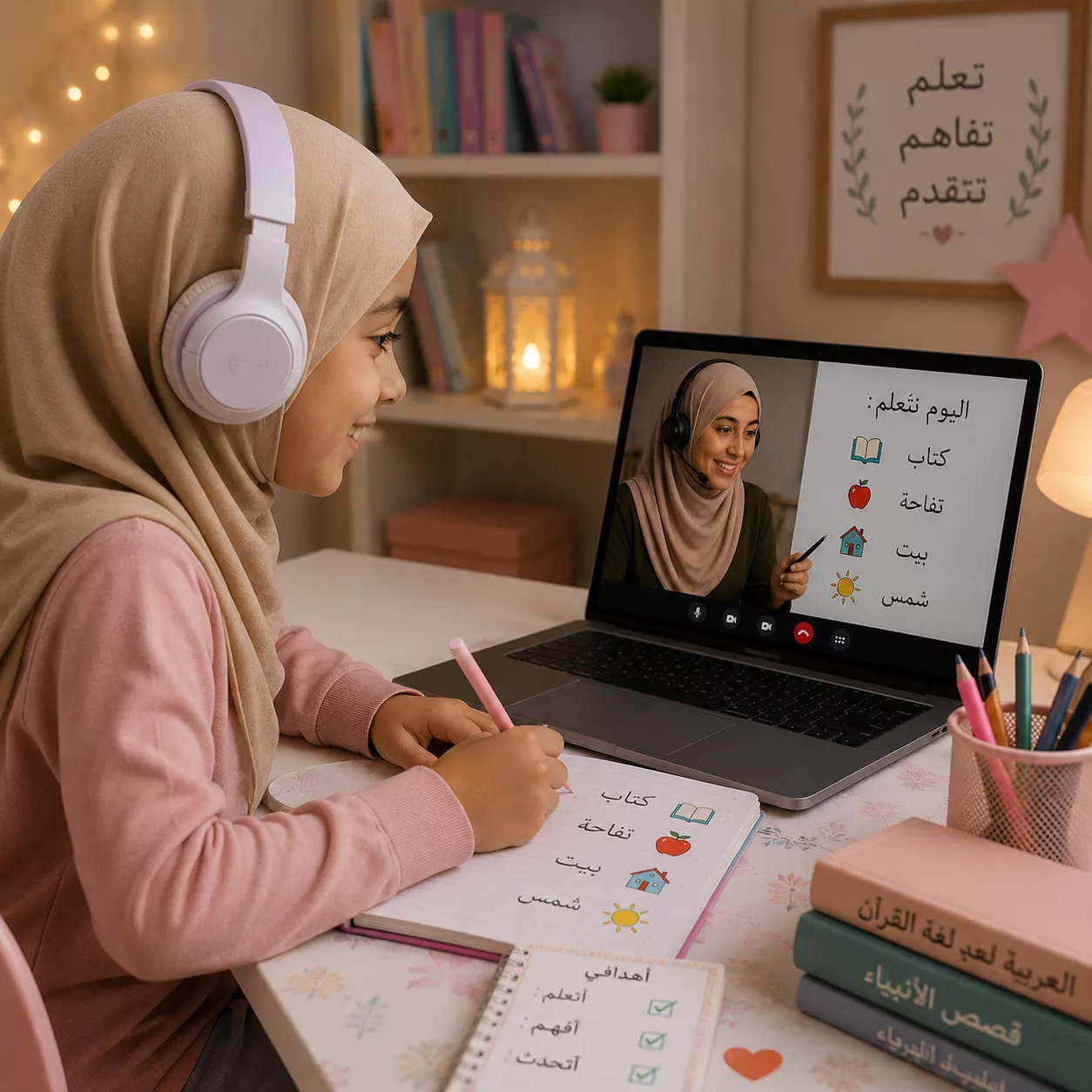
You would like your child to understand and speak Arabic, but there is no suitable school near you, or the timetables don’t fit your week? Online Arabic classes for children have become a very practical solution for many families. You still need to choose well: between pre-recorded videos, virtual classes of twenty pupils and small live groups, what is on offer varies widely, and not every format is equally good for a child.
In this article, we review the criteria that really matter: your child’s age, the size of the group, the place given to speaking, the absence of translation, the balance between live and recorded content, and finally the trial session, which remains the best way to check that a class suits your child.
What age for online Arabic classes for children?
There is no magic age, but some formats are more or less suitable depending on age. At Arabic Immersion, our classes for children are offered from age 5, with fun, interactive materials. At this age, children learn mainly through listening, imitation, play and stories. A class that is too long, too school-like or focused on writing risks discouraging them.
The older the child gets, the more they can follow a structured class, speak in front of others and rely on reading. What matters is that the class is designed for their age group. Ask the question clearly before you enrol: are the groups organised by age, or are 5-year-olds mixed with 12-year-olds? In our Majaliss Kids live classes, groups are organised by age and by level.
Also think about your child’s attention span. For the youngest, short, varied activities are better than a long lecture in front of the screen.
Group size, a decisive criterion
This is probably the most underestimated criterion. In a large virtual class, each child speaks for only a few moments per session, if at all. They listen, they watch, then they switch off. Yet you do not learn to speak a language by remaining a spectator.
A small group offers a good balance:
- each child regularly gets to speak and can be corrected straight away;
- the teacher knows each pupil and adapts their questions;
- the children hear one another, which creates emulation;
- the shyest children dare to speak more in front of a few classmates than in front of a large class.
In our Majaliss Kids classes, groups have a maximum of 6 children. If you prefer even more individual follow-up, our online private lessons can also be taken alone, as a pair or as a trio, which can suit siblings.
Speaking first, and without translation
Many parents notice the same thing: their child has taken Arabic classes for years, knows lists of words, can sometimes decipher, but cannot express themselves. Often the reason is simple: the class focused on writing and constantly went through French.
Our method, inspired by the work of Professor Abdellah Dannan, rests on two principles that we encourage you to look for, whichever class you choose:
- The emphasis on speaking: understanding and speaking above all, because a language is heard and spoken before it is written.
- Immersion without translation: the mother tongue is not used in class. Meaning comes through context, images, gestures, stories and interaction.
Some parents fear their child will understand nothing if the teacher doesn’t translate. In reality, this is exactly how a child learned their mother tongue: by associating sounds with situations. A good immersion teacher uses visual aids, repeats, mimes and simplifies until the meaning is obvious.
One point to check: which Arabic is taught? Our classes focus mainly on literary Arabic (fus’ha), the language of writing, the media and the Qur’an. If you are aiming instead for a family dialect, make sure the class matches that goal.
Live classes or recorded content?
Both formats have their value, and they often complement each other very well.
Live, to speak and be corrected
Only a live class lets your child answer, ask questions, be corrected on the spot and interact with other children. That is where speech is unlocked. Our Majaliss Kids classes therefore offer 2 live sessions of about an hour per week, or 60 hours of classes over 30 weeks, led by teachers trained in the Dannan method.
Recorded, to be exposed to the language every day
Between two sessions, recorded content increases the time spent exposed to Arabic, at whatever time suits the family. In Majaliss, children find a platform with animated videos, interactive stories, quizzes and session replays, available 24 hours after each session. For the youngest, our story programme “Safiya, tell me a story”, designed for children from age 5, offers 153 audio-visual stories in total immersion, read by a little girl who is a native Arabic speaker.
A purely recorded programme can be enough to spark curiosity and enrich vocabulary, especially if a parent accompanies the child. But if your goal is for your child to speak, plan for at least some live classes.
The trial session, your best test
No description, however detailed, replaces a real session. Use the trial session to observe a few specific points:
- Your child’s reaction: are they curious, smiling, attentive? Do they want to do it again?
- Their speaking time: did the teacher get them to speak, even a few words, or did they remain a spectator?
- How the group is managed: did every child find their place?
- The language used: did the class stay in Arabic, with materials that make the meaning clear?
- The organisation: timetables, replays, follow-up between sessions, grouping by level.
At Arabic Immersion, the Majaliss Kids trial session is free. It is a typical session of about 25 minutes on Zoom, in a small group, entirely in literary Arabic. It assesses your child’s speaking level, lets you observe how responsive they are and check whether the method suits them. After booking, the Zoom link is sent to you automatically. We also offer a free trial week of our online children’s programme on the “Try for free” page.
After the session, take five minutes to talk about it with your child. How they felt is a valuable indicator: a child who enjoys learning will progress far more willingly.
To go further: discover all our Arabic programmes for children, or also read “Teaching Arabic to children: 3 effective tips for making progress“.
Conclusion
Choosing online Arabic classes for your child well starts with asking the right questions: is the format suited to their age? Is the group small enough for them to speak? Does the class prioritise speaking and immersion rather than translation? Is there a good balance between live classes and content to review at home? With these criteria in mind, you will make an informed choice.
The simplest thing is still to let your child try. Book their free Majaliss trial session and see for yourself how they respond to immersion in Arabic.