You have decided to learn Arabic and, very quickly, the same question comes up: where do you start with the Arabic alphabet as an adult? These letters that run together from right to left, these little signs above and below the words, these sounds that don’t exist in English… It can all seem intimidating at first glance. Rest assured: Arabic script follows a clear logic, and a motivated adult can perfectly well master it step by step.
In this article, you will discover how the alphabet works, how letters change shape, what the short vowels (the harakat) are for, which mistakes most often hold beginners back, and how to organise your first weeks to move from isolated letters to reading real words.
Why start with the Arabic alphabet?
You can start Arabic through speaking, and it is even an excellent instinct: a language is heard and spoken before it is written. But sooner or later, reading becomes essential. Without it, you depend on approximate transcriptions, you cannot revise your materials on your own and you stay locked out of the texts that interest you, whether the Qur’an, books or simple signs.
On the page for our reading programme, mastering the Arabic alphabet is in fact presented as the crucial first step towards reading: knowing how to identify and correctly pronounce the 28 letters, and understanding their different forms depending on their position in the word. In our FAQ, we also point out that it is possible to focus solely on speaking, while recommending learning to read and write for complete mastery of the language.
In other words, speaking and writing are not opposed. They reinforce each other. The sounds you hear help you recognise the letters, and the letters you recognise fix the sounds in your memory.
How Arabic script works
Before memorising anything, take a few minutes to understand the system. It will save you a great deal of confusion later on.
A script written from right to left, and joined up
Arabic is written and read from right to left. Above all, it is almost always written in joined letters: within a word, the letters connect to one another, rather like our cursive handwriting. There is no distinction between capital and lower-case letters, which simplifies things a little.
Shapes that change with position
Because the letters join up, most of them take a slightly different shape depending on where they are: isolated, at the beginning of the word, in the middle or at the end. Most often, the letter keeps its recognisable “skeleton” and only loses or gains a connecting stroke or a small loop. For example, the letter ب (ba) becomes بـ at the beginning of a word and ـب at the end of a word.
A few letters, such as ا, د, ر or و, never join to the letter that follows them. That is why an Arabic word can contain small internal “gaps”: these are not spaces between two words, but normal breaks.
Families of letters that look alike
Several letters share exactly the same basic shape and are distinguished only by their dots. This is the case with ب, ت and ث, which differ only in the number and position of their dots. Learning the letters in families rather than in strict alphabetical order is often more effective: you memorise one shape, then learn to spot the dots.
The harakat, Arabic’s short vowels
In Arabic, the alphabet mainly records consonants and long vowels. Short vowels are indicated by small signs called harakat, placed above or below the letters.
- Fatha: a small stroke above the letter, pronounced “a”.
- Kasra: a small stroke below, pronounced “i”.
- Damma: a small loop-shaped sign above, pronounced “ou” (as in “soup”).
- Soukoun: a small circle indicating the absence of a vowel.
- Chadda: a sign indicating that a consonant is doubled.
Long vowels, for their part, are written with actual letters: ا for the long “a”, و for the long “ou” and ي for the long “i”.
With or without harakat?
In most everyday texts, the harakat are not written: the reader deduces them from the context and their knowledge of the language. You do, however, find them in the Qur’an, in many materials for beginners and in some children’s books.
At Arabic Immersion, these two realities complement each other. The Learn to read Arabic programme, based on the Nourania method, starts from letters and sounds and moves step by step towards fluent reading with the harakat. Our immersion programmes, for their part, make a different teaching choice: all content is vocalised orally, but written texts are presented without harakat. According to our method, inspired by the work of Professor Abdellah Dannan, many learners trained only with the harakat later struggle to do without them. For an adult beginner, remember the general idea: the harakat are a valuable aid for getting started, and the long-term goal is to be able to read without them.
Common mistakes made by adult beginners
Adults learn quickly, but they also have habits that can slow them down. Here are the pitfalls most often encountered at the alphabet stage.
- Remembering the names of the letters without their sounds. Knowing that ج is called “jim” is not enough: what matters for reading is the sound it makes with each vowel.
- Relying on transcription in Latin letters. Writing “kh” or “3” under every word is reassuring at first, but it delays the moment when your eye recognises the Arabic letters directly.
- Neglecting pronunciation. Some letters, such as ع, ح, خ or ق, have no equivalent in English. Working on them from the start, with their point of articulation (makhraj), avoids picking up bad habits that are hard to correct later.
- Wanting to learn everything in a week. Swallowing all 28 letters at once gives an impression of speed, but confusion soon sets in. Better a few letters properly mastered, then syllables, then words.
- Reading silently. Reading aloud anchors the sounds and lets you spot your own mistakes.
- Learning without ever being corrected. Alone with a book, you can repeat a mistake for weeks without realising it. Outside feedback, even occasional, changes everything.
A simple progression for your first weeks
To make steady progress, rely on a structured approach. Our reading programme for adults follows five steps that you can also keep in mind if you are working on your own:
- Discovery: you are introduced to a new letter, a pronunciation rule or a reading technique.
- Repetition: you repeat the letters, words or sentences aloud after the teacher.
- Listening: you train your sound recognition by identifying the right sounds.
- Observation: you train your visual recognition by spotting the right letters or words.
- Practice: you read in turn and have your pronunciation corrected.
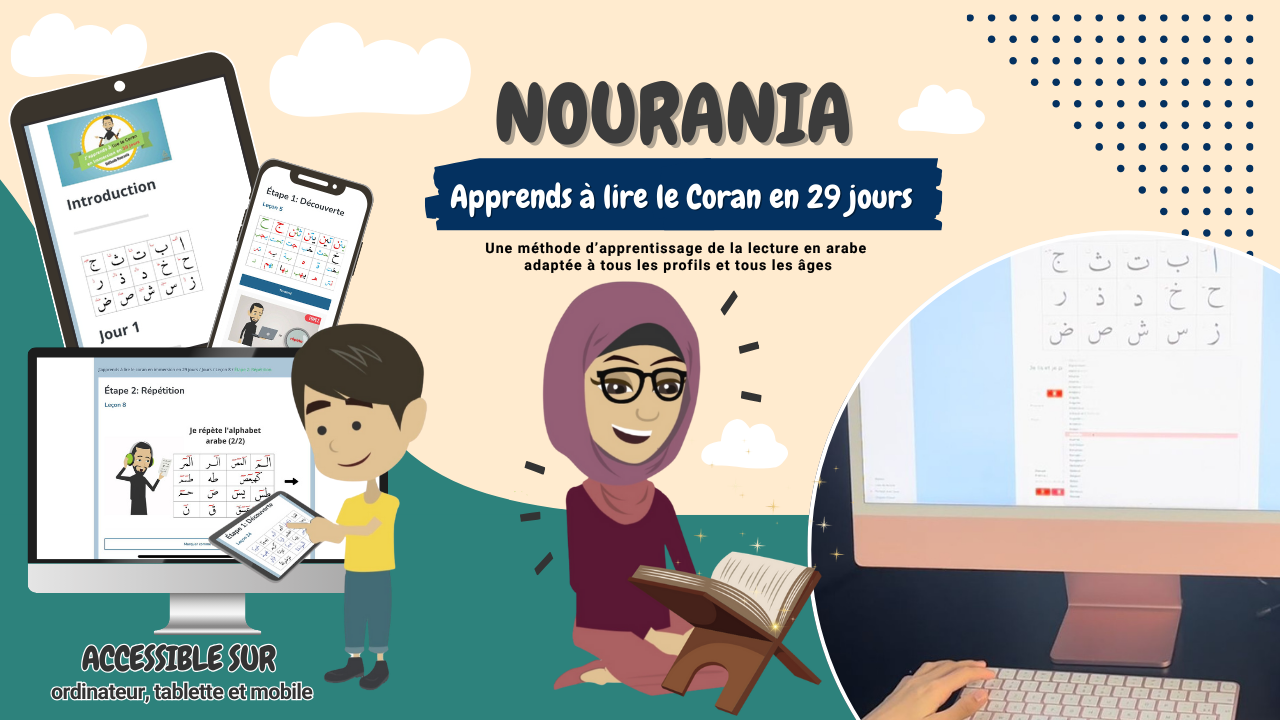
In practice, this programme brings together 44 audio-visual lessons based on the Nourania method, designed to be followed over 29 days, but everyone can progress at their own pace thanks to lifetime access. Self-correcting quizzes are there for practice, and the audio forum lets you record your reading to receive corrections from the teachers. No prior knowledge is needed: the course starts with letters and sounds. As it draws on examples taken from the Qur’an and introduces the rules of tajwid, it is particularly suitable for those who also want to read the Qur’anic text accurately.
Whether or not you follow this programme, a few habits make a real difference: short but regular sessions rather than one long session a week, always reading aloud, and revising the letters you have already seen before tackling new ones.
To go further: discover our programme for learning to read Arabic (adults), or also read “5 pitfalls to avoid when learning to read and speak Arabic“.
Conclusion
The Arabic alphabet is not an insurmountable mountain. By first understanding the logic of the script, learning the letters in families, associating each shape with its sound and having yourself corrected regularly, you will move from isolated letters to your first words faster than you imagine. The most important thing is regularity.
Ready to take the plunge with a clear framework? You can try our Learn to read Arabic programme for free and discover for yourself how the first lessons work.