
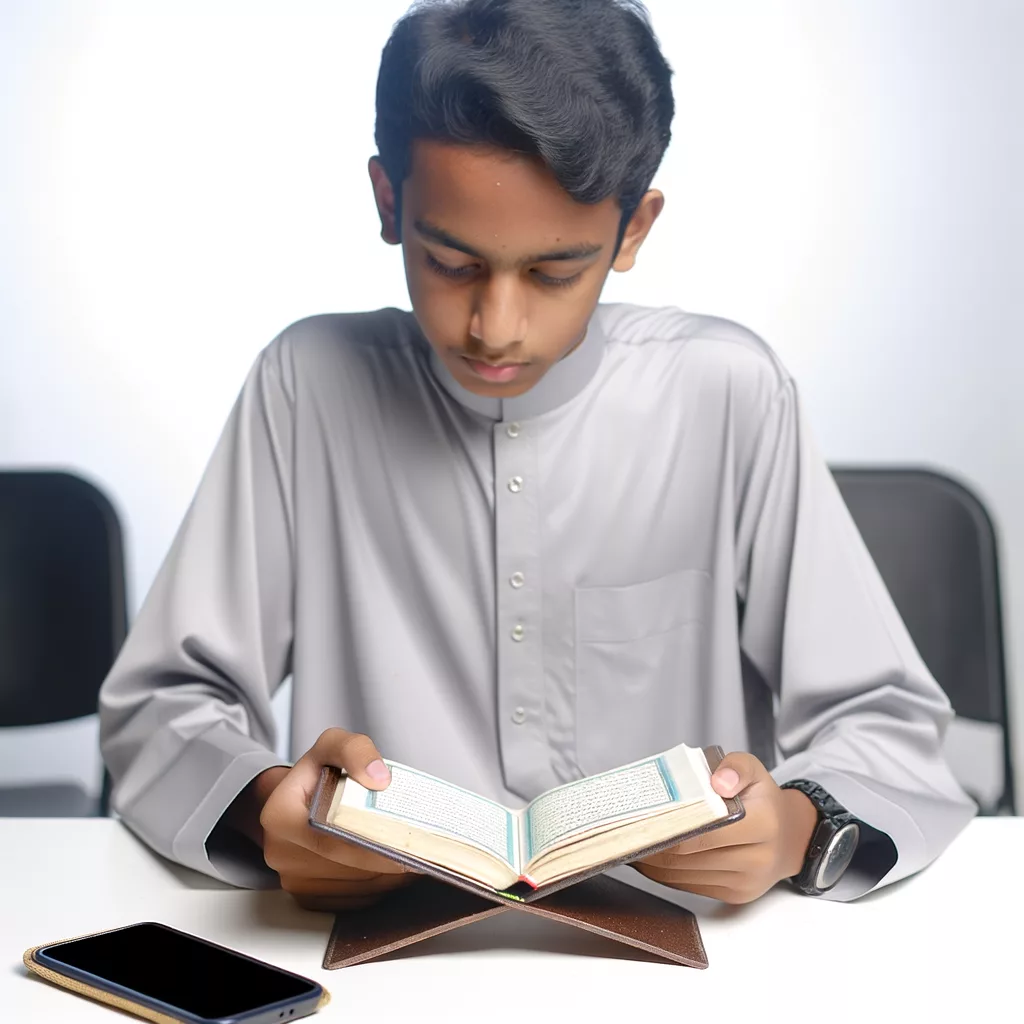
In the digital age, when every moment of a young Muslim’s life is punctuated by screens, notifications and the dizzying speed of social media, an essential question arises: what does it mean to preserve your Muslim identity in this connected world? Caught between the search for authentic reference points and the pressure of a global culture sometimes far removed from Islamic values, Muslim youth face intense challenges that are nevertheless full of hope. At the heart of these upheavals, learning Arabic and opening up to immersion in Arabic become a real key – not only for understanding the Qur’an in Arabic, but also for nourishing a living, rooted and luminous Islamic spirituality.
Many young people feel this tension: on the one hand, unlimited access to information, debates and sometimes contradictory influences; on the other, a deep aspiration to sincerity in Islam, inner peace, gratitude to Allah and love of the Prophet Muhammad. How can you find a stable sense of meaning and draw closer to reading the Qur’an, tajwid, the tafsir of the Qur’an and the science of hadith when attention is scattered and instant gratification rules? How can you fully live prayer in Islam – khushu in prayer, the joy of jumu’a, the rhythm of Ramadan – while navigating a society in which Muslim identity and the practice of Islam are sometimes misunderstood or marginalised?
This article invites you to explore living, practical ways to meet these challenges, enrich your Islamic education and strengthen your Muslim faith. By placing immersive learning of literary Arabic and understanding of the Qur’an at the heart of the journey, the aim is to rediscover the deep meaning of the sunna and the sira of the Prophet, to forge bonds with the companions of the Prophet and the ahl al-bayt, and to inhabit Islamic culture authentically in a digital world. In the face of the temptation of forgetfulness or superficiality, immersion in Arabic, memorising the Qur’an, and the daily practice of dhikr, du’a, tawba and patience in Islam become so many markers for journeying with serenity, strength and wisdom towards the light of Allah.
Today, for every young Muslim in France and elsewhere, the question is no longer just how to survive modernity, but how to shine through your identity, your values and your culture. Knowing how to learn Arabic without translation, making the beauty of literary Arabic and Islamic civilisation your own, and reconnecting with the mosque, the Muslim community and Muslim volunteering all open the way to a fulfilling Muslim spiritual life, inner peace in Islam, and kindness towards yourself, your loved ones and society as a whole. Let us reflect on this together, to turn digital challenges into opportunities for growth and fulfilment, in the light of the Qur’an and the prophetic tradition.
Muslim identity and the challenges facing young people in the digital age: how to strengthen your roots through learning Arabic and understanding the Qur’an
In the digital age, Muslim youth face unprecedented identity challenges, torn between the many demands of the virtual world and a deep need for spiritual roots. Between social media, fragmented information and the growing influence of the dominant culture, it becomes essential to preserve, and even strengthen, Muslim identity. Here, learning Arabic appears as a precious key: not only because it allows you to understand the Qur’an in its original language, but also because it invites immersion in Arabic, away from the filters of translation. Diving into literary Arabic, experiencing listening to and reading the Qur’an in Arabic, opening your heart to memorising the Qur’an with the rules of tajwid: all this forges a living and intimate connection with revelation.
This approach is not only about formal knowledge of the sacred text: it offers every young Muslim the chance to taste the unique flavour of the divine words, to contemplate the wisdom of the tafsir of the Qur’an, to be touched by the beauty of the sunna as it resonates in the science of hadith, or to follow step by step the sira of the Prophet and the inspiring lives of the companions of the Prophet and the ahl al-bayt. Taking root in the Muslim faith then means living an Islamic spirituality embodied in the practice of Islam, salat, khushu in prayer, the Friday prayer at the mosque, the call of the adhan, Islamic invocations and daily dhikr — practices whose meaning is intensified when approached through the language of the Qur’an.
At the heart of these contemporary challenges, learning Arabic without translation not only opens a door to Islamic culture and the history of Islam, but also strengthens confidence in your Muslim identity. For today’s Muslim youth, this learning is a source of inner peace and spiritual well-being that goes beyond Islam in France or elsewhere. It encourages the discovery of aqida and fiqh, reflection on moderation (wasatiyya), gratitude to Allah, love of the Prophet and rootedness in community life. Thus, through learning Arabic, every young Muslim finds the resources to face the demands of the modern world while finding refuge, reference points and light in Islamic spirituality.
Immersion in Arabic and Islamic spirituality: reconnecting with reading the Qur’an, prayer in Islam and the prophetic tradition in the age of social media
In the age of social media, Muslim youth navigate between a constant flood of ephemeral messages and a deep desire to reconnect with authentic Islamic spirituality. Learning Arabic today is not only access to a language; it opens the doors to the Qur’an in Arabic, the sunna of the Prophet and the immense heritage of the history of Islam. Thanks to immersion in Arabic, far from partial translations that impoverish the meaning, it becomes possible to feel the beauty of tajwid when reading the Qur’an, to taste the depth of dhikr in prayer in Islam and to marvel at the age-old wisdom of the hadiths. Understanding literary Arabic allows you to make the science of hadith your own, to explore the sira of the Prophet and to grasp the teachings of the companions and the ahl al-bayt directly at their source.
In the face of the addictive power of digital platforms, finding an authentic connection with your Muslim faith requires a return to the essentials: attentive listening, inner silence, contemplation – those moments when the heart bows and the deep meaning of salat is revealed, when khushu in prayer becomes palpable. Young people, saturated with fast information, benefit from giving themselves the slow time of memorising the Qur’an, meditating on the tafsir of the Qur’an without a screen or interruption, and exploring patience in Islam, sincerity in Islam and the love of Allah by learning Arabic without translation.
It also means reconnecting with the sacred rhythms of Ramadan, fasting in Islam and blessed nights such as laylat al-qadr; feeling the intensity of the adhan at the mosque, sharing jumu’a with the Muslim community, experiencing gratitude to Allah during a discreet invocation or a moment of spiritual intimacy. This immersive approach shapes Muslim identity beyond digital superficiality: it connects Muslim youth to the great tradition of the scholars of Islam, from Andalusian civilisation to historic Islamic universities such as Al-Azhar or Zaytouna.
By inhabiting the language of the Qur’an, young people manage to establish a stable spiritual routine, founded on Islamic reading, dhikr, du’a, halal trade, Islamic solidarity and community mutual aid. They open up to the richness of Islamic culture, calligraphy, Islamic art, the wisdom of the elders and contemporary challenges such as racism, Islamophobia, interfaith dialogue or protecting the environment in Islam. Learning Arabic thus becomes the founding act of a living, luminous spirituality, able to flourish despite, or thanks to, the challenges of the digital age.
Memorising the Qur’an, the science of hadith and Islamic education: classic tools and adapted solutions for connected Muslim youth
In the digital age, Muslim youth face a double challenge: preserving the richness of the Islamic heritage while adapting to new ways of learning. Memorising the Qur’an, once passed on in mosques or within the Muslim family, relied on recitation with tajwid and on natural immersion in literary Arabic. Today, digital tools – mobile apps for reading the Qur’an in Arabic, interactive tafsir platforms, podcasts on the science of hadith, videos on the sira of the Prophet or the sunna – make the sacred texts easier to access, but do not always replace the depth of the traditional bond. Many young people want to learn Arabic without translation to grasp the living meaning of the verses, or to understand the Qur’an in Arabic in its original beauty. However, the profusion of resources can sometimes scatter attention, harm khushu in prayer and give an impression of spiritual superficiality. Faced with this abundance, favouring an approach to learning Arabic through immersion, centred on listening, oral practice and the natural acquisition of meaning, appears to be a solid alternative. It enables not only memorising the Qur’an and access to the sunna, but also making Islamic education your own in the language that carried the revelation and shaped the history of Islam. In this way, connected Muslim youth can combine technology and spirituality, drawing on time-honoured methods such as guidance from an imam or traditional halqas, while benefiting from the teaching advantages of modern media. Adopting a stable spiritual routine, practising patience in Islam in the face of distractions, strengthening sincerity in Islam in your learning, and cultivating gratitude to Allah for guidance and ease are all reference points that allow the new generation to keep the beating heart of the Muslim faith alive, beyond the mere consumption of digital information.
Digital culture, influence on identity and the Muslim community: preserving faith, patience and sincerity in Islam through daily practice and immersive learning
In the digital age, Muslim youth live in an environment where global culture, an accelerated pace and the influence of social media shape everyone’s identity. In this whirlwind, preserving the Muslim faith and being anchored in patience in Islam and sincerity in Islam take on a new dimension, both intimate and collective. Practising Islam day to day is no longer limited to simple ritual gestures, but becomes an intentional commitment in every interaction, every choice, every moment of life, whether visible or discreet. For the Muslim community, keeping Islamic spirituality alive, ensuring purity of heart in prayer in Islam or salat, cultivating khushu in prayer and strengthening one’s connection with Allah are as much challenges as sources of strength in the face of outside pressures and questions of identity.
It is particularly in immersive learning of the Arabic language that an unsuspected remedy for this erosion of reference points lies: learning Arabic without translation, through genuine immersion in Arabic, reconnects heart and mind to the authentic source of Islam. Literary Arabic, the chosen language of the Qur’an, the hadiths, the sunna, the sira of the Prophet and the companions of the Prophet, offers direct access to wisdom and to the beauty of Islamic invocations, dhikr, du’a and tajwid in reading the Qur’an. Understanding the Qur’an in Arabic, diving into the tafsir of the Qur’an, and being introduced to the sciences of hadith, aqida, fiqh and the stories of the ahl al-bayt make it possible to pass on a rooted and serene Muslim identity, far from the stereotypes conveyed by the media.
So by integrating learning Arabic with the daily practice of the values of akhlāq, gratitude to Allah, modesty in Islam, love of the Prophet and community engagement through Islamic solidarity, Muslim youth forge a serene identity, an inner strength and a voice anchored in the age-old heritage of Islamic civilisation. The spiritual routine, Islamic festivals such as Ramadan, eid al-fitr, eid al-adha and laylat al-qadr, the great gatherings of hajj or jumu’a, and even learning Islamic calligraphy form a subtle weave of reference points that radiate patience, sincerity and the joy of being Muslim in the contemporary world. Through family transmission, the Islamic education of Muslim children, intergenerational dialogue or a commitment to Islamic studies – whether at Al-Azhar, Zaytouna, Qayrawan or in local mosques – a resilient youth is patiently built, able to combine spiritual well-being, Islamic ethics and ambition in a digital world searching for meaning.
To go further: discover our online Arabic classes for adults, or also read “Learning Arabic to purify the heart and heal the diseases of the soul” and “Learning Arabic through the pilgrimage of Hajj and Umrah“.
Conclusion
In the digital age, Muslim youth live at a real crossroads between modernity and tradition, between openness to the world and rootedness in an inherited identity. The challenges are many: preserving the Muslim faith, searching for meaning, balancing spiritual values against virtual demands, vulnerability to the influence of social media or to the dilution of Islamic culture. Yet on this sometimes uncertain journey, luminous paths remain, forged by the guidance of the Qur’an, the prophetic example and the strength of the Muslim community.
Learning Arabic and reconnecting with immersion in Arabic means no longer living the revelation behind a veil of translation. Awakening to literary Arabic means giving deep meaning to every word recited, every verse meditated upon when reading the Qur’an, every prayer in Islam. It means regaining direct access to the Qur’an in Arabic, absorbing the beauty of tajwid and drawing a living understanding of the divine message from the science of hadith and the tafsir of the Qur’an. Through learning Arabic, memorising the Qur’an once again becomes a source of spiritual anchoring, and the sunna, the sira of the Prophet and the wisdom of the companions of the Prophet and the ahl al-bayt shine in their original clarity.
Digital technology, when tamed by awareness and guided by Islamic spirituality, can become a formidable ally in the practice of Islam: access to Islamic education, sharing teachings from the scholars of Islam and Islamic universities, and a living memory of traditions through podcasts, videos and educational apps. Immersion, even amid modernity, brings precious gentleness and stability: it forges patience in Islam, sincerity in Islam and gratitude to Allah, and nourishes a serene Muslim spiritual life despite the tumult of the connected world.
Progressing in learning Arabic without translation also means weaving a unique bond with salat, khushu in prayer, the Friday prayer and Islamic invocations such as dhikr, du’a and tawba. It means finding refuge in the love of Allah and the love of the Prophet, and discovering the depth of Ramadan, the light of fasting in Islam, the beauty of laylat al-qadr and festivals such as eid al-fitr and eid al-adha. At every stage, the soul grows stronger to face modern life while preserving authenticity, inner peace and spiritual well-being.
Supported by a committed Muslim family, Muslim children raised with respect for Islam and a Muslim community bound together by mutual aid, zakat and volunteering, today’s young people are the heirs of a rich Islamic civilisation. Their ethical commitment, whether in Islamic finance, halal, the environment in Islam or interfaith dialogue, is shaping an Islam in France and in the West that proudly carries the banner of respect, modesty, moderation and openness.
So even in the digital age, the roots remain strong when the heart opens to the language of Allah, to memorising the Qur’an, to the wisdom of hadith and the sunna, and to the knowledge and beauty of a living and enlightened practice of Islam. Young Muslims, armed with patience, sincerity, love and knowledge, are ready to write the finest pages of the history of modern Islam, with nobility, humility and confidence.



