
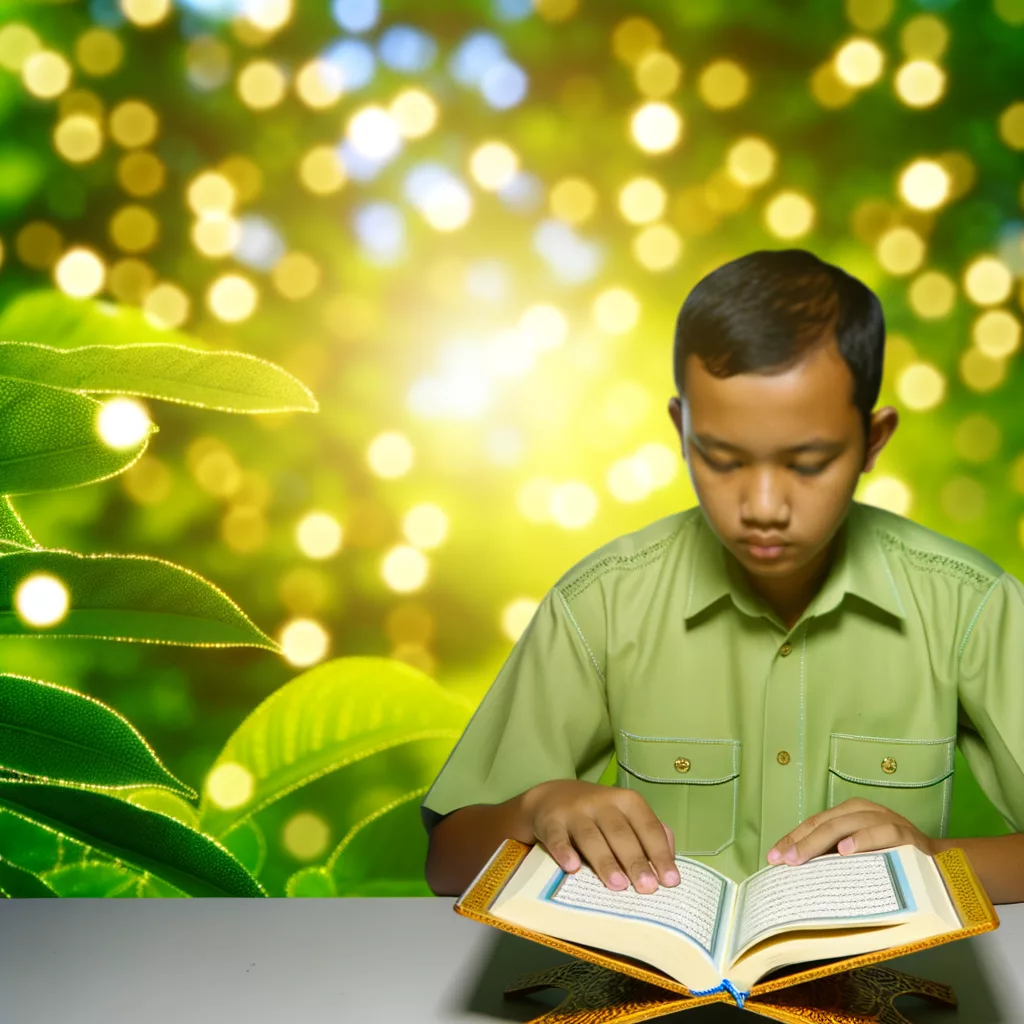
Learning Arabic means opening the door to an age-old wisdom at the heart of Islamic spirituality and giving yourself the means to grasp, in its original depth, one of humanity’s most beautiful messages: the preservation of divine creation. In a world marked by ecological crisis, the Muslim faith, through the Qur’an in Arabic and the sunna of the Prophet Muhammad, enlightens consciences and soothes souls who wish to live in harmony with nature. But to feel this call to balance, to gratitude towards Allah and to respect for living things, we must absorb the sacred text as it was revealed, in literary Arabic, without filter or translation, with heart and mind in total immersion.
Reading the Qur’an in Arabic, attentively memorising its verses, listening to the tajwid that makes every word vibrate, and meditating on the tafsir of the Qur’an naturally lead us to rediscover ecology in Islam. Every passage, every Islamic invocation, every account from the sira of the Prophet or of his companions reveals an ethic of preservation and respect. Through the history of Islam and the lived experience of the ahl al-bayt, our relationship with nature is raised to the level of worship, gratitude towards Allah, dhikr and silent prayer.
Far beyond mere knowledge, learning Arabic invites a living experience in which ecology takes root in faith, the practice of Islam and everyday conduct, from the Muslim couple to the whole community. In the spiritual routine of prayer in Islam, in the moments of jumu’a at the mosque, in the Ramadan fast or during hajj, every act reminds us of our responsibility as guardians: not to waste, to honour purity, to seek the right balance. But how can we fully embrace this heritage without the light of the original language, which makes the meaning clear and the heart receptive?
Immersive learning of Arabic without translation offers a natural way to recover this lost unity, to feel the beauty and urgency of the ecological message, and to take part in restoring our sacred bond with creation. This article offers a path to understanding this intimate link between faith, nature and learning Arabic, so that we may inhabit the world with greater awareness, inner peace and love of Allah.
Understanding the link between ecology in Islam and the preservation of creation through learning literary Arabic
The deep link between ecology in Islam and the preservation of creation becomes clear when we open ourselves to learning literary Arabic. Understanding the Qur’an in Arabic, in its original language, means rediscovering the subtlety with which God speaks of His work, of nature and of human responsibility for this trust. Through immersion in Arabic, without translation, the verses that celebrate the Earth as an immense mercy and invite respect for the cycle of water, plants and animals reveal themselves with a new warmth. The notions of khilafah, that state of “stewardship” entrusted to humankind, and of amanah, the conscientious safeguarding of created things, can only truly be grasped through attentive reading of the Qur’an in Arabic.
Learning Arabic allows us to taste the sound and the many layers of meaning of words such as “israf” (waste) or “fasad” (corruption), against which Allah warns. It is by approaching the tafsir of the Qur’an and the science of hadith in the language of the first companions of the Prophet that we understand the essential place of patience in Islam, sincerity (ikhlas) and gratitude towards Allah in the face of the magnificence and fragility of divine creation. Studying the sira of the Prophet, with his interactions full of moderation and care towards animals and plants, placed in their linguistic context, reminds us that Islam is, in its essence, an ecological spirituality.
This direct relationship with literary Arabic gives substance to the practice of prayer in Islam and to dhikr, in which every memorised word carries the original weight of praise or invocation. By immersing themselves in Arabic without going through the filter of translation, Muslims cultivate a more organic love of Allah and a deep attentiveness to His word, and develop a keen awareness of the balance and harmony that Muslim spiritual life seeks to preserve. Ecology in Islam is then no longer just a contemporary theme: it becomes a natural consequence of faith, an intimate extension of reading the Qur’an and of the prophetic tradition, lived from within thanks to learning Arabic.
Absorbing the Qur’an in Arabic: immersion, meditation and ecological awareness
Absorbing the Qur’an in Arabic opens the door to a deep understanding of Islamic spirituality and naturally reveals the ecological awareness present in the divine message. When we set out on the path of learning Arabic, especially literary Arabic, every word of the Qur’an resonates with an intensity that translation cannot convey. Immersion in Arabic allows us to perceive the subtle nuances that link the preservation of the environment to the Muslim faith. For example, meditating on the verses that speak of creation, the cycles of nature, water, plants or the alternation of day and night invites gratitude towards Allah and the preservation of His creation. Learning Arabic without translation encourages a more authentic reading of the Qur’an: the beauty of tajwid, the deep reflection encouraged by the tafsir of the Qur’an and the practice of memorising the Qur’an lead to a renewed inner experience. The science of hadith and the study of the sunna show how the Prophet, the companions and the ahl al-bayt displayed a luminous respect for nature. Immersion in the Qur’an in Arabic nourishes khushu in prayer, cultivates patience in Islam, intensifies gratitude and strengthens sincerity towards the Creator. This path of learning is not only a return to the source of Islam; it is also an invitation to rediscover, in the rhythm of Islamic invocations and dhikr, an awareness of our responsibility towards the Earth. Thus every page read and every verse meditated on in literary Arabic makes the practice of Islam a path of harmony between the heart, the universe and the divine will.
The Prophet Muhammad and his companions: examples of environmental ethics in the sira and the hadiths
In the sira of the Prophet Muhammad, the question of ecology in Islam appears not as a modern idea, but as a natural extension of the Muslim faith and of Islamic ethics. The authentic hadiths and the exemplary life of the Prophet and his companions illustrate a keen awareness of the preservation of divine creation, which runs through the whole practice of Islam. The Prophet, in his nobility and mercy, taught through his sunna a deep respect for nature: conserving water even on the bank of an abundant river, avoiding all waste in Islam, and treating every living being – trees, animals, humans – with kindness and justice. This ethical relationship stems from an understanding of the Qur’an in Arabic, whose injunctions can be grasped in all their subtlety through learning literary Arabic and immersion in Arabic. Mastering tajwid, studying the tafsir of the Qur’an and memorising the Qur’an give access to an approach in which every word, every recommendation on the environment or the measured use of resources, finds an echo in Islamic spirituality.
The companions of the Prophet, models of akhlaq and of sincerity in Islam, placed this love of Allah at the heart of their care for the earth. They planted trees knowing, according to a famous hadith recorded in the science of hadith, that “if the end of the world were to come and one of you had a seedling in hand, let him still plant it”. This simple gesture then becomes an ongoing sadaqa, a living expression of gratitude towards Allah. In the sira and the tradition of the ahl al-bayt, caring for animals, protecting water sources and preventing needless destruction were seen as forms of piety, linked to an authentic and rich Muslim spiritual life.
Immersion in Arabic and learning Arabic without translation open the doors to this awareness: understanding the subtlety of the Qur’an in Arabic and the beauty of Islamic invocations in their original language fosters a direct and deep bond with creation, the practice of Islam and responsibility towards the environment. Thus, cultivating patience in Islam, moderation (wasatiyya) and modesty also translates into gratitude for the good things of this world, attention to waste, and commitment to an ecology in Islam that naturally echoes the recommendations of the Prophet Muhammad, his companions and the whole Islamic tradition.
Islamic spirituality and gratitude towards Allah: cultivating love of nature in the practice of Islam
In Islamic spirituality, gratitude towards Allah is not just words, but a deep feeling that shows itself in every gesture, every look cast on creation. In the light of the Qur’anic teachings and the sunna, believers realise that the surrounding nature is part of the trust given by Allah to humanity. Becoming aware of this mission stirs a twofold emotion: love for the One who creates with such perfection, and responsibility for what has been placed in our hands. Understanding the Qur’an in Arabic and diving into immersion in literary Arabic give access to the subtle nuances of the words that invite us to contemplate the signs of the Creator in the sky, the earth, plants and animals. Every verse, every word of the Qur’an in Arabic, every account from the sira of the Prophet or of the companions of the Prophet encourages humankind to admire, protect and give thanks. Gratitude towards Allah comes alive in dhikr, invocation and prayer in Islam – when salat or jumu’a are lived with khushu, they become a silent hymn to the beauty of creation and to moderation in Islam.
This state of mind is also passed on within the Muslim family, through the Islamic education of children who learn from a very young age that every drop of water, every branch, is a divine gift. The great scholars of Islam, from Al-Azhar to Zaytouna, insist on this responsibility inscribed in fiqh and the sharia: avoiding waste in Islam, preserving resources, and practising patience and sincerity in Islam in the face of ecological challenges. The Muslim couple and the Muslim community are all called to live this love of Allah together by protecting creation: a form of sadaqa and Islamic solidarity towards every being, human or not.
This attitude irrigates the believer’s spiritual routine and spiritual well-being. By recalling the words of the Prophet on mercy towards nature, and by studying the tafsir of the Qur’an or the science of hadith, we understand that gratitude towards Allah excludes nothing and no one from its sphere. Being grateful means acting with justice and beauty in our daily deeds; it means constantly reconnecting with the inner peace sought in Islam. Thus, cultivating love of nature means turning one’s heart towards the One who fashions all things, and walking humbly on the earth, aware that every step is an opportunity to show one’s gratitude and one’s attachment to an Islamic spirituality lived to the full, in harmony with ecology in Islam.
Further reading: discover our online Arabic courses for adults, or read “Learning Arabic and staying consistent with the Monday and Thursday fast” and “Learning Arabic to understand the Qur’an and grow spiritually“.
Conclusion
Preserving divine creation is not only an ecological responsibility; it is an authentic act of faith and gratitude in Islam. When we open ourselves to the richness of the Arabic language, to the literary Arabic of the Qur’an, a whole world of meanings, nuances and wisdom becomes accessible, allowing us to understand Islam’s deep attachment to the Earth and to the balance of Allah’s creation. Learning Arabic, especially through immersion in Arabic without translation, connects us to the original word of the Qur’an, to the hadiths and to the sira of the Prophet Muhammad, those living sources that show how deeply the preservation of the environment is rooted in Islamic spirituality.
By diving into reading the Qur’an in Arabic, memorising the Qur’an and studying the tafsir of the Qur’an, we gradually absorb the sacred view that Islam takes of every element of the world: the tree, water, the breeze, the mountains, the beneficial rain, every creature that fills our daily lives. This view nourishes patience in Islam, gratitude towards Allah, sincerity in our actions, humility before the perfection of creation, and love of Allah through the contemplation and respect of His work.
The Prophet Muhammad, his companions and the ahl al-bayt embodied, through their sunna, their conduct and the accounts of the sira, an environmental ethic in which every gesture counts: not wasting, conserving water, protecting animals, planting trees, practising modesty and moderation. This heritage illuminates every prayer in Islam, whether daily salat, Friday prayer, or acts of dhikr, du’a or tawba, in which we constantly find praise of the beauty of creation, the call to repent for our negligence and the sincere wish to contribute, on our own scale, to the harmony willed by the Creator.
Absorbing this ecological awareness through learning Arabic also means passing on a balanced vision and a strong, peaceful Muslim identity to Muslim children and the Muslim community, inspiring young generations in France and elsewhere to commit to an ecology in Islam anchored in the eternal values of the Qur’an and the sunna. It means reconnecting with the dignity of Islamic civilisations, from the Andalusian caliphate to universities such as Al-Azhar, Zaytouna or Qayrawan, which cultivated science, respect for living things and a comprehensive Islamic ethic.
Through tajwid, every recitation of the Qur’an becomes an opportunity to meditate on the signs of the Earth. Through Muslim spiritual life, the spiritual routine, and the celebrations of Ramadan, eid al-fitr or hajj, the ecological dimension takes concrete form in our food choices, the fight against waste, Islamic solidarity, zakat, volunteering and community mutual aid. Even interfaith dialogue, da’wa or mosque life can become levers for education and collective action in favour of a world more respectful of divine creation.
Thus, learning Arabic, immersing yourself in the Qur’an in Arabic and welcoming the wisdom of the hadiths and the sira means opening yourself to a path in which ecology, Islamic spirituality and the practice of Islam are intimately linked. In the gentleness of prayer, the beauty of dhikr or the depth of tafsir, a harmony is woven in which every believer, man or woman, can find inner peace and a sense of commitment, by preserving the precious trust given to humanity: the creation of Allah. This invites us to live Islam not as mere belonging, but as a daily light, a breath of love for the Creator, a living bond with all the nature that surrounds us.



