
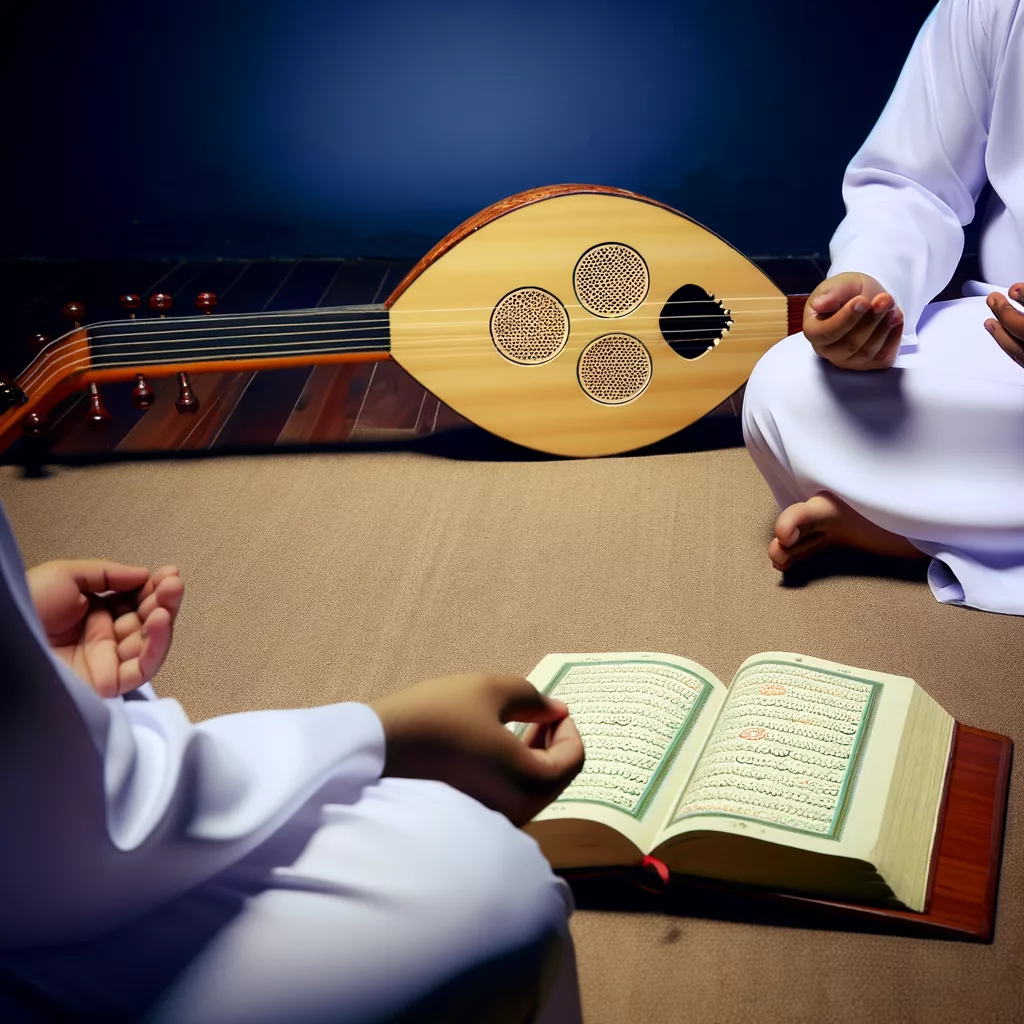
Music in Islam: a path between texts, debates and the search for meaning
What does music evoke for you? A moment of peace, a deep emotion, the memory of something past, or, in the context of Islam, a delicate question where spirituality, tradition and culture meet? For centuries, Muslims have legitimately asked what place music has in their faith: is it permitted, restricted or forbidden? Opinions abound, swinging between strictness and openness, silence and song, asceticism and celebration. For anyone seeking to live their Muslim faith to the full, navigating these debates takes more than a simple translation of the texts or listening to sermons. It means entering the original world of the sources yourself, breathing the air of the Qur’an in Arabic, immersing yourself in the science of hadith, and keeping company with the legacy of the Companions of the Prophet and the immense knowledge of the scholars of Islam.
Learning literary Arabic then becomes far more than an academic exercise: it is a key to understanding the Qur’an in the light of the original revelation, savouring the subtlety of Qur’anic tafsir, appreciating the nuances of fiqh opinions on music, and taking an informed part in discussions about the practice of Islam in a changing world. Immersion in Arabic opens unsuspected doors: it lets you grasp the deep meaning of the hadiths, enter the Islamic spirituality of dhikr and prayer (salat), question your own practice in the light of the texts and the living tradition, explore the diversity of Islamic culture, and better understand the role of music, silence, the voice and song in the education of the Muslim faith.
In this article, we invite you on an immersive journey to the heart of the debates on music in Islam: diving into the texts of the Qur’an in Arabic, listening carefully to the opinions of the scholars, discovering Arabic without translation and reflecting on personal practice. Along the way, music will become a true revealer of the richness of Islamic civilisation and the depth of Muslim spirituality. Perhaps, on this path, learning Arabic will even transform your reading of the Qur’an, your prayer and your relationship with the world.
Understanding the debates on music in Islam: immersion in the texts of the Qur’an, hadith and the scholarly tradition
To understand the debates on music in Islam, it is essential to dive attentively into immersion in literary Arabic and into a careful reading of the Qur’an in Arabic, together with the study of the sunna of the Prophet and the science of hadith. The diversity of opinions, which runs through the schools of fiqh and centuries of scholarly tradition, can only truly be grasped by learning Arabic without translation, so as to approach the subtlety of the vocabulary, the richness of the contexts and the depth of the theological arguments. Certain verses of the Qur’an, interpreted through tafsir, refer indirectly to music, while the hadiths reported by the Companions of the Prophet and discussed by the ahl al-bayt offer nuanced perspectives, ranging from warning to tolerance in context. A fine understanding of these texts, in their original language and according to the rules of tajwid, makes it possible to grasp their implications for the practice of Islam today: prayer in Islam, Islamic spirituality, and the ritual joy expressed during Ramadan, the hajj or festivals such as eid al-fitr and eid al-adha. The dialogue between the scholars of Islam, past and present, those of Al-Azhar or Qayrawan, reflects the importance of Islamic education and of an informed Muslim faith, founded on the search for meaning, understanding of the Qur’an and faithfulness to the sunna. Learning Arabic thus becomes an essential key to navigating the richness of Islamic civilisation, deepening one’s akhlaq and reaching a Muslim spiritual life in which discernment and sincerity in Islam guide every choice, in inner peace and gratitude towards Allah.
Going further: learning literary Arabic in the service of understanding the Qur’an and legal opinions
Learning literary Arabic opens the doors to an authentic understanding of the Qur’an and of legal opinions in Islam, where every word holds a deep meaning shaped by the richness of the original language. In Muslim spiritual life, learning Arabic is not simply an intellectual asset: it becomes a true act of faith, a way of drawing closer to Allah and His Prophet. Committing to immersion in Arabic, learning Arabic without translation, means agreeing to soak up the sounds, the rhythms and the very essence of the revelation as it was revealed to our beloved Prophet Muhammad, and passed on by the Companions of the Prophet and the ahl al-bayt. You then discover the depth of tajwid, the art of reciting the Qur’an, and the refinement of Qur’anic tafsir: the subtle nuances of each verse, the guidance of fiqh and the sharia, and the balance of the sunna take on their full flavour and coherence. Learning Arabic brings new life to the science of hadith, to the sira of the Prophet and to the immense legacy of the scholars of Islam, past and present, and gives unfiltered access to the great fatwas, to the Islamic jurisprudence of the different madhahib, but also to works of Islamic spirituality, to Sufism, to Islamic ethics and to the beauty of Islamic art. Understanding the Qur’an in Arabic, praying in Islam with khushu, and memorising verses and Islamic invocations in the Arabic language renew the meaning of every salat, from dhikr to du’a, from tawba to gratitude towards Allah. For the Muslim community, the transmission of Islamic education, the awakening of Muslim children and the preservation of Muslim identity find in the mastery of literary Arabic an essential pillar, the guarantee of a rooted faith, of love for the Prophet and of spiritual authenticity at the heart of Islamic culture, the history of Islam and contemporary practice, whether you live in France or elsewhere.
Music, Islamic spirituality and personal practice: between dhikr, prayer and the education of the Muslim faith
At the heart of Islamic spirituality, personal practice involves a delicate balance between sensory experience and the search for inner depth. From this perspective, the question of music takes on its full meaning: while some currents oppose listening to certain instruments or melodies, others recognise in religious chants, such as the Sufi sama, a path towards the elevation of the soul and closeness to Allah. But whatever opinion one adopts, the fundamental element remains the pursuit of dhikr, that is, the constant remembrance of God, whether through the recitation of the Qur’an in Arabic, the ritual salat, or the Islamic invocations (du’a) that strengthen patience and gratitude towards Allah. For many, the melodic beauty of Qur’an recitation, the application of the rules of tajwid, or the subtle art of the adhan are felt as a “sacred chant”, filling the heart with an inner peace that is hard to describe in words. This immersion in Arabic, without translation, makes the Muslim faith resonate and begins an authentic spiritual education, by passing on the deep meaning of the divine words and of the sunna of the Prophet.
By cultivating the understanding and memorisation of the Qur’an in literary Arabic, each believer gradually shapes their own spiritual routine, finding in recitation a bulwark against daily stress and a solid point of reference within the Muslim community. Muslim children thus grow up lulled by Qur’anic psalmody, the hadiths and the call of the muezzin, helping to build a strong and serene Muslim identity, whether you live in France or elsewhere. Learning Arabic through immersion, relying on repeated listening and authentic pronunciation, lets you anchor yourself in a centuries-old chain of knowledge: the science of hadith, Qur’anic tafsir, the sira of the Prophet and the wisdom of the Companions. This journey through sounds, words and rituals invites the Muslim not only to enrich their practice of Islam, but also to deepen their intimate relationship with the Creator, drawing on the heritage of Islamic civilisation and the universal values of peace, sincerity and love of Allah.
Learning Arabic without translation: an essential bridge to exploring history, Islamic culture and the scholars’ opinions on music
Learning Arabic without going through translation is far more than a simple language-learning technique: it gives you the most authentic key to the history of Islam, to the cultural diversity of the Muslim world, and above all to the richness of scholarly debates, such as the one on music in Islam. Immersive learning of literary Arabic lets you grasp the subtleties of the Qur’an in Arabic, hear the exact scope of the hadiths, understand the science of hadith, or begin studying Qur’anic tafsir, without the pitfalls of approximation and loss of meaning that translation often brings. Diving into immersion in Arabic means following the very approach of the Companions of the Prophet and the great scholars of Islam, who passed on and debated, on the practice of music or other questions of fiqh, with the precise words of the text, the finesse of cultural nuances and the real historical context. Reading the reasoning on whether music is lawful or unlawful, exploring collections of fatwas, going back to the scriptural sources and navigating the different schools (madhahib) of Muslim law requires a living mastery of Arabic without translation: only there do the arguments, contexts, allusions and intentions reveal themselves in all their depth. This approach does not concern scholarly debates alone: it touches the overall understanding of Islamic culture, of the prophetic biography (sira of the Prophet), of the interactions of the Companions of the Prophet and the ahl al-bayt, and of the emergence and evolution of spiritual practices, in Sufism as in jurisprudence. For the modern believer, learning Arabic thus becomes a way into prayer in Islam (salat) with true khushu, into reading and memorising the Qur’an with mastery of tajwid, into the depth of the sunna, but also into community life, Islamic calligraphy, Islamic art, Andalusian culture and the vast intellectual heritage of Islamic civilisation. It is also a means of reconnecting with authentic Islamic education, of approaching debates about the practice of Islam today with serenity, of engaging with the Muslim community with discernment, and of passing on the Muslim faith in its original beauty, far from the misunderstandings born of linguistic distance. Learning Arabic without translation then offers a true bridge, both intimate and universal, towards spirituality, patience in Islam, sincerity, gratitude towards Allah, love of the Prophet, interfaith dialogue, inner peace, and the building of a rooted and enlightened Muslim identity.
Over the course of this journey through the opinions and debates on music in Islam, one fundamental truth stands out: the diversity of opinions can only be fully perceived in the light of an intimate understanding of the founding texts and of the language that carries them. Learning Arabic, especially literary Arabic, then becomes far more than a language skill: it is a living bridge to the heart of the Muslim faith, direct access to the Qur’an, the sunna and the legacy of the scholars of Islam. Through immersion in Arabic, without filter or translation, the believer draws closer to the authentic meaning of the revealed words, to tajwid when reading the Qur’an, to the depth of tafsir, to the clarity of the hadiths and to the subtlety of the legal opinions drawn from fiqh and the sharia.
This living bond with the language elevates prayer in Islam, nourishes khushu during salat and illuminates daily invocations: dhikr, du’a, tawba, so many acts that weave a soothing and profound spiritual routine. Understanding the Qur’an in Arabic during Ramadan, feeling the uniqueness of a night of laylat al-qadr, tasting the satisfaction of fasting, or perceiving the grandeur of the hajj and the umrah through the original words strengthens love for Allah, for the Prophet and for the whole Muslim community. It is the whole of Islamic culture, in its diversity and wisdom, that unfolds through chants, voices, debates and harmonies: from Sufism to classical jurisprudence, from the Andalusian caliphates to contemporary mosques, every note and every silence reveals the richness of a civilisation.
Deepening your learning of Arabic and diving into Arabic without translation gives you the chance to understand the music of the Qur’an and the hadiths, to feel the depth of the sira of the Prophet, and to perceive the subtle nuances in the opinions of the ahl al-bayt, the Companions and the scholars of Islam. It means being able to pass on to your children, within the Muslim family or as Muslim youth, a living heritage rooted in direct experience and sincerity in Islam.
The practice of Islam, whether it is expressed in the silence of prayer, the recitation of the Qur’an, respectful listening to music or meditation on creation, always gains in accuracy and richness through access to the original source. Learning Arabic, then, means answering the call of the heart and of the mind: to embrace the complexity of the debates, to taste inner peace, and to appreciate, in every verse, every fatwa or melody, the timeless beauty of the Muslim faith and of Islamic culture.
Further reading: discover our online Arabic courses for adults, or read “Learning Arabic to understand the rules of inheritance in Islam” and “Learning Arabic to enjoin good and forbid evil“.



