
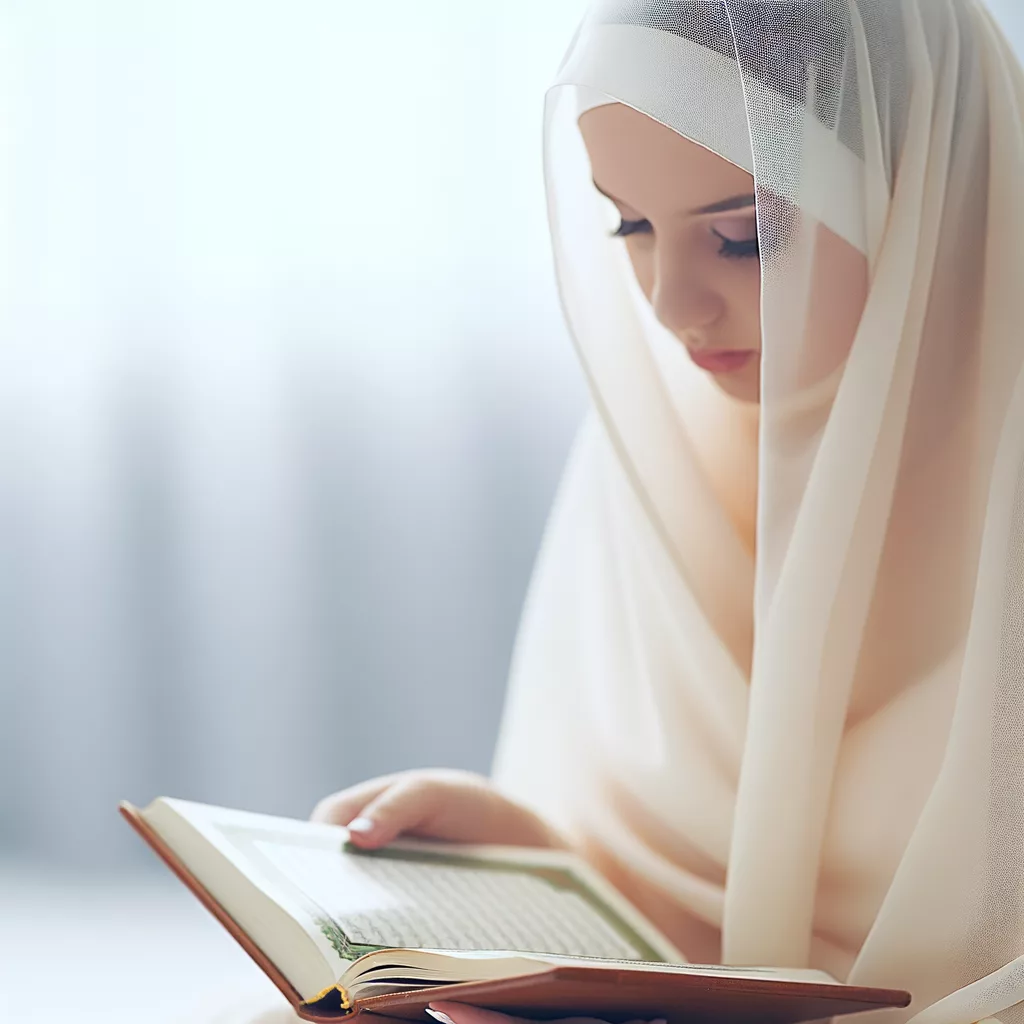
In a world where appearances so often capture all the attention, the question of sincerity in hijab and modesty is growing in importance, especially in our contemporary era, when Muslim identity takes many forms. But what is true modesty in Islam, and what place does sincerity hold in the practice of hijab? These questions run through the heart of every believing man and woman who wishes to anchor their faith in authenticity, and to make every gesture – from wearing the hijab to prayer, from dhikr to everyday conduct – a faithful expression of their love of Allah and their quest for spiritual well-being.
It is in the depths of the Qur’an in Arabic and of the prophetic teachings, passed down through the sunna, the hadiths, the sira of the Prophet and the exemplary lives of the companions, that the deep meaning of modesty is found. But to truly understand the Qur’an, grasp the subtleties of modesty according to Islam and feel the Islamic spirituality that flows from it, learning Arabic stands out as an essential key. Learning Arabic is not simply a matter of translating words, but of living an immersion in Arabic, experiencing the language as the direct vehicle of revelation and making every reading of the Qur’an, every tajwid lesson, every act of dhikr or prayer in Islam an authentic and profound experience.
Sincerity in Islam, whether in outward modesty or in purity of heart, is not born of habit or of simply respecting visible codes: it is embodied in a living understanding of the sacred texts, the internalisation of their teachings and the desire to please Allah with humility and love. Over the centuries, scholars of Islam, mufassirun, ulema and exemplary figures have stressed the link between the science of hadith, reading the Qur’an in its original language, and the deep transformation of the believer.
In this article, we invite you to rediscover hijab and modesty in the light of the Qur’an, exploring the sincerity that should accompany them, through immersion in Arabic and the rediscovery of authentic spirituality. How can learning literary Arabic and understanding the Qur’an without translation nourish the believer’s modesty? In what way does the practice of hijab, when supported by sincerity of heart, contribute to building our Muslim identity, to inner peace and to the beauty of the Muslim community? These are all avenues for reflection, rooted in lived experience, the Muslim faith and the quest for a better practice of Islam. Far more than a mere garment or a moral code, the sincere hijab questions us, uplifts us and connects us, through language and the heart, to the prophetic tradition, to the wisdom of Allah and to the splendour of Muslim spiritual life.
Sincerity in Islam: the true meaning of modesty and hijab in the light of the Qur’an and the Sunna
Sincerity in Islam is the invisible heart of every act of worship, and this is particularly true when it comes to hijab and modesty. This sincerity, or ikhlas, is not simply about performing an outward gesture but about rooting its meaning in a deep Muslim faith, intent above all on pleasing Allah. When we look into the Qur’an in Arabic or the sunna of the Prophet, we see that modesty – haya’ – goes far beyond mere appearance: it envelops the heart, words, intention and every dimension of Islamic conduct (akhlaq). The companions of the Prophet, guided by his luminous example, drew from reading the Qur’an and from the science of hadith the foundations of a sincere modesty that connects the outward to the inward, form to meaning.
Sincerity and modesty in Islam nourish each other. For a Muslim woman, wearing the hijab is not only responding to a legal injunction; it is expressing, through a choice of modesty, love of Allah, gratitude for being guided and the wish to honour Islamic spirituality at every moment. Understanding these teachings in the original text, through learning Arabic and immersion in Arabic, enriches awareness of this subtle link between the visible act and the hidden intention. When we bow in prayer in Islam, khushu, that inner presence, strengthens the modesty of both gesture and heart – which is why learning Arabic without translation, exploring the tafsir of the Qur’an, perfecting one’s tajwid or meditating on Islamic invocations (du’a, dhikr) give every aspect of Muslim spiritual life its full meaning.
On this path, sincerity becomes the criterion of true modesty. Whether we are discovering the practices of fasting in Islam, the precious moments of Ramadan or the meaning of hijab, it is clarity of heart, good intention and the search for deep spiritual well-being that give deeds their value. Contemporary scholars, heirs to a long tradition of Islamic education, stress the importance of aligning inner faith and outward conduct, so as to fill individual life and the Muslim community with authentic light. Ultimately, sincerity in hijab and modesty is a path towards inner peace and closeness to Allah, illuminated by the wisdom of revelation and the example of the pious generations.
Immersion in Arabic and learning about hijab: understanding modesty through language and Islamic spirituality
When we approach the question of hijab and modesty, it becomes clear that its depth can only be grasped through real immersion in Arabic and an openness to Islamic spirituality. Learning Arabic is not limited to acquiring vocabulary; above all, it means absorbing a worldview shaped by the wisdom of the Qur’an in Arabic and of the sunna. In the original language of the divine message, the notions of modesty, sincerity in Islam, or khushu in prayer take on a breadth and a flavour that cannot be translated. Every word, every notion, such as “haya'” for modesty, resonates differently when we access literary Arabic directly, without the filter of translation.
Immersion in Arabic thus makes it possible to understand modesty not only as a dress code or a set of outward rules, but as an inner attitude, a state of the heart continually turned towards Allah. By committing to learning Arabic, we enter the living fabric of the science of hadith, the tafsir of the Qur’an and the sira of the Prophet and his noble companions. We discover how the hijab was lived in the time of the Prophet, what place it holds in Islamic civilisation, and how it fits into Muslim spiritual life, in connection with faith, patience in Islam, gratitude towards Allah and modesty before the Creator.
Understanding the Qur’an in Arabic, even through the short surahs or reading the Qur’an during prayer in Islam, offers subtle nuances on modesty, sincerity and intention that cannot always be captured in translation. Memorising the Qur’an and practising tajwid immerse the believer in the beauty of the divine language, gradually shaping their conduct (akhlaq) and their worldview. Learning Arabic without translation then transforms the study of hijab: it is no longer just a garment, but a living link between Muslim identity, family values, love of Allah and love of the Prophet, in the daily practice of Islam.
Finally, this immersive approach inspires authentic modesty, nourished by regular contact with the texts and with Islamic invocations (du’a, dhikr), by Friday prayer at the mosque, patience and tawba. Thus, through learning Arabic, the hijab becomes the reflection of a spirituality turned towards sincerity and the constant search for spiritual well-being, within a Muslim community bound together by Islamic ethics, mutual aid and solidarity.
Reading the Qur’an in literary Arabic: sincerity, hijab and the depth of tafsir in the practice of Islam
Reading the Qur’an in literary Arabic is much more than a simple act of piety; it is an approach of deep sincerity towards Allah and His revealed Word. When we choose to learn Arabic and to dive into immersion in Arabic, we choose authenticity and the purity of the message, without intermediary or the filter of translation. The practice of hijab, modesty and humility in Islam are inseparable from this sincerity. Understanding the Qur’an in Arabic makes it possible to perceive the subtleties of the sacred text, to grasp anew the depth of the tafsir of the Qur’an and to access the beauty of tajwid, those rules of intonation that raise recitation to the level of a spiritual quest. Every verse, every word, carried by a sincere intention, shapes the believer’s heart and adab, nourishing Muslim faith, khushu in prayer, and awareness of Allah’s presence in every act – from fasting in Islam to dhikr, including Islamic conduct in daily life.
Whoever reads the Qur’an in Arabic, with sincerity and humility, soon perceives that modesty is not just a garment or an outward appearance, but a state of the soul. The veil, or hijab, thus becomes the visible reflection of an inner journey, that of tawba, patience in Islam, and gratitude towards Allah for the guidance received. This direct relationship with the divine Word guides every choice, from salat to memorising the Qur’an, shedding new light on the science of hadith, the sunna, the sira of the Prophet and the edifying examples of the companions of the Prophet and of the ahl al-bayt. It is this immersion without translation that gives access to the very roots of Islamic spirituality, developing a living love of Allah and love of the Prophet, embodied in the daily practice of Islam.
In reality, the more we devote ourselves to reading the Qur’an in Arabic, the more we deepen the dimension of sincerity in Islam. This sincerity irrigates every practice: respecting modesty in all circumstances, Islamic invocations made from the heart, Ramadan lived as an inner journey, Friday prayer, the experience of hajj, helping others and the constant quest for inner peace. Direct understanding, reflection and meditation on the revealed text nourish wasatiyya, moderation in Islam, and inspire Islamic conduct in the face of life’s challenges: stress and Islam, spiritual health, spiritual routine – everything takes on a new flavour in the light of the Qur’an, without a language barrier. This is where learning Arabic becomes not only a spiritual act but also an ethical and cultural commitment, a living bridge between Islamic education, Islamic culture and the history of Islam, rooting the believer in dignity, inner freedom and the enrichment of awareness.
Islamic education and sincerity: modesty of the heart, modesty of appearance and Muslim identity in the contemporary era
Authentic Islamic education does not aim only at learning literary Arabic or memorising the Qur’an, although these sciences are priceless treasures of the Muslim heritage. It shapes the heart first, instilling sincerity (ikhlas) in every intention, every act and every gesture, whether in modesty of appearance or inner modesty. Wearing the hijab or observing modesty in Islam is not reduced to a piece of fabric or an outward dress code: it is above all a deep disposition of the heart, a humble wish to conform to what pleases Allah and to the sunna. This state is born and sustained through immersion in Arabic and in the primary sources, where understanding the Qur’an in Arabic reveals the depth of the concept of haya – that modesty intrinsic to the Muslim faith, rooted in the constant awareness that Allah is watching us. In our contemporary societies, marked by secularism, debates on Muslim identity and scrutinising looks, true modesty becomes an act of courage and trust in Allah. Sincerity in Islam then means coherence: when appearance, language, conduct (akhlaq) and Muslim spiritual life vibrate in harmony with a heart at peace. This requires patience, dhikr, the pursuit of knowledge (talab al-‘ilm), but also a living reading of the Qur’an, deeply felt in prayer in Islam or contemplated in the tafsir of the Qur’an. Modesty and sincerity then become luminous ramparts that protect the soul from formalism and ostentation, while preserving the universal beauty of the Islamic message, accessible to everyone, beyond languages and borders. Learning Arabic without translation, being naturally exposed to Islamic culture, cultivating gratitude towards Allah and love of the Prophet: all this gently forms a strong, serene Muslim identity, anchored in excellence of conduct, in good manners in society as in the intimacy of the heart.
Moving towards sincerity in hijab and modesty means setting out on an intimate path, enriched by Qur’anic wisdom and the depth of the Sunna. It goes far beyond mere appearance to touch the heart, where the Muslim faith takes root and draws its strength. By exploring modesty in the light of the Qur’an, the science of hadith, the sira of the Prophet and the lives of the first companions, we discover that the very essence of hijab and modesty in Islam lies in a pure intention, turned humbly towards Allah – an intention nourished by every prayer, every du’a, every act of patience and gratitude.
Acquiring an authentic understanding of this sincerity ‒ whether in the daily practice of hijab, the choice of modesty in our behaviour or the refinement of our akhlaq – means diving into the deep meaning of the sacred texts. Learning Arabic then offers unfiltered access to the Qur’anic message: reading the Qur’an in literary Arabic, pausing over the richness of tafsir, feeling khushu in salat, and reciting Islamic invocations from the heart. It is through this immersion in Arabic, founded on natural exposure to the language, that we develop a living, vibrant vision of faith; modesty then becomes an inner light that illuminates one’s whole being.
Today, in a society marked by diversity, secularism and sometimes misunderstanding, choosing sincerity and modesty means cultivating a peaceful, confident Muslim identity, enriched by Islamic culture and direct knowledge of its sources. It means drawing on the heritage of Islamic civilisation – from the Andalusian era to contemporary scholars – to inspire couples, families, children and the whole community. Immersing yourself in learning Arabic, without the barrier of translation, means strengthening the bond with the Qur’an, entering the depth of tafsir, tasting the sweetness of dhikr, the humility of repentance in Islam and the inner peace of a spiritual routine.
Whether through memorising the Qur’an, studying hadiths, taking part in mosque life, community solidarity or engaging in interfaith dialogue, every act of modesty and every moment of sincerity helps build a bridge between Islamic spirituality and everyday life. Hijab and modesty lived with sincerity then become sources of inner peace, hope, strength in the face of trials, and light shared within the Muslim family as well as within society.
In the end, understanding and living modesty in Islam means embracing a holistic vision in which love of Allah and of the Prophet, the search for balance (wasatiyya) and constancy in spiritual well-being are rooted as much in knowledge as in action, in the heart as much as in deeds. Learning Arabic, this key to authenticity, invites every Muslim to draw from the source, to grow in sincerity, and to radiate the beauty of Islam with wisdom, humility and hope.
Further reading: discover our online Arabic courses for adults, or read “Learning Arabic to access the science of hadith and the isnad” and “Learning Arabic to understand the differences between Sunnis and Shias“.



