
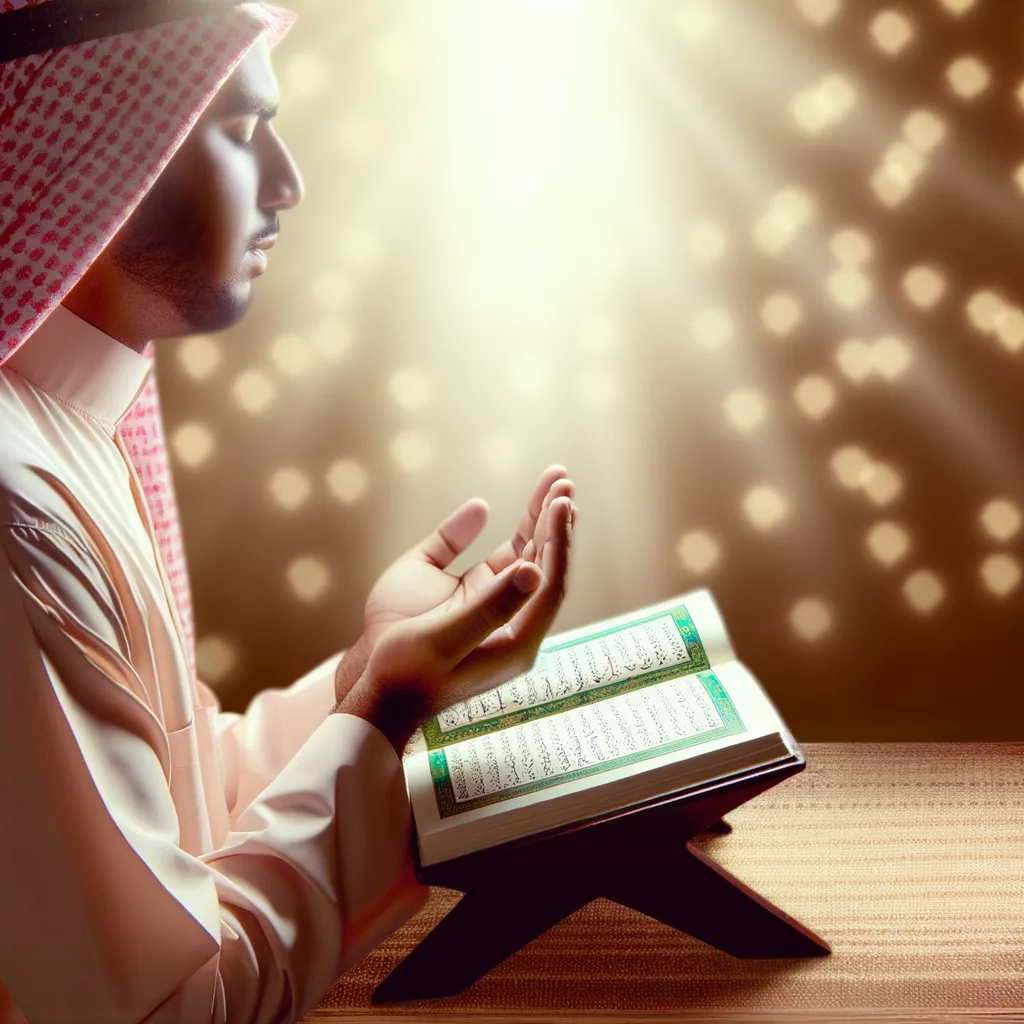
Can we really learn to repent sincerely without grasping the depth and beauty of the language in which the Qur’an was revealed? For anyone wondering about the meaning of tawba, of returning to Allah after a mistake, a lapse or a trial, the heart feels a desire for intimate transformation: to return to what matters most, to purify one’s soul, to taste the mercy of Allah and to reconnect with His light. But how can we give repentance in Islam its full spiritual dimension, without settling for words, passing regrets or mechanical routines? How can repentance become a true path of inner rebirth, anchored in the practice of Islam, living prayer, patience, gratitude and hope?
This is where learning Arabic takes on its full meaning. Not as a mere skill, but as a key to drawing sincerely closer to Allah. For the Qur’an in Arabic, in its original beauty, offers nuances, promises and gentleness that go beyond translation; every letter recited with tajwid, every invocation whispered in the language of the Prophet, becomes a direct bridge to the Divine Essence. Immersion in Arabic then transforms the act of repentance into a living, profound experience, in which reading the Qur’an, memorising and meditating on its verses, du’a and dhikr will gradually reveal the power of mercy and the strength of forgiveness.
At a time when the practice of Islam and Muslim spirituality are sometimes weakened by routine, social pressure or distance from the community, committing to learning literary Arabic, without depending on translation, becomes an act of will and of love of Allah; it also means rediscovering the authentic bond with the Sunna, the sira of the Prophet and the companions, drawing from the source of the tradition and understanding the Qur’an as it was revealed. It also allows us to live the great spiritual dimensions of Ramadan, prayer in Islam, dhikr and gratitude, feeling every word, every breath.
This journey of sincere repentance, the fruit of immersion in Arabic, touches every aspect of the believer’s life: purification of the heart, strengthening of faith, its impact on the Muslim family, the education of children, community solidarity and even the quest for inner peace. It is an invitation to turn a new page, to grow spiritually and to discover, through the science of hadith, tafsir, fiqh or the poetry of invocations, the full flavour of spiritual well-being and divine mercy.
In this article, you will discover how sincere repentance, illuminated by an intimate understanding of the language of the Qur’an, can transform your life, your prayer and your relationship with Allah, and how immersion in Arabic opens the way to an authentic, profound and luminous Islamic spirituality.
Understanding repentance in Islam: tawba, sincerity and returning to Allah in the light of the Qur’an and the Sunna
Repentance, or tawba, holds a central place in Islamic spirituality. Understanding repentance in Islam goes beyond simple regret for past mistakes: it is a genuine self-examination, a sincere return to Allah, driven by Muslim faith and the desire to purify the heart. The Qur’an in Arabic uses the term tawba to describe this inner movement, this journey of the heart that leads from failing to making amends, from straying to the straight path traced by the sunna and the teachings of the Prophet. Sincerity in Islam begins here: daring to acknowledge one’s weakness, placing one’s trust in divine mercy, and forming an authentic intention to change. The companions of the Prophet and the ahl al-bayt illustrated this humble journey through their lives, passing down through the centuries the science of hadith and the lessons of the sira of the Prophet on the virtue of repentance. When we deepen our reading of the Qur’an, it becomes clear that repentance is continually encouraged and its fruits abundantly mentioned: purification of hearts, elevation of spiritual rank, and the opening of the doors of tranquillity and inner peace in Islam. Certain verses, in literary Arabic, reveal the beauty of divine forgiveness, which only immersion in Arabic allows us to grasp in all its depth. Learning Arabic then becomes much more than a linguistic tool: it opens direct access to the tafsir of the Qur’an, to the purity of Islamic invocations and to khushu in prayer, by understanding every word of salat without translation. Tawba thus takes root in a living understanding of the Qur’anic message, nourishing the practice of Islam and gratitude towards Allah, and bringing every believer closer to a balanced, peaceful Muslim spiritual life turned towards the light of forgiveness and the love of Allah.
Immersion in Arabic: a natural path to grasp the depth of repentance through reading the Qur’an and tajwid
Immersion in Arabic opens a subtle but powerful door to a deep understanding of repentance – tawba – as taught by the Qur’an and illustrated in the sunna of the Prophet. When we commit to learning Arabic, especially through immersive methods that avoid systematic translation, we begin to listen to, read and meditate on the very words revealed by Allah. This direct exposure to literary Arabic, the Arabic of the Qur’an, allows us to feel intimately spiritual notions such as sincerity in Islam, patience, gratitude towards Allah and the transforming power of repentance.
When learning to read the Qur’an in Arabic, even as a beginner, every ayah about tawba gains in intensity: expressions of pain and hope and the promise of divine forgiveness resonate in their original form, unfiltered and unsimplified. Regular practice of tajwid while reading the Qur’an, with all its demand for precision and beauty, gradually shapes the believer’s heart: the effort to pronounce correctly, slowly, with khushu – deep focus in prayer – gives repentance a lived flavour rather than one simply understood intellectually.
The journey of immersion in Arabic is not only about learning words; it invites us to taste the inner music of the sacred text, to feel the subtle difference between tawba and maghfira, and to grasp the richness of dhikr and du’a in traditional Islamic invocations. Memorising the Qur’an, even just a few surahs, allows us to carry within us calls to Allah, to repeat them in salat or during fasting in Islam, and to meditate on them during the Night of Decree – laylat al-qadr – or at Friday prayers.
This natural path, which unfolds without the detour of translation, also allows us to encounter the sciences of hadith, the sira of the Prophet and the wisdom of the companions in a brighter light: every account of sincere tawba, every exhortation to patience in Islam or to forgiveness then stands in its original context, living, vibrant, imbued with humility and hope. Learning Arabic in this way, within the practice of Islam, means transforming every reading of the Qur’an and the sunna into a living experience of returning to Allah, where every word read or recited becomes a renewed prayer, a step towards inner peace and the love of Allah.
Memorising and meditating on the Qur’an: strengthening your faith and purifying your heart by embracing literary Arabic without translation
When we seek to repent sincerely and draw closer to Allah, memorising and meditating on the Qur’an become essential pillars for strengthening faith and purifying the heart. Learning Arabic, especially literary Arabic, brings a new dimension to Islamic spirituality, because it allows us to grasp the deep meaning of the verses without going through the barrier of translation. Immersion in Arabic is like stepping directly into the light of the divine message: every word, every sound carries the wisdom and gentleness of the Qur’an in Arabic. By learning Arabic without translation, the believer comes as close as possible to the original language of Allah and the Prophet, bringing to life their reading of the Qur’an, their memorisation of the Qur’an and their meditation (tafakkur). It is also by practising the art of tajwid according to the sunna that we feel connected to the prophetic tradition, to the science of hadith and to the legacy of the companions of the Prophet and the ahl al-bayt, who were all steeped in Qur’anic Arabic.
Reading and memorising the Qur’an in its original language is not limited to the intellect; it nourishes the heart and soul, fostering khushu in prayer and sincerity in Islam. It is a direct path to gratitude towards Allah, to repentance in Islam (tawba), to patience in Islam and to steadfastness in the Muslim faith, because every verse learned becomes a daily companion that recalls divine mercy and guidance. Understanding the Qur’an directly in Arabic opens a door to the wisdom of the scholars of Islam – centuries of Islamic studies at Al-Azhar, Qayrawan and Zaytouna – and lets us immerse ourselves in the depth of the tafsir of the Qur’an, the hadiths, the sira of the Prophet and the whole of Islamic civilisation.
More than a simple linguistic exercise, learning Arabic through immersion invites a living meditation in which every recitation, every dhikr, every invocation (du’a) resonates in the heart, purifying the intention and rekindling the love of Allah and of the Prophet. This approach brings inner peace, strengthens spiritual well-being and helps us anchor ourselves in the practice of Islam, in salat as well as in the high points of Ramadan or hajj. It also brings deep unity within the Muslim community, bringing together children, families, young people and adults around a shared heritage, passed down across borders and eras. Memorising in Arabic without translation, far from being a difficulty, thus becomes a source of joy, serenity and light, a simple and constant act that embodies the sincerity of tawba and the hope invoked at every Friday prayer as in the most intimate moments of spiritual life.
Growing spiritually: the impact of invocations, dhikr and the practice of repentance on life and the Muslim community
At the heart of Muslim spiritual life, invocations and dhikr give rhythm to existence, instilling with every breath the remembrance of Allah and a deep serenity. Assiduous practice of dhikr, sincere du’a and tawba – repentance in Islam – shapes not only the individual soul but also strengthens the cohesion of the Muslim community. To truly repent is to acknowledge one’s failings with fervour and humility, then to turn to the Most Merciful in the hope of purification and a new beginning. This dynamic of constantly returning to Allah transforms the heart, cultivates patience in Islam and increases sincerity in Islam, until the believer is anchored in deep gratitude towards their Creator and in love of Allah and love of the Prophet.
Learning Arabic plays a major role here: understanding the Qur’an in Arabic, grasping the beauty of tajwid, and accessing the true meaning of dhikr and Islamic invocations without translation give spiritual practices a unique flavour and intensity. When, in salat, we meditate on the deep meaning of the verses recited in literary Arabic, khushu in prayer reaches a level of concentration rarely equalled. Memorising the Qur’an, studying the tafsir of the Qur’an, knowledge of hadith and the science of hadith, the sunna, the sira of the Prophet, as well as the history of the companions of the Prophet and the ahl al-bayt, become inexhaustible sources of inspiration and guidance. This is how, through immersion in Arabic and the practice of repentance, individuals do not only transform themselves but also weave bonds of brotherhood, Islamic solidarity and community mutual aid. The home, the Muslim family, Muslim youth and the entire community are then built around a living, awakened Islamic spirituality, turned towards excellence of conduct (akhlaq) and inner peace in Islam. This dynamic fills the community with spiritual light, making every sincere repentance and every invocation a pillar of personal and collective renewal, in the service of spiritual well-being, progress and mercy within Islamic civilisation.
Further reading: discover our programme for learning to read Arabic (adults), or read “Learning Arabic and living the last ten nights of Ramadan” and “Learning Arabic with Surah Al-Kahf and its Friday reading“.
Conclusion
The path of sincere repentance, as traced by the mercy of Allah in the Qur’an and the Sunna, is above all a return to our purest essence. Deepening tawba is not an isolated episode, but a continuous inner adventure that shapes every dimension of Muslim life, weaving humility, patience, sincerity and gratitude towards Allah through our sometimes chaotic lives. In the light of the Qur’an in Arabic and through the moving accounts of the companions of the Prophet, the ahl al-bayt and the scholars of Islam, repentance in Islam takes on a unique depth and colour, vibrant with meaning and hope.
Learning Arabic and immersing yourself in the original language of the Qur’an without depending on translation opens the door to a renewed, subtle and authentic understanding of Islamic spirituality. It offers your heart the melody of tajwid, the flavour of reading the Qur’an, the intimacy of memorisation and the richness of tafsir passed down through the centuries. Attentive practice of salat, inspiration drawn from du’a, developing khushu in Friday prayer or daily prayer – everything takes root and flourishes as you progress in literary Arabic, a sacred language, the vehicle of the divine and of the Islamic heritage.
In this quest, learning Arabic becomes much more than an intellectual exercise: it becomes a living bridge to the deep meaning of tawba and of the Muslim faith, a way of absorbing the subtleties of dhikr and the nuances of the Islamic invocations that have nourished the souls of generations of Muslims. It allows spirituality to be anchored in the life of the Muslim community, strengthens Muslim identity, passes this treasure on to Muslim youth, and nourishes the love of Allah and the love of the Prophet through the language in which they were expressed.
By meditating on the Qur’an and immersing ourselves in the sira of the Prophet and the science of hadith, we discover that patience in repentance, modesty in the practice of Islam and gratitude in daily life form the royal road to inner peace in Islam, spiritual health and authentic well-being. These are the qualities that give meaning to every Ramadan, every fast, every invocation, every act of worship, and that make the history of Islam, Islamic culture and halal trade a living civilisation, shaped by mercy.
No repentance is ever defeated before the clemency of Allah, and every word of the Qur’an resonates as renewed proof of His closeness. Committing to learning Arabic, tasting immersion in literary Arabic and meditating constantly on the wisdom of the Sunna means drawing closer to the One who welcomes every sincere return, mends every broken thread and illuminates every darkness of the heart. Thus Muslim spiritual life, in its richness and diversity, becomes an inexhaustible source of renewal, patience, peace and hope. For above all, learning Arabic and integrating the depth of repentance enrich, soothe and transform our existence, opening the way to an invaluable closeness to our Creator.



