
Learning Arabic is much more than mastering a language: it opens a subtle door to Islamic spirituality, to culture, to prayer and to a deep understanding of the Qur’an in its most authentic form. And there is an art, silent and luminous, that connects the eye, the hand and the heart to the very essence of Islam: Islamic calligraphy.
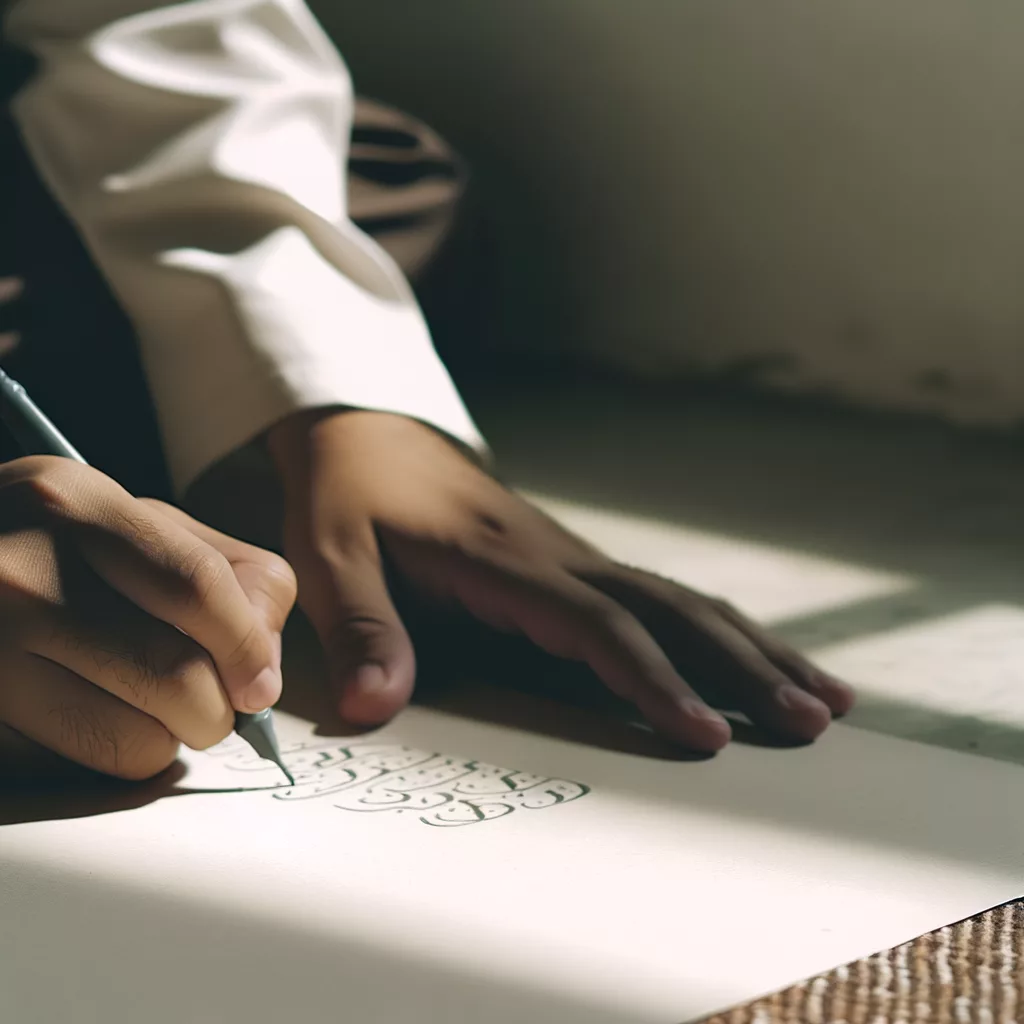
Picture yourself, brush or qalam in hand, tracing a letter, a word, a verse, while immersing yourself in the sacred rhythm of sounds and shapes. You are not simply writing; you are living an Arabic immersion. Every gesture becomes an invocation, and every line carries the spirituality of those who, since the first companions of the Prophet, sought to write down and pass on the Word of Allah with beauty. Far from being mere ornament, Islamic calligraphy is a living experience — a bridge between learning Arabic, meditating on the meaning of the Qur’an, and awakening the Muslim faith.
If you want to create this space of awakening, introduce children or adults to sacred writing, give flesh to the memory of the Qur’an in Arabic and guide others towards the love of Allah through the beauty of the letters, then running an Islamic calligraphy workshop becomes a true act of transmission and spiritual well-being. It is a different way of passing things on: not through word-for-word translation, but through sensitivity, patience and the inner light that has stirred the Muslim community for generations.
This article will guide you through every step, with practical advice, so that the practice of calligraphy becomes a source of immersive Arabic learning, Islamic education, love of the Prophet, and connection to dhikr and the recitation of the Qur’an. You will find teaching principles suited to all ages, drawn from the Islamic tradition and open to the diversity of today’s practices. Exploring calligraphy offers everyone — children, Muslim families, brothers or sisters in Islam, converts or the simply curious — a soothing way into the science of hadith, the writing of the Qur’an, the tafsir of the divine text, the beauty of prayer (salat) and the vitality of our Muslim identity.
In the humble, quiet setting of a workshop, learning Arabic takes on its full meaning: free from the fear of making mistakes, nourished by sincerity, moderation, gratitude and patience — values dear to the Islamic tradition. Calligraphy then becomes not an end in itself but a path towards inner peace, wonder and the love of Allah, carried by every stroke of ink that links heaven and earth.
Islamic calligraphy, an art in the service of spirituality: diving into Arabic immersion and understanding the Qur’an
Islamic calligraphy transcends the simple artistic gesture: it embodies a sincere quest for beauty, patience and Islamic spirituality. Taking up the qalam means reconnecting with the age-old tradition of the scholars of Islam, the companions of the Prophet and the ahl al-bayt, for whom the revealed word of the Qur’an in Arabic was the beating heart of their lives, their practice of Islam and their invocations. Training your hand to trace the letters of literary Arabic means immersing yourself fully, without the detour of translation, in the sacred dimension of every word and every verse, and tasting the miracle of the divine message in its original language. This living, sensory Arabic immersion turns learning Arabic into an experience in which gesture, sight and intention blend with understanding the Qur’an, with the tajwid of Qur’an reading, with memorisation and the tafsir of the Qur’an, and even with the science of hadith and the sira of the Prophet, all of which were preserved through this script. To practise calligraphy is thus to meditate on patience in Islam, sincerity of intention and the love of Allah nourished by contemplating His Word. It is to cultivate khushu in prayer (salat), and to engrave on your heart gratitude towards Allah, dhikr, repentance (tawba), inner peace and modesty. By introducing Muslim adults and children to this art, we extend the legacy of an Islamic civilisation that raised so high the study of Arabic, Islamic education, spiritual well-being, the transmission of the sunna and respect for Islamic culture. Islamic calligraphy then becomes a luminous gateway to a deeper, more authentic Muslim spiritual life, fully rooted in Arabic immersion and a subtle, direct understanding of the Qur’an, beyond words, in the very vibration of faith.
Islamic calligraphy is not limited to an aesthetic gesture: it is a living bridge to learning literary Arabic and to an immersion in Arabic, without translation, in the sacred world of the Qur’an and the tradition of the Prophet. Running an Islamic calligraphy workshop means offering much more than an artistic technique: it opens a door to understanding the Qur’an in Arabic, the sunna, the hadith, and also the sira of the Prophet and the stories of the companions and the ahl al-bayt. Every participant, young or adult, feels the emotion of writing the name of Allah or an Islamic invocation (du’a, dhikr) in the purity of the alif, the softness of the ra and the majesty of the lam – each letter carrying meaning, spirituality, patience and gratitude towards Allah. By guiding the hand step by step across the paper, we pass on a calm, meditative and deep relationship with the sacred language. Calligraphic forms then become an ideal support for memorising the Qur’an, revising the rules of tajwid, exploring the richness of tafsir or reflecting on the practice of Islam in all its beauty. A well-run workshop encourages concentration, sincerity (ikhlas) and khushu in prayer, because calligraphy invites inwardness and contemplation. It teaches patience in Islam, modesty and respect for tradition, while encouraging Islamic solidarity and exchange between generations. It can also become a bridge between the history of Islam, Islamic culture, Muslim identity and daily life — a unique opportunity to weave a living link between Islamic education, Islamic art and the Muslim faith. Through learning calligraphy, Arabic comes alive naturally, like an inner light spread by centuries of Islamic civilisation, calling the heart to inner peace and the love of Allah.
Preparing and running an introductory workshop: passing on literary Arabic through artistic practice and learning without translation
Running an introductory Islamic calligraphy workshop means offering much more than an artistic discovery: it means passing on the richness of literary Arabic in a natural, lively and spiritually nourishing way. The workshop begins in an atmosphere of Arabic immersion, where every stroke and every curve becomes a first step towards learning Arabic without translation, directly linking hand, eye and heart to the deep meaning of the letters. You explain the origin of the scripts, the sacred place of calligraphy in the history of Islam, its role in preserving the Qur’an in Arabic and the hadiths, and its importance in the science of tafsir of the Qur’an and the sunna.
During the workshop, participants experience literary Arabic in a concrete way – by tracing the words of Islamic invocations, of the salat or of patience in Islam, they intuitively absorb sounds, rhythms and shapes, long before worrying about translations. Artistic practice then acts as a bridge between visual beauty and the deep meaning of the words, allowing them to feel Arabic as a whole. This immersive approach recalls the way the companions of the Prophet learned: through oral repetition, memorising the Qur’an, and meditating on shapes and pronunciation – cultivating their connection with the sacred text and Islamic spirituality.
Far from conventional school methods, the workshop invites participants to live the language as an art, both an expression of the Muslim faith and a cultural heritage. You share anecdotes about the role of calligraphy in Islamic civilisation, from the Andalusian caliphate to Islamic universities such as Al-Azhar or Zaytuna, and encourage each participant, child or adult, to link their gesture with reading the Qur’an, dhikr and the awakening of gratitude towards Allah. This introduction thus lays the foundations for a living, dynamic way of learning Arabic, open to culture and deeply connected to the practice of Islam and spiritual well-being, naturally sparking the desire to keep discovering the language and the prophetic tradition.
Fostering the connection between writing, the Muslim faith and reciting the Qur’an in Arabic: calligraphy as a tool for Islamic education
Islamic calligraphy is not limited to visual art: it acts as a living bridge between gesture, heart and the Muslim faith. When a workshop opens onto the beauty of writing, it actually opens the door to an Arabic immersion that goes beyond simply copying letters. Every stroke and every curve traced with intention is an opportunity to deepen your connection with Islamic spirituality, just as the believer meditates on the verses of the Qur’an in Arabic. The very act of writing divine words strengthens the presence of dhikr, encourages the practice of gratitude towards Allah and fosters renewed sincerity in learning Arabic.
As the workshop goes on, participants discover that literary Arabic is not only a language to learn in order to understand the Qur’an; it becomes the support for reading the Qur’an, memorising the Qur’an and internalising tajwid. Calligraphy offers a space where the inner voice accompanies the brush: recitation, even whispered, harmonises with the rhythm of writing, and the deep meaning of the text springs forth more naturally than through translation alone. For many, it is the subtlest way to learn Arabic without translation, by immersing themselves in the aesthetics and dynamics of the sacred text.
This sensory rooting has a profound impact on the Islamic education of Muslim children, but also on the spiritual journey of adults and Muslim families. The experience of calligraphy lets everyone live Arabic as a living language of faith, of Islamic invocations, of the formulas of du’a and tawba, and even approach the traditional sciences: tafsir of the Qur’an, the science of hadith, the sira of the Prophet, and the stories of the companions of the Prophet and the ahl al-bayt. The stories of Islamic civilisation, from the Andalusian caliphate to Islamic universities such as Al-Azhar, are reflected at the tip of the qalam and in every calligraphed page.
Islamic calligraphy thus becomes an act of transmission, almost sacred, in which the hand that writes teaches as much as the mouth that recites. Practising calligraphy means cultivating patience in Islam, developing khushu in prayer, finding inner peace in Islam and honouring the prophetic tradition. It is also, in a way, a daily reconnection with love of the Prophet and the love of Allah, at the very heart of daily life, in the spiritual routine of the twenty-first-century Muslim. Workshop after workshop, this approach transforms not only the practice of Islam but Muslim identity itself — a reminder that every word, every name of Allah beautifully traced, carries a breath of spiritual well-being and community kindness.
At the end of this Islamic calligraphy workshop, one thing becomes clear: writing the Arabic letter means immersing yourself in a world far beyond aesthetics. Every stroke becomes an open door to the heart of Islamic spirituality, a way to learn Arabic differently, letting hand, eye and soul converse. Here, learning Arabic takes on the colours of the most natural immersion, without translation or barriers, living every word and every verse of the Qur’an in Arabic as a sensory and spiritual experience, an embodied approach.
Running a workshop means offering a space where literary Arabic is no longer an abstraction or an obstacle but a living material, accessible to all who wish to understand the Qur’an, deepen their prayer in Islam, cultivate khushu or savour the subtleties of tajwid. It means passing on the keys to taste the auditory and visual beauty of Qur’an recitation and to strengthen the intimate bond with the sunna, the science of hadith and the heritage of the companions of the Prophet and the ahl al-bayt. Calligraphy then becomes a concrete tool of Islamic education, carrying as much faith as history, revealing the greatness of Islamic civilisation, the richness of Sufism as well as the rigour of fiqh and the madhahib.
Through writing, the Muslim child, young people searching for identity, the Muslim family or the convert eager to learn Arabic without translation rediscover the deep meaning of dhikr, invocations and du’a, and the gentleness of tawba. The art of calligraphy becomes a shortcut to patience, gratitude towards Allah, love of the Prophet, repentance and moderation, and also a vehicle for respectful dialogue in society, in the mosque or within the Muslim community.
Finally, running an Islamic calligraphy workshop means weaving bonds of brotherhood and passing on a heritage. It means honouring the history of Islam, the scholars of every era and universities such as Al-Azhar or Zaytuna, and anchoring the practice of Islam in a calm spiritual routine, between Eid, Ramadan and sadaqa, between ecology, solidarity and the search for inner peace. Islamic calligraphy is therefore not just an art: it traces the invisible thread that links language, heart, faith and conscience, inviting everyone to take their humble place in the continuity of the Qur’anic light and to recognise the unique richness of learning Arabic through immersion, in order to grow in spirituality and humanity.
Further reading: discover our training to become an Arabic teacher, or read “Learning Arabic with the imam: his role in the Muslim community“.



