
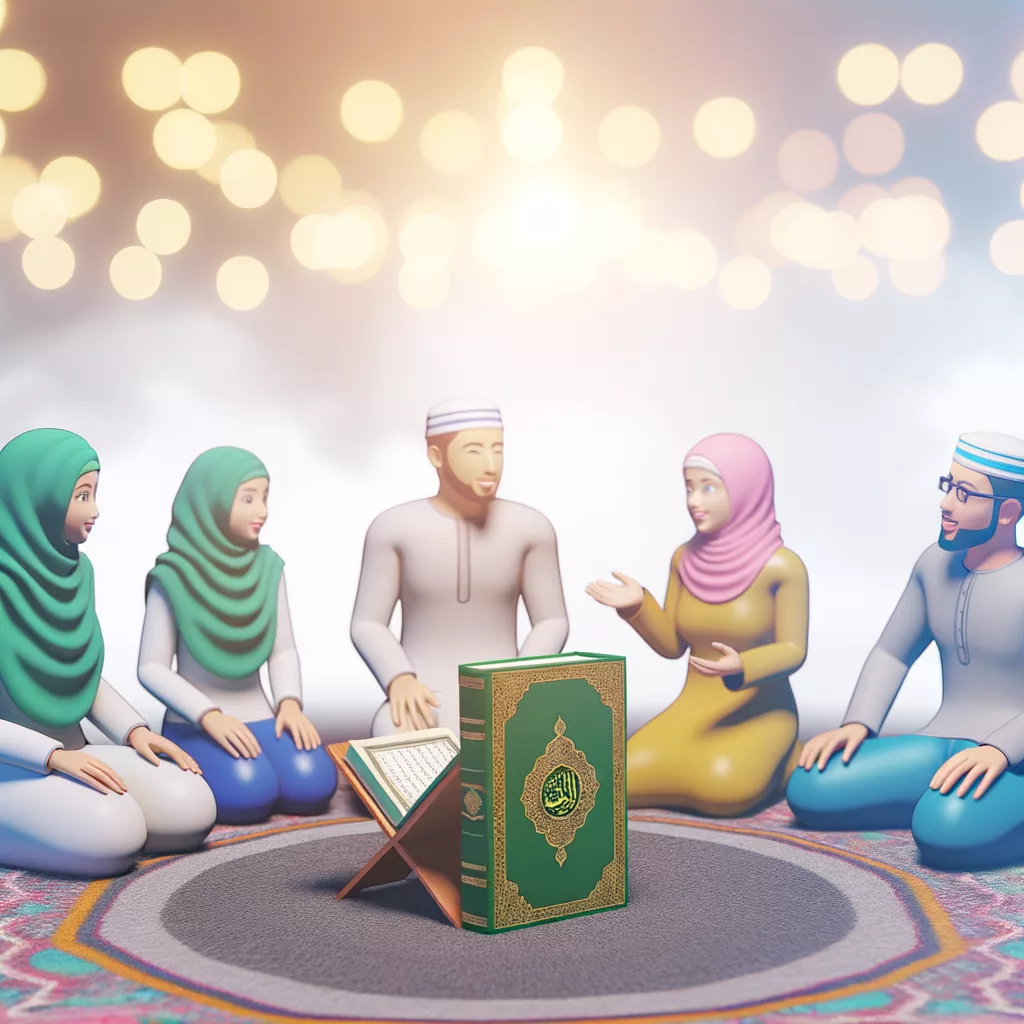
At the heart of every Muslim home, a discreet treasure shapes peace, trust and love: consultation, or shoura. Much more than a simple exchange of words, shoura expresses a prophetic wisdom that has irrigated the life of the Muslim family and couple since the first companions of the Prophet. It symbolises the ability to listen, to understand and to unite hearts around a shared decision, rooted in the tradition of the Qur’an in Arabic, the sunna and the sira of the Prophet, a living heritage of Islamic civilisation. Yet in a world marked by hasty judgements and the tumult of differences, rediscovering this practice can become a challenge. We then lose part of that Islamic spirituality, that inner peace and that khushu in prayer which radiate through the family and the education of children in Islam.
This is where a subtle but fundamental link emerges between learning Arabic, immersing yourself in the language of the Qur’an without translation, and reconnecting with authentic shoura. Learning literary Arabic is not limited to reciting or memorising tajwid, nor to simply reading the Qur’an; it opens the door to a deep understanding of the values of consultation, kindness and solidarity on which the Muslim faith is founded. Diving into the tafsir of the Qur’an, studying the science of hadith or meditating on love of the Prophet in the original Arabic means absorbing the spirit of dialogue and mercy recommended by the practice of Islam. This turns shoura into a living bridge to gratitude towards Allah, patience in difficulties, the sincerity of every family prayer, balance in Islamic education and the strength of Muslim identity in a plural world, like that of Muslims in France.
Through this exploration, we will understand how shoura, nourished by immersion in Arabic and an authentic understanding of the Qur’an in Arabic, becomes a foundation for the Muslim couple, the Muslim family and beyond, for the whole community. This living method invites us to reconnect with spirituality and to build relationships on Islamic ethics and community mutual aid, drawing inspiration from the prophetic model through to the wisdom of the history of Islam and the Andalusian caliphate. Let us enter together into this dimension where every family conversation, every prayer and every supplication becomes an act of love for Allah and the Prophet, a celebration of solidarity and consultation in Islam, and a foundation for the future of children’s education and the vitality of our community.
Shoura at the heart of the Muslim couple: how learning Arabic and the Qur’an strengthens family dialogue
Within the Muslim couple, shoura – that sincere and respectful consultation recommended by the Qur’an and the Sunna – lays the foundations of a deep harmony and a union based on trust. When husband and wife commit together to learning Arabic and understanding the Qur’an in Arabic, they discover a common language that goes far beyond words. Immersion in Arabic, without going through translation, lets them feel directly the singular beauty of literary Arabic and access the divine message of the Sacred Book with an almost original freshness. Through reading the Qur’an, memorising surahs, perfecting tajwid or exploring tafsir, every moment of shared study becomes an opportunity for kindly consultation and authentic dialogue. Discussing the hadiths and the wisdom of the companions of the Prophet and the ahl al-bayt, or revisiting the sira of the Prophet together, nourishes the family’s Islamic spirituality and roots the Muslim faith in real life. This dialogue, enriched by the vocabulary, concepts and values drawn from Qur’anic Arabic, refines the practice of Islam, enhances salat, deepens khushu in prayer and inspires a peaceful Islamic education for Muslim children. Learning Arabic together not only opens the doors to understanding the Qur’an, but also strengthens the bond of the couple who, guided by consultation (shoura) and listening, weave sincerity, patience, gratitude towards Allah and love of the Prophet into daily life. The home then becomes a place where shoura is not only about resolving difficulties, but also about jointly building a strong Muslim identity, rooted in the living beauty of the revealed language and open to Islamic culture, history, spirituality and ethics.
Immersion in Arabic and prophetic wisdom: drawing on the tafsir of the Qur’an and the sunna for family consultation
To feel deeply the beauty of the consultation (shoura) recommended by the Prophet, you need only open the Qur’an in Arabic and immerse yourself in the account of the Prophet’s family life. The Qur’anic verses that speak of consultation shine with their full light when approached through an attentive reading of the Qur’an, without the mediation of translation, absorbing the richness of literary Arabic. This direct link with the source reveals the subtle nuances of the word choura, the delicacy of the rahma (compassion) that emanates from it, and the relational warmth encouraged by the sunna. Learning Arabic gives you the means to contemplate, in the tafsir of the Qur’an and through exegesis, the way the Prophet consulted his wives, his children, his companions and sometimes even the youngest members of the Muslim family, with sincere listening and a concern for fairness.
Immersion in Arabic thus changes our view of family relationships: we discover that shoura is not a simple discussion, but a science of the heart, an akhlaq (noble conduct) deeply rooted in our Muslim faith. Authentic hadiths, studied through the science of hadith, illustrate how family decisions were made in serenity and gentleness. Every word chosen by the Prophet in Arabic carries a universal wisdom, revealing that consultation invites inner peace, patience in Islam and gratitude towards Allah for the blessing of a united family. When learning Arabic happens without translation, carried by attentive listening to the verses during prayer in Islam or by memorising the Qur’an with tajwid, shoura comes to life: it becomes a luminous feature of the practice of Islam, a discreet pillar of Muslim spiritual life and an art of kindly speech in the couple or with the children.
In the Prophet’s household, consultation was like pure water irrigating the root of the Muslim family: his wife shared her opinion, the children expressed their wishes, and the companions of the Prophet served as models of active listening and humility. Learning Arabic and immersing yourself in the Qur’an in Arabic means receiving these lessons in the heart, perceiving their strength and gentleness, and raising consultation to the rank of an act of faith and tenderness. This prophetic wisdom breathes into the Muslim family and couple the ability to go through trials with sincerity, to avoid anger, to anchor patience and to preserve the inner peace guaranteed by the love of Allah and the Prophet. So shoura becomes a daily light in our homes, amplified by the living echo of the revealed language and nourished by the whole Islamic tradition.
Islamic education, family prayer and the practice of shoura: forging strong bonds through authentic understanding
At the heart of the Muslim family, Islamic education finds its breath when it relies on sincere listening, consultation and shared spiritual practice. Shoura, or consultation, makes it possible to anchor genuine dialogue in the home, where everyone – parents and children alike – expresses themselves, asks questions, understands and learns. This collective approach, when it is part of learning Arabic and discovering the Qur’an in Arabic, fosters a unique immersion in which the divine word is no longer foreign but a source of meaning and peace. Family prayer sessions and reading the Qur’an together, even haltingly at first, then become living moments where literary Arabic, memorising the Qur’an or perfecting tajwid patiently weave family unity. Discussions about the tafsir of the Qur’an or the hadiths, real applications of shoura, not only awaken the Muslim faith but forge a shared awareness, steeped in the sunna and the history of the companions of the Prophet. This regular practice of consultation paves the way to an authentic understanding of the practice of Islam: listening, humility and sincerity in Islam are not passed on by command but by example, in these exchanges where mutual respect and kindness take root. By cultivating the habit of discussing questions of daily life or Islamic ethics, parents and children together shape a solid, serene Muslim identity open to Islamic culture. Through immersive learning around the Qur’an, dhikr or Islamic supplications, the family experiences a living spirituality; every prayer in Islam, every Friday prayer, every Ramadan thus becomes an opportunity to strengthen these bonds woven by consultation and enlightened understanding.
From the Muslim family to the community: Islamic spirituality, solidarity and the heritage of consultation in the history of Islam
The Muslim family, as the founding cell of Islamic society, has always been seen as reaching far beyond the private sphere: it is a crucible where solidarity is forged, where Islamic spirituality takes root and where the living heritage of consultation (shoura) is passed on. In the history of Islam, the principle of consultation was first cultivated within the home, giving rise to generations whose strength lay in their ability to talk, to listen and to reflect together before deciding. The Companions of the Prophet and the ahl al-bayt are its luminous models: they practised shoura in the family, and this model radiated across the whole community. Islamic spirituality never separates inner life from social commitment: the Qur’an in Arabic is full of verses in which believers are invited to consult one another with patience in Islam, sincerity in Islam and gratitude towards Allah. Understanding the Qur’an in literary Arabic, immersing yourself in its teachings without the filters of translation, means receiving directly this universal message that links the family, the neighbourhood and the community in an unbroken chain of Islamic solidarity and community mutual aid.
Through learning Arabic, immersion in Arabic and studying the tafsir of the Qur’an or the hadiths in Arabic without translation, those who seek to live the practice of Islam fully discover that shoura irrigates every sphere of collective life: from the Muslim family to the Muslim community, from the Muslim couple to the Andalusian caliphate or the great Islamic universities such as Al-Azhar, Zaytouna or Qayrawan. The accounts of the sira of the Prophet and of the scholars of Islam, and the treasures of Islamic civilisation, reveal that the ability to consult, to debate and to take decisions together remains the secret of prosperous societies, able to stand the test of time and to defend an authentic Muslim identity, open to interfaith dialogue, solidarity and inner peace. Today, learning Arabic, committing to memorising the Qur’an or practising prayer in Islam with khushu means reconnecting with this living tradition: that of a deeply community-minded Islam, where every voice counts and where mutual aid, respect and patience weave the fabric of a civilisation in which family life illuminates collective life, for the spiritual well-being of all.
Consultation (shoura) is not only a moral principle or a theoretical heritage of Islamic civilisation: it is the living sap, the peaceful but constant breath that unites the Muslim couple, strengthens the family and gives the community its cohesion. Throughout this article, we have seen how authentic recourse to shoura, enlightened by learning Arabic and a deep understanding of the Qur’an in Arabic, anchors marital and family relationships in trust, wisdom and mercy.
Choosing the path of immersion in Arabic means opening the door to a more sincere and richer dialogue, where every word, every piece of advice, every du’a shared as a family takes on a new dimension, as close as possible to the spirit of the Prophet and his companions. It means going beyond mere translations to connect with the intention of the Qur’an, dive into the sunna, grasp the sira of the Prophet, and feel, in family consultation, the same energy that drove the greatest generations in the history of Islam. Understanding and tasting the tafsir of the Qur’an, mastering tajwid, listening to the narration of hadiths: all this nourishes the practice of shoura in the intimacy of the home, during prayer in Islam or in everyday conversations.
Islamic education, when carried by the language of the Book and a living Islamic culture, shapes hearts open to patience in Islam, sincerity, gratitude towards Allah, repentance and love of the Prophet. Consultation then becomes an act of worship, a path to inner peace, a way to express your thoughts gently, to listen with humility and to build with kindness the future of the Muslim couple and the Muslim family.
So, through the regular practice of shoura in marriage and in raising children in Islam, during the Friday prayer or at the great milestones of life (Ramadan, eid, pilgrimage), every member of the family helps to safeguard a heritage and to build a fulfilled Muslim identity. The whole Muslim community is strengthened, more united, more resilient in the face of contemporary challenges, from secularism in France to interfaith dialogue, from preserving Islamic culture to enriching an invigorating spiritual routine.
In the end, learning Arabic is not just acquiring a language: it is an education of the heart, a bridge to understanding, compassion and consultation. In every family conversation, every shared prayer, every recitation with tajwid, the breath of shoura invites us to live Islam in its depth, to cultivate inner peace, community mutual aid, patience and gratitude. For it is by weaving together the thread of listening, advice and consultation that the couple, the family and the community fulfil the ideal of Muslim spiritual life: moving forward, hand in hand, in the light of the Qur’an, towards peace, wisdom and excellence in human relationships.
Further reading: discover our online Arabic courses for adults, or also read “Learning Arabic to support a brother in difficulty” and “Learning Arabic on the roads of Islam and its travel rites“.



