
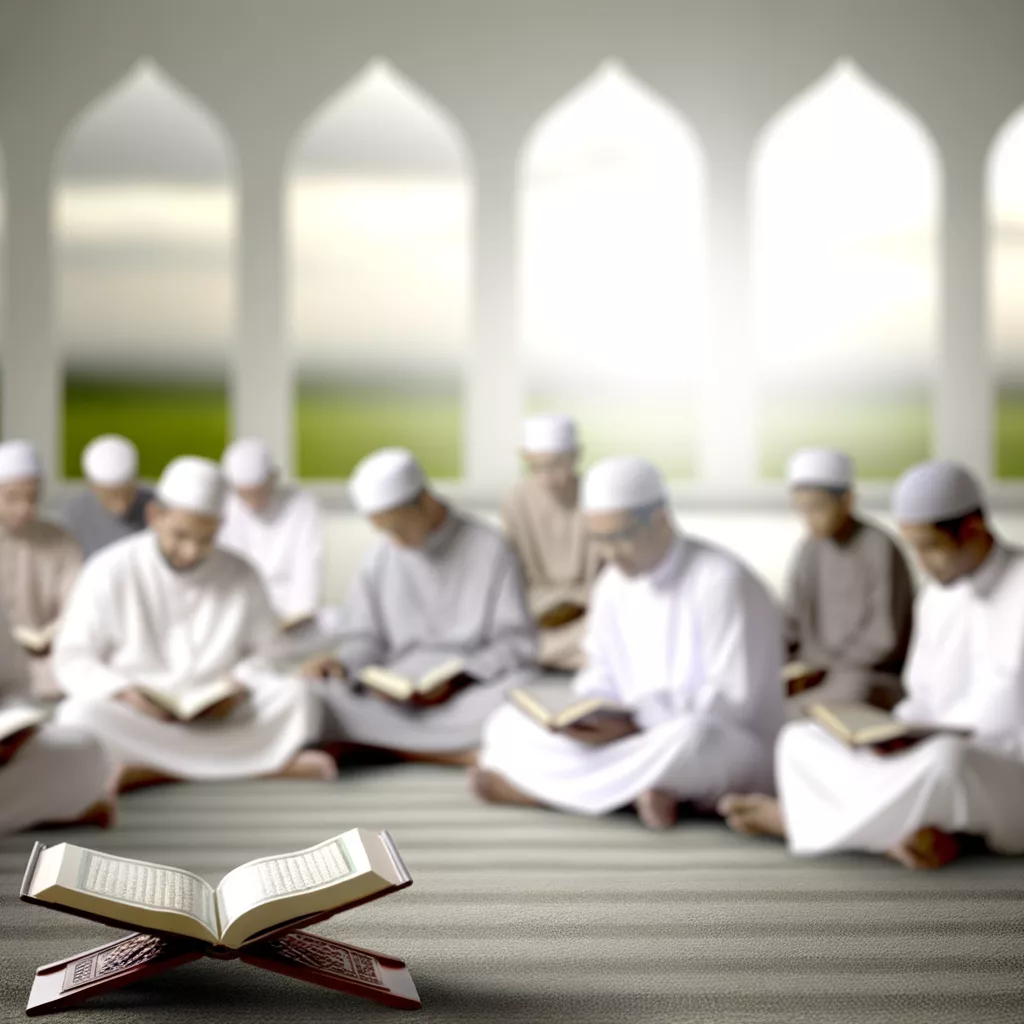
Learning Arabic is not just a matter of words, rules or grammar. For millions of Muslims and lovers of Islamic wisdom around the world, learning Arabic is like a return to the sources, an immersion in the living light of the Qur’an, the sunna and the authentic practice of the companions of the Prophet (PBUH). When you aspire to understand the Qur’an in Arabic, to savour the beauty of reading the Qur’an, to taste the depth of the invocations (du’a) or to feel the spirituality of the prayers (salat) with khushu, a secret takes shape: Arabic is not just a code to decipher, but a key that opens the door to a whole universe of meanings, tradition and closeness to Allah.
Over the centuries, the biography of the companions of the Prophet, those radiant figures known as the sahaba, has never ceased to inspire hearts thirsting for Muslim faith and knowledge. They who received the revelation in literary Arabic embodied the perfect model of immersive learning: attentive listening, active memorisation, living transmission, all without going through translation, but by absorbing the overall meaning of the sacred words and of the prophetic conduct. Their love of the Prophet (PBUH), their patience in Islam, their sincerity in the practice of Islam, their gratitude towards Allah and their tireless pursuit of the science of hadith and the tafsir of the Qur’an still form a beacon today for anyone who wishes to live Arabic as a spiritual and community experience.
Beyond vocabulary lists and textbooks, learning Arabic truly enters our lives when, following the example of the companions, it nourishes the heart and the mind: recognising in every verse the wisdom of the Creator, finding in the sira of the Prophet (PBUH) the breath of reform, finding in immersion in Arabic the echo of the first generations who built Islamic civilisation and passed on the treasures of hadith, fiqh and akhlaq through the ages. Understanding the Qur’an, the sunna and the life of the ahl al-bayt in the original language also means reconnecting with the strength of the Muslim community, renewing the bond with the Muslim family, inspiring Muslim youth and shaping one’s Muslim identity with rootedness and pride, in a world where Islamic culture still lights up inner paths.
This journey is not reserved for scholars, nor confined to Islamic universities such as Al-Azhar or Zaytuna. Every believer, every Muslim couple, every Muslim child, every person seeking inner peace or spiritual well-being can today make this path their own: living the learning of Arabic as an authentic immersion, in the exceptional light of the companions, to let the light of the Qur’an, prayer, dhikr and gratitude shine in their daily life, and to transform lastingly their relationship with Allah, with themselves and with the community.
Learning Arabic in the light of the companions of the Prophet: an authentic immersion for understanding the Qur’an and the sunna
At the heart of the Muslim faith, learning Arabic is far more than a linguistic skill: it is a door onto the universe of the Qur’an and the sunna. The companions of the Prophet (PBUH), whose sira illuminates every generation, were immersed in the richness of literary Arabic, without recourse to translation, living each revelation as an immediate light on their daily lives. Their example reminds us that understanding the Qur’an in Arabic, being initiated into tajwid, grasping the nuances of the tafsir of the Qur’an or diving into the science of hadith means reconnecting with the original vibration of the Revelation. Through immersion in Arabic, you do not merely read or memorise; you live inwardly every word of the reading of the Qur’an, every invocation of dhikr, every verse recited in prayer, seeking khushu and sincerity in Islam. The practice of Islam, from the Friday prayer to the morning invocation, takes on a new depth: that of true understanding, that of companionship with the Prophet and his family (ahl al-bayt) through the very words they heard. This bond with literary Arabic transcends mere learning: it sheds light on patience in Islam, gratitude towards Allah and love of the Prophet, and infuses Islamic spirituality from the Ramadan fast to the night prayers of Laylat al-Qadr. For Muslim families, the Islamic education of children, a couple’s spiritual routine or Islamic solidarity within the Muslim community take on their full meaning when they are rooted in the language of the Qur’an. Learning Arabic like the companions means choosing authenticity: accessing the purity of the message, tasting the beauty of dhikr, passing on Muslim identity and taking root in the history of Islam, from the Andalusian caliphate to contemporary scholars. Immersion in Arabic is not an end in itself, but the means of cultivating inner peace, spiritual well-being and light on the path of Allah, inspired by the living example of those who illuminated Islamic civilisation.
The living example of the companions of the Prophet: between the practice of Islam, Islamic spirituality and the quest for knowledge
Through the history of the companions of the Prophet (PBUH), every seeker of truth discovers the living radiance of an authentic practice of Islam, rooted in a deep Islamic spirituality and a constant thirst for knowledge. Theirs was not the life of passive witnesses to the revelation, but of passionate actors, present at every stage of the birth and rise of the Muslim community. From the first hearing of the message revealed in literary Arabic, the companions engaged in learning Arabic not as a mere linguistic matter, but as a sacred door to reading the Qur’an, memorising the Qur’an, tajwid and a refined understanding of the tafsir of the Qur’an. Immersion in Arabic — without translation, with all the weight of the original meaning — allowed them to taste the sweetness of the verses and to root the sunna and the science of hadith at the heart of their daily lives.
The sira of the Prophet and the accounts of the ahl al-bayt bear witness to their commitment to spreading the Muslim faith, whether through patience in Islam in the face of the trials of emigration and persecution, sincerity in Islam in worship, or gratitude towards Allah in the spirit of the Muslim community. The living practice of salat, with khushu in prayer, the Friday prayers, dhikr and Islamic invocations, nourished their Muslim spiritual life and made repentance (tawba) a compass for the heart. Their fasting in Islam — during Ramadan, on supererogatory days or on the nights of Laylat al-Qadr — was anchored in a collective and personal experience in which love of Allah and love of the Prophet gave meaning to every act, inscribed in Islamic ethics.
The transmission of knowledge, reflection on fiqh and aqida, Islamic education within the Muslim family, Muslim youth facing the challenges of their time: all of this shapes a living Islamic culture. The companions thus embody the timeless model of a Muslim identity, in which Islamic studies, Islamic conduct (akhlaq), Islamic solidarity, giving (sadaqa, zakat) and inner peace come together in the life of every Muslim, yesterday as today. Their example invites an authentic immersion in Arabic, in order to understand the Qur’an in Arabic, to live Islamic spirituality with strength and serenity, and to draw from the history of Islam a light to illuminate the community’s present.
Reading and memorising the Qur’an: the teachings of the sahaba on literary Arabic and the science of hadith
The companions of the Prophet (PBUH), timeless models of the Muslim faith, embodied love of the Qur’an and of literary Arabic in every aspect of their lives. For them, learning Arabic was not simply an academic exercise: it was a gateway to light, to the deep meaning of the divine message, and to the authentic practice of Islam. Their immersion in Arabic, entirely natural and free of systematic translation, allowed them to feel the power of the Qur’anic words, to be moved on hearing each verse and to express a living Islamic spirituality in prayer (salat), dhikr and Islamic invocations (du’a). This instinctive mastery of literary Arabic, pure and subtle, made direct understanding of the Qur’an in Arabic easier, as well as recitation according to the rules of tajwid and memorisation of the Qur’an, an inexhaustible treasure of guidance, patience in Islam and gratitude towards Allah.
The sahaba encouraged everyone to dive into reading the Qur’an and to taste its secrets through the tafsir of the Qur’an, by asking the Prophet about the overall meaning of the verses, but also by listening to his explanations. The science of hadith, just as central to the formation of the companions, also rests on a deep knowledge of the language and of the subtleties of prophetic speech. The extreme care the companions took in faithfully transmitting the sunna, and their precision in memorising and reporting the words and deeds of the Messenger, flowed from this immersion in literary Arabic. For them, living Islam meant becoming one with the Word and the Example, to the point of experiencing khushu in prayer, sincerity in Islam, patience, repentance (tawba) and love of the Prophet in daily life.
Over the generations, these noble teachings built an Islamic culture of listening, of deep meaning and of living practice, whether in the Friday prayer (jumu’ah), Ramadan, the celebration of Islamic festivals such as Eid al-Fitr and Eid al-Adha, or the experience of the hajj and Umrah. The natural assimilation of literary Arabic, passed on by word of mouth by the companions of the Prophet, the ahl al-bayt and the scholars of Islam, inspired a unique spiritual, educational and cultural heritage, from Andalusia to the great Islamic universities such as Al-Azhar and Zaytuna, and on to the mosques of Europe today. Immersing yourself in learning Arabic following their example means reconnecting with a tradition of attention, love and effort to understand the Qur’an in its original language, and to taste the depth of hadith, in order to illuminate the life of every believer and every Muslim family and to strengthen the contemporary Muslim community.
Community life and transmission: how the Islamic education of the companions inspires Muslim youth and the Muslim family today
The community life of the companions of the Prophet (PBUH) shines as a timeless model, as much for its strength as for the depth of its educational principles. Their daily life was marked not only by prayer and the collective practice of salat, but also by a sincere attachment to the transmission of the Muslim faith, to Islamic solidarity and to spiritual awakening. This constant interaction between learning, community mutual aid and love of the Prophet still nourishes Muslim youth and the Muslim family today, as they seek to harmonise Muslim identity with contemporary challenges, particularly in France and in the West.
At the heart of this tradition, we discover that Islamic education was not limited to memorising the Qur’an or simply knowing the hadiths. It was embodied in immersion in Arabic, in acquiring literary Arabic and above all in learning Arabic without translation, so as to taste the original flavour of the Qur’an in Arabic, feel the deep meaning of tajwid and dhikr, and live Islamic spirituality in all its freshness. The families of Medina, guided by the companions of the Prophet and the ahl al-bayt, instilled in their Muslim children a passion for the language, for the sunna and for the stories of the sira of the Prophet, but also for patience in Islam, sincerity, gratitude towards Allah, love of the Prophet and the constant search for inner peace.
Even today, the Muslim family can draw inspiration from these living models, in which every moment of daily life – from Islamic invocations to reading the Qur’an, from du’a to repentance in Islam, from shared meals to Ramadan evenings, from the Friday prayers to the joy of Islamic festivals such as Eid al-Fitr and Eid al-Adha – becomes an opportunity for education, for passing on Islamic ethics and for intergenerational dialogue around Islamic culture and the history of Islam. Muslim youth draw new strength from this heritage to face the challenges of Islamophobia, of laïcité and Islam, and of preserving modesty in Islam and Islamic conduct (akhlaq).
Following in the footsteps of the companions ultimately means cultivating moderation (wasatiyya), and encouraging kindness, solidarity, sadaqa, halal food, the fight against waste in Islam and every form of community mutual aid. This model of education, founded on lived example, lights the way to a deep Muslim spiritual life, in which learning Arabic and understanding the tafsir of the Qur’an and the science of hadith nourish every family, every mosque and every heart eager for light. These ancestral lessons, still relevant today, remind us that transmission is not reduced to mere instruction, but works first and foremost through brotherhood and spiritual radiance within the Muslim community and society as a whole.
Careful study of the biography of the companions of the Prophet, those guiding lights of the Muslim faith, offers inexhaustible inspiration to anyone who wishes to learn Arabic and immerse themselves in authentic Islamic spirituality. Their example reminds us that learning Arabic is never a mere technical or academic acquisition; it is rooted in a sincere aspiration to understand the Qur’an in Arabic, to taste the sweetness of the sunna and to deepen the science of hadith in its original language.
Through their patience, their quest for sincerity in Islam and their gratitude towards Allah, the sahaba show us that immersion in Arabic and natural exposure to literary Arabic weave deep bonds between faith, intellect and heart. For them, reading the Qur’an, memorising the Qur’an and reciting with tajwid were not mere rituals, but moments of inner dialogue, of dhikr, of du’a and of tawba. Their daily life – between prayer in Islam, salat, khushu in prayer, the Friday prayer, fasting in Islam, Ramadan, the hajj and community life – made the Arabic language the living vehicle of an Islamic culture rooted in love of Allah and His Prophet, patience in the face of trials and community mutual aid.
Their legacy shines today in the Islamic education passed on from generation to generation – whether for the Muslim family, the Muslim couple, Muslim children or Muslim youth –, inviting everyone to rediscover the flavour and unity of the ummah through one language, one practice of Islam, one recitation of the Qur’an in Arabic. This transmission, carried by the gentleness of the sira of the Prophet, the wisdom of the ahl al-bayt and the quiet strength of the scholars of Islam, shapes our Muslim identity and strengthens our rootedness in the history of Islam, from the Andalusian caliphate to contemporary Islamic civilisation.
The immersive path, inspired by the companions of the Prophet, thus remains the most natural, the deepest and the most coherent for anyone who, driven by Islamic spirituality, dreams of reading, feeling and understanding the sacred Book in its original purity. Learning Arabic without translation gives a new dimension to your spiritual routine and to your relationship with the mosque, the imam and the Muslim community, with a concern for moderation, inner peace and spiritual well-being. Like the sahaba, learning Arabic then becomes an act of love, faithfulness and elevation, transcending time, borders and circumstances.
By reflecting on their luminous journey, everyone can draw new strength to face the challenges of Islam in France, engage in dialogue with society, pass on their heritage to their children, build a solid spiritual routine or simply rediscover, in the silence of Islamic reading, the unequalled flavour of the divine word. Thus immersive Arabic learning, guided by the example of the companions, stands out as a key to opening yourself fully to the wisdom of the Qur’an and the timeless beauty of Islam, at the heart of everyday life.
Further reading: discover our online Arabic courses for adults, or also read “Learning Arabic and choosing the tafsir suited to your level” and “Learning Arabic with contemporary French-speaking scholars“.



