In short: here is how to memorize Arabic vocabulary for good: review each word several times at increasingly spaced intervals (spaced repetition), learn words in context rather than in lists, link them to images and sounds rather than to their translation, group them by root and reuse them when you speak. Start with the most frequent words. Ten to fifteen minutes a day is enough if you are consistent.
You learn ten Arabic words on Monday, and by Friday only three are left. That is normal: the brain quickly forgets what does not seem useful to it. The good news is that forgetting follows fairly predictable rules, and you can use them to learn Arabic vocabulary far more effectively.
Here are the techniques that really work, the first words to learn, the mistakes to avoid and a simple routine for putting it all into practice.
Why we forget Arabic vocabulary
In the late 19th century, the German psychologist Hermann Ebbinghaus identified what is known as the forgetting curve: information learned only once fades very quickly over the following days. On the other hand, each time you review it at the right moment, it is forgotten more slowly.
For Arabic, this poses a particular challenge. English has borrowed a fair number of words from Arabic (coffee, sugar, algebra, cotton, magazine…), and that is a small head start. But most everyday vocabulary is genuinely new to an English speaker. So you need to meet each word several times before it sticks.
Spaced repetition
The principle is simple: instead of reviewing every word every day, you review each word just before you forget it, at longer and longer intervals. For example:
- the same day, in the evening;
- the next day;
- three days later;
- a week later;
- two to three weeks later;
- then a month later.
If you remember the word, the next interval gets longer. If you have forgotten it, it goes back to the start. Above all, try to recall the word from memory before looking at the answer: that effort is what fixes it, far more than simply rereading.
How to make good flashcards
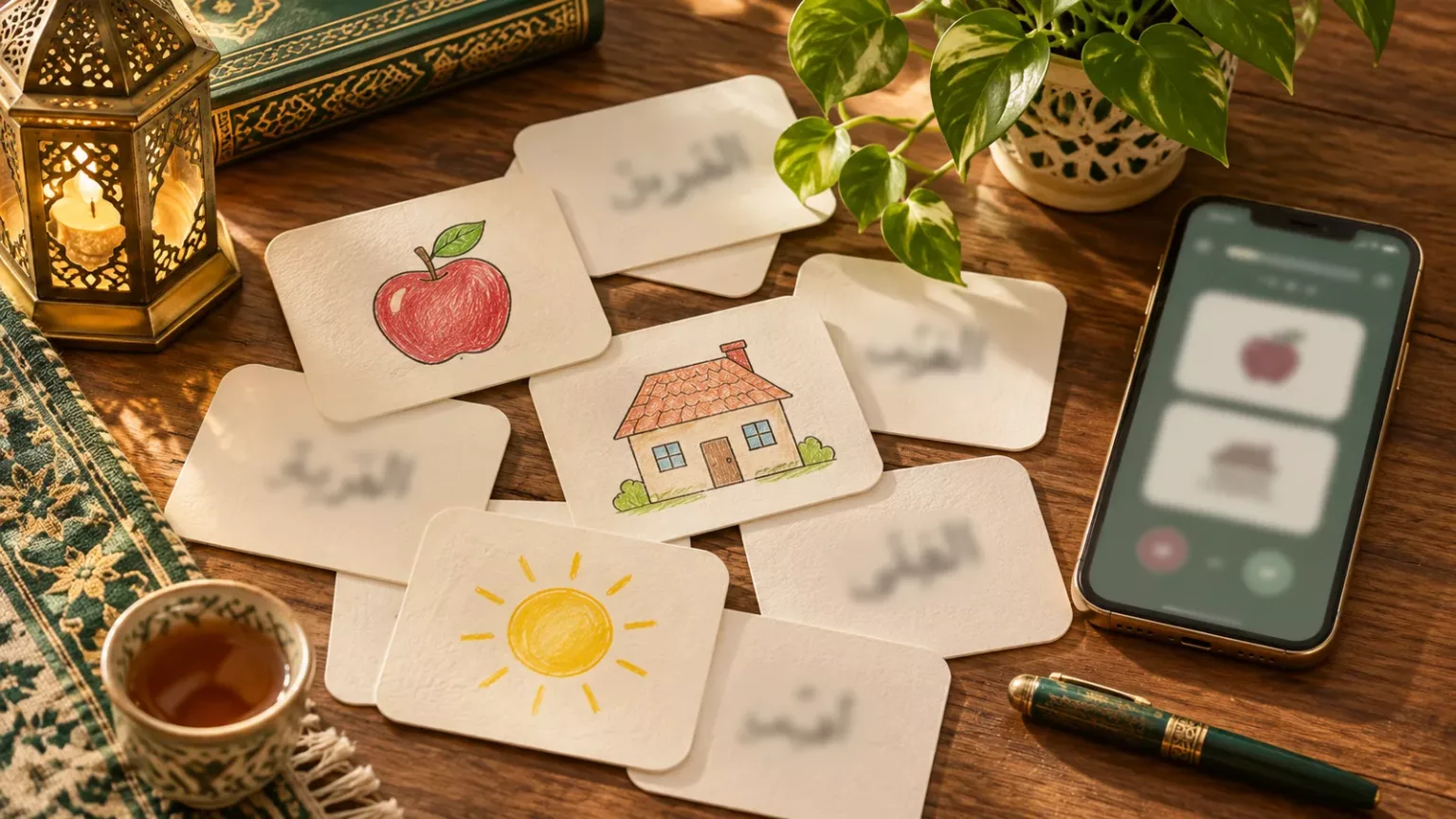
- Question side: the Arabic word, with vowel marks, plus an image and an audio recording if possible.
- Answer side: an image or a short sentence in Arabic, rather than a simple translation. Translation is only a last resort.
- One word per card, in a short real sentence: أَشْرَبُ الْمَاءَ (I drink water) is easier to remember than مَاء on its own.
- For a noun, add its plural: كِتَاب / كُتُب. In Arabic, the plural is often unpredictable, so you might as well learn it straight away.
Paper, Anki or Quizlet?
All three work. Paper cards sorted into numbered boxes (the Leitner system) are simple and screen-free. A spaced repetition app such as Anki works out the intervals for you and lets you add audio. Tools like Quizlet are handy for reviewing through games, but manage intervals less precisely. The best tool is the one you will actually open every day. If you follow the Self-Paced Package, 175 flashcards are included as a bonus for review.
Learning words in context, without translation
A list of fifty unrelated words is quickly forgotten. A word you meet in a story, a dialogue or a concrete situation leaves a much stronger trace, because it is linked to a meaning, an emotion, an image.
Images rather than translations
When you link تُفَّاح to a picture of an apple rather than to the word “apple”, you create a direct link between Arabic and meaning. In the long run, this is what lets you understand without translating in your head.
Sound, always
Say each word out loud and listen to it spoken by a native speaker. A word you can say is a word you will recognize when you hear it, and one you will dare to use.
That is why we favour immersion: you discover vocabulary in situations, then meet it again several times in different contexts. In the Self-Paced Package, vocabulary comes through videos, audio and images to describe.
Roots: a family for every new word
Most Arabic words come from a root of three consonants. When you learn دَرَسَ (he studied), also look out for مَدْرَسَة (a school), مُدَرِّس (a teacher) and دَرْس (a lesson). A root you already know makes every new word in the family easier to guess and to remember. It is one of the great advantages of Arabic: the further you go, the faster new vocabulary comes.
The first Arabic words to learn
There is no need to start with endless themed lists. Begin with the words you will hear and use most often, always in a short sentence:
| Group | Examples | In a sentence |
|---|---|---|
| Pronouns and questions | أَنَا، أَنْتَ، هُوَ، هِيَ، مَا، مَنْ، أَيْنَ | مَا اسْمُكَ؟ (what is your name?) |
| Everyday verbs | أَكَلَ، شَرِبَ، ذَهَبَ، جَلَسَ، قَرَأَ، كَتَبَ | ذَهَبْتُ إِلَى الْمَدْرَسَةِ (I went to school) |
| Family | أَبٌ، أُمٌّ، أَخٌ، أُخْتٌ، اِبْنٌ | هَذَا أَبِي (this is my father) |
| Home and food | بَيْتٌ، بَابٌ، مَاءٌ، خُبْزٌ، تُفَّاحٌ | أَشْرَبُ الْمَاءَ (I drink water) |
| Little words | وَ، فِي، مِنْ، إِلَى، عَلَى | الْكِتَابُ عَلَى الطَّاوِلَةِ (the book is on the table) |
| Numbers from 1 to 10 | وَاحِدٌ، اِثْنَانِ، ثَلَاثَةٌ… عَشَرَةٌ | عِنْدِي ثَلَاثَةُ كُتُبٍ (I have three books) |
Then add the vocabulary linked to your goal: prayer and the Qur’an, travel, work or family life.
Mistakes that make you forget words
- Learning long lists in one go: fifty words on Sunday, almost all forgotten by Wednesday.
- Working only with the translation: the word stays “stuck” to English and comes back too slowly.
- Sticking to Latin letters: transliteration delays reading and distorts pronunciation.
- Learning a noun without its plural or gender: you will have to learn it again later.
- Rereading instead of testing yourself: rereading gives the illusion that you know; searching your memory for the word is what anchors it.
- Never reusing the words: a word you never say ends up fading away.
How to memorize Arabic vocabulary in 15 minutes a day
- 5 minutes of review: go through the cards due today, out loud.
- 5 minutes of new material: listen to a short story or dialogue and note three to five new words, in their sentence.
- 5 minutes of use: make two or three sentences with the day’s words, out loud or in writing.
Can you memorize Arabic words fast?
Yes, if “fast” means steady rather than rushed. Five new words a day, well reviewed, add up to more than 1,500 words in a year. That is far more effective than fifty words crammed in one go and then forgotten. A word is truly acquired when you recognize it by ear, can pronounce it and can use it in a sentence without thinking.
Vocabulary that sticks, without endless lists
In the Self-Paced Package, vocabulary comes to you through immersion, with videos, audio and images, and 175 flashcards are included for review. Free trial, then €29 a month or €290 a year, with a 15-day money-back guarantee. For children: 153 stories in Arabic, each with a picture dictionary and a quiz.
What about children?
Children remember very well what they hear often, in situations that make sense to them. To help them, focus on stories, songs, pictures and plenty of repetition through play, rather than lists to learn by heart. That is the idea behind Safiya, Tell Me a Story: each of the 153 stories comes with a picture dictionary and a quiz, so children meet the same words in several forms.
Read also: “Learning Arabic fast: 5 tips that really work” and “Is Arabic hard to learn?“.
Frequently asked questions
How many Arabic words should you learn a day?
Between three and ten new words a day is a good pace for most adults, as long as you review them. A few words that really stick are better than lots of words quickly forgotten.
Should you learn vocabulary with the English translation?
At the very beginning, a translation can be reassuring. But the sooner you link words to images, gestures and situations, the sooner you will understand Arabic without going through English.
How can you remember the vocabulary of the Qur’an?
Many words come up again and again in the Qur’an. Learn them within their verse rather than in isolation, review them with spaced repetition and reread the verses out loud. If you cannot read yet, start with reading, using the Noorani Qaida (Nourania method).
Modern Standard Arabic or dialect: which vocabulary should you learn?
The vocabulary of Modern Standard Arabic is that of the Qur’an, books and the media, understood across the Arab world. Much of it is also found in the dialects. It is the Arabic we teach. To choose, read “Literary Arabic or dialect: which should you learn first?“.
Is a PDF vocabulary list enough?
A list helps you know what to learn, but it does not make you hear or reuse the words. Use it as a starting point, then turn each word into a card with its sound, an image and a sentence.
Which words should you learn first?
The most frequent ones and the most useful for you: pronouns, questions, everyday verbs, family, home, food, numbers, then the vocabulary linked to your goal (prayer, travel, work). The table above gives you a starting point.