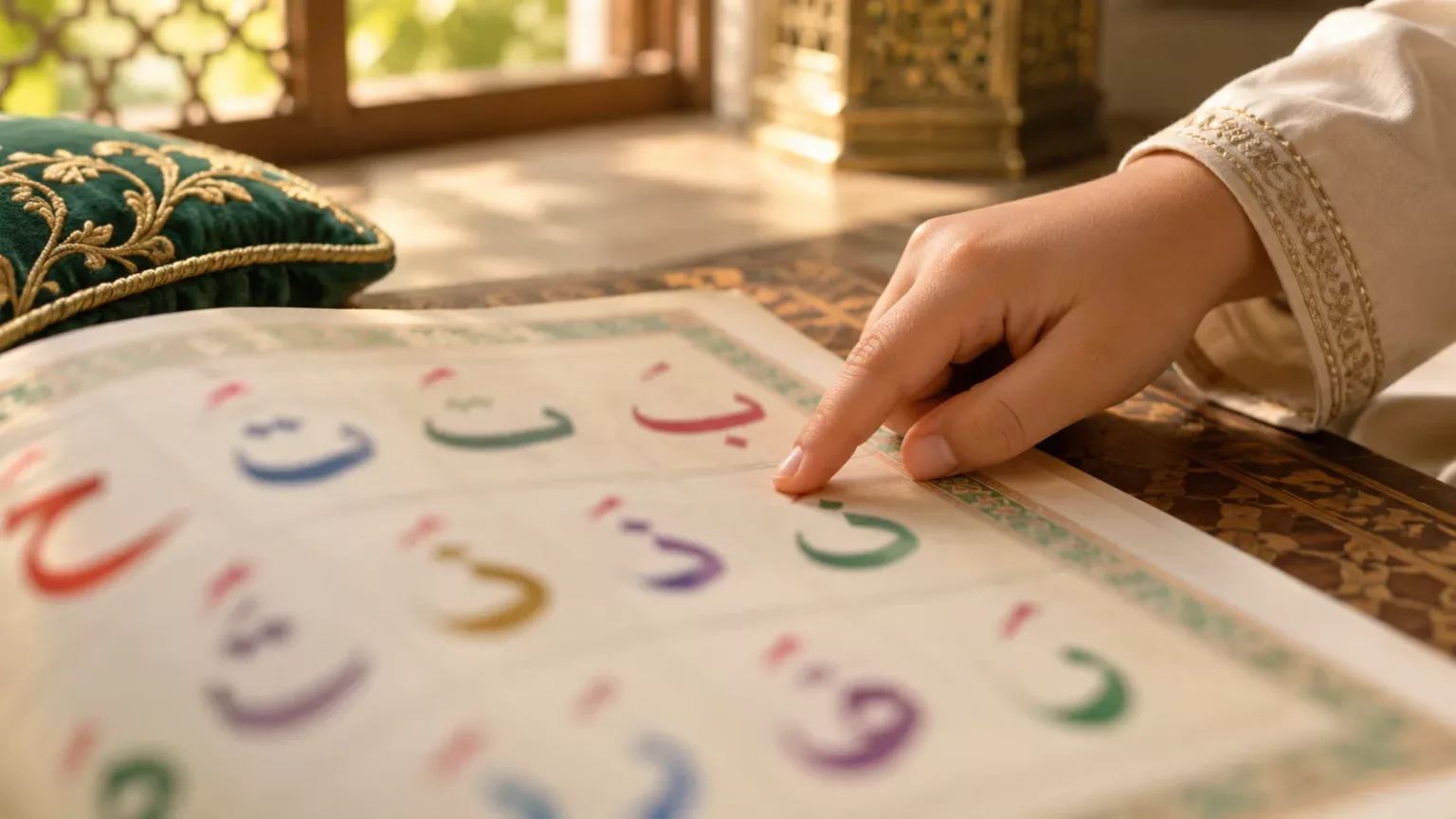
In short: the Noorani Qaida (Al Qaida An-Nooraniyyah, also known as the Nourania method) is a step-by-step primer for learning to read Arabic, and the Qur’an in particular. You start with the isolated letters, then joined letters, vowels, lengthening and the main reading rules, until you can read verses. It suits children from age 4 or 5 as well as adult beginners, and requires no prior knowledge. Allow anything from a few weeks to a few months, depending on your pace.
If you are looking for a way to learn to read Arabic, you have probably come across the name “Noorani Qaida”, also spelled Nourania, Nooraniyah, Nuraniyah or Qaida Noorania. It is one of the most widely used reading primers in Qur’an schools and online courses, for children and adults alike.
This guide answers the questions people ask before they start: what the method involves, how the lessons are organised, from what age, how long it takes, which book to choose, and whether to learn it on your own or with a teacher.
What is the Noorani Qaida (Nourania method)?
The Noorani Qaida, or القاعدة النورانية (Al Qaida An-Nooraniyyah), is a primer for reading Arabic. Its principle is simple: you do not learn the alphabet as a list to recite; you learn to read sounds, from the simplest to the most complex, with correct pronunciation from the very start.
Each lesson introduces just one new difficulty and builds on what has already been covered. The examples are often taken from the Qur’an, so learners become familiar early on with the words they will meet in the Qur’anic text.
Who wrote the Noorani Qaida?
The primer is attributed to Sheikh Noor Muhammad Haqqani, a Qur’an teacher from the Indian subcontinent. It has since been reprinted and adapted many times, which is why not all editions are identical.
The Noorani Qaida lessons, stage by stage
Depending on the edition, the book has anywhere from 12 to around 20 lessons, and the way they are divided varies slightly. The progression, however, always follows the same logic:
| Stage | What you learn | Example |
|---|---|---|
| 1. Isolated letters | Recognising and pronouncing each letter from its point of articulation (makhraj) | ا ب ت ث |
| 2. Joined letters | Recognising a letter at the beginning, middle or end of a word | بـ ـبـ ـب |
| 3. “Disjointed” letters | Reading the letters that open certain surahs (al-huruf al-muqatta’at) | الم |
| 4. Short vowels | Fatha, kasra, damma | بَ بِ بُ |
| 5. Tanween | The doubled vowels at the end of a word | بً بٍ بٌ |
| 6. Long vowels (madd) | Lengthening a vowel with alif, waw or ya | بَا بِي بُو |
| 7. Sukoon | Reading a consonant with no vowel | بَبْ |
| 8. Shaddah | Reading a doubled consonant | رَبَّ |
| 9. Basic tajweed rules and verses | Reading words, sentences and then verses with the essential rules | بِسْمِ اللَّهِ |
This progression explains its success: at no point does the learner have to deal with several new things at once. If your book numbers the lessons differently, that is fine: the order of the stages stays the same.
Who is the Noorani Qaida for, and from what age?
- Children from age 4 or 5, as long as sessions are short, lively and regular. Some schools start at 4; our programme for children is designed for ages 5 and up.
- Adult beginners starting from zero, including those who have never seen an Arabic letter.
- People who already read “a little” but hesitantly, or with pronunciation mistakes that have set in over the years.
- Parents who want to support their child: many learn at the same time.
How long does it take to finish the Noorani Qaida?
It depends on the pace, the learner’s age and the quality of the correction. As a rough guide:
- An adult who practises a little every day can work through all the stages in a few weeks. With only one lesson a week, expect several months instead.
- A child usually progresses more slowly, and that is normal: children need shorter sessions and more repetition.
- Reading with ease then takes a bit more practice: rereading regularly, out loud, until your reading becomes fluent.
Our Learn to Read Arabic programme is designed to be completed in 29 days, at around 30 minutes a day. It is a target, not a race: everyone moves at their own pace, and confident reading is better than fast reading.
Try the Nourania method for free, today
44 interactive lessons that follow the Nourania method, with reading aloud into the microphone in every lesson. Day 1 is free (lessons 1 and 2 plus the daily review), with no appointment to book: a first name and an email address are all you need. After that, €147 as a one-off payment, with lifetime access for the whole household.
What the Noorani Qaida can do, and what it cannot
The Noorani Qaida is a reading method. It lets you decode a vowelled text, such as the Qur’an, correctly and with good pronunciation. That is a valuable foundation.
However, it does not teach you to understand or speak Arabic. After the Noorani Qaida, you can read, but you do not yet understand what you are reading. For that, you need to learn the language itself: vocabulary, listening, speaking. That is why we present it as a first step, which complements learning the language through immersion, as we explain in “our method“.
Which Noorani Qaida book should you choose?
The Noorani Qaida comes in many forms: small or large format, covers in different colours, editions with explanations in English or other languages, or with audio you can access through a QR code. A few pointers to help you choose:
- The recitation (riwayah): most editions follow the Hafs recitation, the most widespread. If the people around you recite in Warsh, check the edition.
- Audio: an edition with reference recordings is a real plus if you are learning without a teacher.
- Format: a large format with big letters is more comfortable for children and beginners.
The book is also available as a PDF on many websites. Whatever the format, what matters most is not the book, but hearing the right model and being corrected out loud.
Learning the Noorani Qaida on your own, with a teacher or online?
| Option | Advantages | Limits |
|---|---|---|
| Book on its own | Inexpensive, at your own pace | No correction: pronunciation mistakes set in |
| Teacher or school | Direct correction, a motivating setting | Fixed times, cost per session, often only one session a week |
| Free videos | A pronunciation model to listen to | No structured progression, no feedback on your reading |
| Guided online programme | Structured progression, every day, at your own pace | Requires consistency; check that it makes you read out loud |
Whatever you choose, keep one rule in mind: you do not learn the Noorani Qaida with your eyes, but with your mouth and your ears.
How to follow the Noorani Qaida well
- Always read out loud. The method is practised with the mouth and the ear, not just the eyes.
- Get corrected. A letter mispronounced at the start becomes a habit that is hard to break. A teacher, or at least a reference recording, is essential.
- Aim for consistency. A short lesson every day is better than several lessons at once at the weekend.
- Review before moving on. Reread the previous lesson before starting a new one.
- Do not go too fast. Move on to the next stage when you can read the previous one without hesitation.
Noorani Qaida, Baghdadi Qaida, Noor al-Bayan: what is the difference?
All three are reading primers for beginners. The Baghdadi Qaida, an older primer, often has learners spell out the letters before reading them. Noor al-Bayan, widely used with young children, focuses on reading syllable by syllable. The Noorani Qaida stands out for its very gradual progression towards reading the Qur’an with the basic rules of tajweed. All three lead to the same goal; what matters most is consistency and correction.
At Arabic Immersion, our Learn to Read Arabic programme follows the Nourania method in 44 interactive lessons. Every lesson ends with reading aloud into the microphone. There is a version for adults and a version for children from age 5, guided by an Ustadha; parents do not need to speak Arabic.
Read also: “The Arabic alphabet: where to start as an adult?” and “How long does it take to learn Arabic?“.
Frequently asked questions
What is the Noorani Qaida, in one sentence?
It is a primer that teaches you to read Arabic and the Qur’an step by step, from isolated letters to verses, one new thing at a time.
Do you need to know the alphabet before starting?
No. The Noorani Qaida starts with the first letter, ا. It is designed precisely for complete beginners.
Is the Noorani Qaida the same as tajweed?
No. Tajweed is the set of rules for reciting the Qur’an. The Noorani Qaida is a reading method that introduces the basic rules of tajweed as you progress. To go further in tajweed, you then continue with dedicated teaching.
Can a 5-year-old learn the Noorani Qaida?
Yes, as long as the format is adapted: short sessions, lots of encouragement and playful materials. In our programme for children, the child earns stars at each stage and follows their progress on a 29-day map.
Can an adult learn the Noorani Qaida?
Yes. Many adults start from zero, or go back to the hesitant reading they learned as children. An adult who practises regularly often progresses quickly, because they understand the logic of each stage.
Can you learn the Noorani Qaida from a PDF?
You can use one as a support, but a PDF will never let you hear the right sound or correct you. At the very least, pair it with reference recordings, and ideally with reading that someone corrects.
What comes after the Noorani Qaida?
You can continue with tajweed to perfect your recitation and, above all, start learning the Arabic language itself so you understand what you read: stories in Arabic for children, immersion classes for adults.