In short: is Arabic hard to learn? For an English speaker, it takes longer than a European language, mainly because of a new alphabet, a few unfamiliar sounds, a rich grammar and a very different vocabulary. But it is also very logical: the alphabet can be learned in a few weeks, most words are built from three-letter roots, and the spelling follows the pronunciation. With the right method and regular practice, it is well within reach.
| Genuinely hard | Easier than you think |
|---|---|
| A new alphabet, written from right to left | 28 letters, no capitals, learned in a few weeks |
| A few sounds that do not exist in English | A vowelled word is read exactly as it is written |
| A vocabulary that is almost entirely new | Families of words built on the same root |
| A rich grammar (cases, the dual, plurals) | Regular patterns that come up again and again |
“Arabic is just too hard.” This idea puts many people off before they have even started. It is not completely wrong: Arabic is a long way from English. But it is often exaggerated and, above all, it lumps together very different kinds of difficulty.
Let’s look at what is really difficult, what is easier than people think, why so many learners get stuck, and how to get around the real obstacles.
Is Arabic hard to learn for English speakers?
Yes, for an English speaker Arabic takes more time than Spanish or French. But “long” does not mean “impossible”. Millions of people learn it as a foreign language, children and adults alike.
The most serious benchmark comes from the US Foreign Service Institute (FSI), which trains American diplomats, and it was designed precisely for native English speakers. It places Arabic in its group of languages that take the longest to learn, alongside Mandarin Chinese, Japanese and Korean: about 88 weeks of intensive classes (2,200 hours) to reach professional proficiency, compared with around 30 weeks for French or Spanish. Keep in mind that these figures describe a high professional level, not more modest goals such as reading or holding a simple conversation. We go through realistic timeframes in “How long does it take to learn Arabic?“.
Is Arabic harder than Chinese, Japanese or Russian?
For an English speaker, the FSI estimates give a useful point of comparison. They measure intensive class time needed to reach a professional level, not how “hard” a language is in the abstract:
| Language | FSI estimate (intensive classes) | The main challenge |
|---|---|---|
| Spanish, French | About 30 weeks | Many words close to English |
| Russian, Hebrew, Persian | About 44 weeks | A new alphabet, a different grammar |
| Arabic | About 88 weeks | A new script, new sounds, new vocabulary |
| Mandarin Chinese, Japanese, Korean | About 88 weeks | Tones (Mandarin), thousands of characters (Chinese, Japanese) |
So Arabic sits in the same group as Chinese and Japanese, but for different reasons: it has an alphabet of 28 letters rather than thousands of characters, and no tones. Its difficulty lies elsewhere, as we will see.
What is really hard
A new alphabet
Arabic is written from right to left, with 28 letters that change shape depending on their position in the word. Short vowels are not always written. This is the first step, and it looks daunting. But it is also the shortest: a few weeks of regular practice are enough to read vowelled words.
Sounds that do not exist in English
Letters such as ع, ح, خ, ق or the so-called “emphatic” letters take real work for the ear and the throat. The good news: they are learned well when you hear them often and are corrected early.
A vocabulary that is almost entirely new
With French or Spanish, an English speaker recognises plenty of words. With Arabic, far fewer, even though English has borrowed more words from Arabic than most people realise: sugar, coffee, algebra, cotton, magazine… Even so, you have to build your vocabulary almost from scratch. This is the longest part, and it is why consistency matters so much. Our tips on how to memorize Arabic vocabulary will help.
How hard is Arabic grammar?
Arabic grammar has its own features:
- cases: the ending of some words changes according to their role in the sentence;
- the dual: as well as the singular and the plural, there is a form for “two”;
- masculine and feminine, right down to “you” and verbs: you do not say “you write” the same way to a man and to a woman;
- “broken” plurals: many plurals are formed by changing the inside of the word, the way English turns “man” into “men”, but far more often: كِتَاب (a book) becomes كُتُب (books).
Presented in tables from day one, this grammar is discouraging. Discovered in context, in sentences you hear often, it becomes much more natural: that is how Arabic-speaking children acquire it.
Modern Standard Arabic and dialects
Modern Standard Arabic (the language of the Qur’an, books and the media) exists alongside many spoken dialects. This can be confusing. To find your way, read “Literary Arabic or dialect: which should you learn first?“.
What is easier than you think
- A regular writing system. Once you know the letters and vowels, a vowelled word is read the way it is written. No spelling surprises like in English, where “though”, “through” and “tough” all sound different.
- No capital letters. Just one form of each letter to recognise, varied according to its position.
- A system of roots. Most words are built from a root of three consonants. For example, ك ت ب (k-t-b) gives كَتَبَ (he wrote), كِتَاب (a book), كَاتِب (a writer) and مَكْتَبَة (a library). Once you understand this mechanism, every new root opens up a whole family of words.
- Regular patterns. Words follow “moulds” (the patterns, or awzan) that come up again and again. You quickly learn to recognise them by ear.
- A language that is often already familiar. For many learners, Arabic is already part of prayer, supplications or family life. That contact makes memorising much easier.
Why is Arabic so hard to learn? The 6 mistakes that make everything harder
Often, it is not the language that holds people back, but the way they learn it:
- Starting with grammar: tables of case endings before you can say a single sentence. You feel you are working hard without being able to speak.
- Translating everything: running every word through English slows down understanding and stops you thinking in Arabic.
- Staying too long with Latin letters: transliteration is reassuring at first, but it delays real reading. It is better to learn the alphabet straight away.
- Wanting to understand every word: getting stuck on each unknown word instead of grasping the overall meaning, the way you do in your own language.
- Never speaking: you understand a little, but freeze as soon as you have to answer.
- Learning alone, without feedback: you repeat your mistakes without realising, and your motivation wears thin.
In other words, Arabic seems difficult when you learn it like a school subject. It becomes much more natural when you learn it as a living language.
Is it harder for an adult or for a child?
Children have a big advantage: they are happy to learn through listening and play, without trying to understand everything, and they easily imitate new sounds. With stories and activities in Arabic, the language quickly becomes familiar.
Adults have other strengths: they understand the logic of roots and patterns, know how to organise themselves and know what they want to achieve. What holds them back most is often the fear of making mistakes. An adult who practises regularly, and dares to speak, makes very good progress.
How to make Arabic easier
- Learn the alphabet first, with a step-by-step method and out loud. Our article “The Arabic alphabet: where to start as an adult?” gives you a simple progression.
- Listen to plenty of understandable Arabic: stories, simple dialogues, videos for learners.
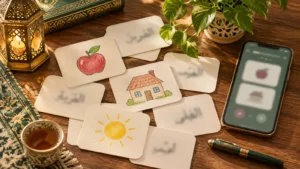
- Learn without translation: link words to images, gestures and situations, the way a child does with their mother tongue. This is the principle behind our method, inspired by the work of Professor Abdellah Dannan.
- Speak early, even with mistakes, in a supportive setting and in a small group.
- Be consistent: a little every day rather than a lot every now and then.
Arabic often seems hard because of the way it is taught
Try a different approach: immersion, without translation, at your own pace. The Self-Paced Package offers videos, audio and exercises, with a free trial and then a 15-day money-back guarantee. To speak with a teacher, the Majaliss Adults live classes (6 participants at most) offer a trial session.
Frequently asked questions
Is Arabic the hardest language in the world?
No. For an English speaker, the Foreign Service Institute places it in the group of languages that take the longest to learn, along with Chinese, Japanese and Korean. But no language is “the hardest” in absolute terms: it all depends on your first language, your goal and your method.
Is it easier to learn to read Arabic or to speak it?
Reading is quicker: a few weeks are enough to decode a vowelled text. Understanding and speaking take longer, at least several months of regular practice. We go into these timeframes in “How long does it take to learn Arabic?“.
Can you learn Arabic on your own?
Partly, yes: the alphabet, reading, comprehension and vocabulary can all be worked on independently with a structured programme. To speak with ease, sooner or later you need to talk with other people and be corrected.
Is Qur’anic Arabic hard?
Learning to read the Qur’an is achievable in a few weeks of daily practice, with a method such as the Noorani Qaida (Nourania method). Understanding it means learning Modern Standard Arabic itself, which takes longer.
Do you need a gift for languages?
No. Consistency, a good method and plenty of listening matter far more than any supposed “gift”. In fact, adults make very good progress when they practise regularly.
Will my child find Arabic difficult?
Rarely, if they learn it through listening and play. Take a look, for example, at Safiya, Tell Me a Story (153 stories in Arabic, with a free trial) or the live classes at the Majaliss Institute for Kids.