
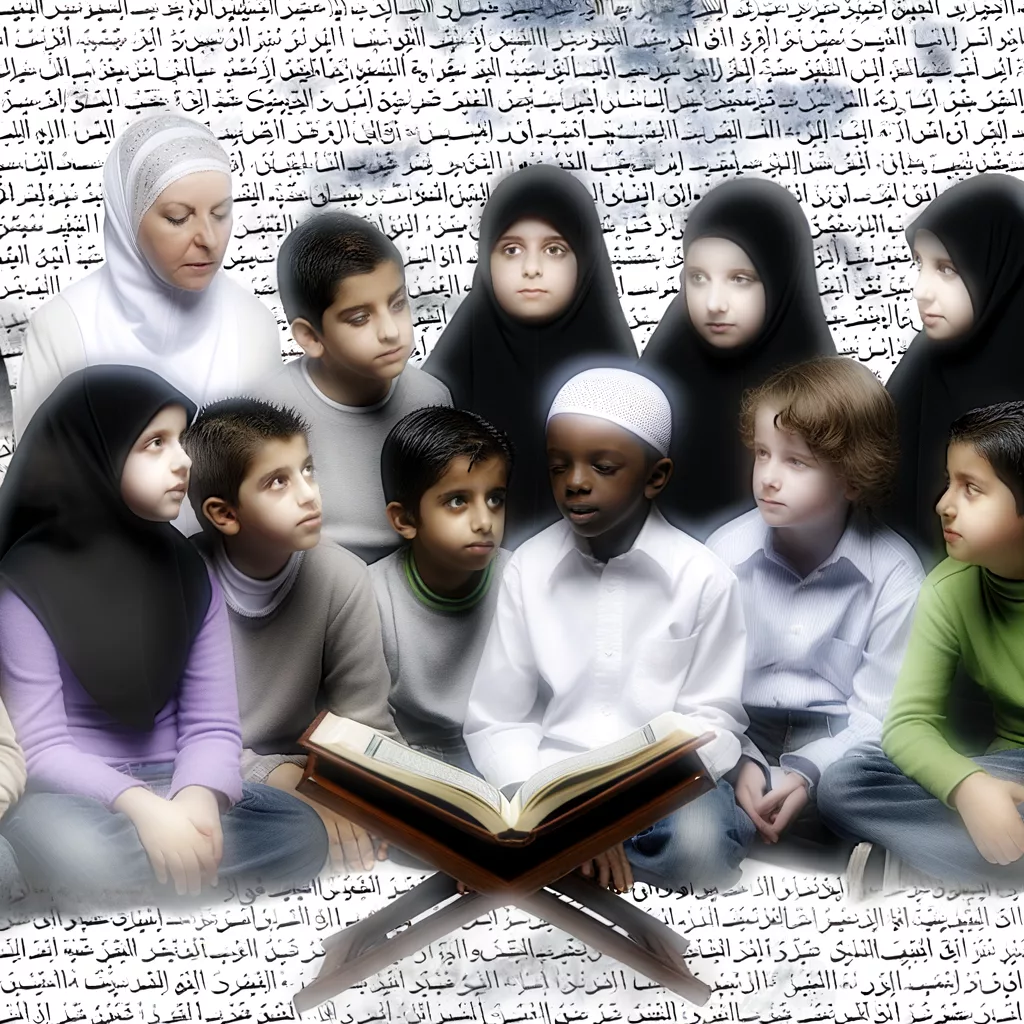
What do we really want to give our children, if not the beauty of a life anchored in peace of heart, the light of faith and the wisdom of the Qur’an? Teaching the five pillars of Islam to children is not merely passing on rituals or duties: it is planting the seeds of a serene identity, a living spirituality and an intimate relationship with Allah. But how can we guide our children towards this deep understanding? How can we make the shahada, salat, zakat, Ramadan and the hajj realities that come alive in their daily lives?
In a world full of distractions, the question of Islamic education, within the Muslim family and throughout the school years, becomes central. Far from a simple list of rules, the five pillars form an inner compass for every young soul. Yet for these pillars to take on real meaning, one universal key stands out: learning Arabic. This choice is not a relic of the past; it is an opportunity to reconnect our children with the original dimension of the Qur’an, to immerse themselves in prayer with khushu, to approach the wisdom of the hadiths, and to discover all the richness of the prophetic tradition.
This is not about encouraging dry memorisation, or piling up words to translate. Immersive learning of Arabic – literary Arabic, the language of the Qur’an and the sunna – gives access to deep meaning, lets children feel the beauty of tajwid when reciting and taste the sweetness of dhikr as the companions of the Prophet and the ahl al-bayt experienced it. Thanks to this immersion in Arabic, our children absorb a whole universe, understand the acts of prayer without distortion, live the Ramadan fast as an inner celebration, marvel when reading the Qur’an, bring memory and meaning together, and develop a rooted Muslim faith.
In this article, let us explore how a living pedagogy, centred on immersion and love, awakens children’s curiosity and gives depth to the practice of Islam. Let us discover how the history of Islamic civilisation, collaborative learning as a family, the celebration of Islamic festivals and a direct link with the sacred language foster the awakening of Islamic spirituality and the anchoring of a conscious Muslim identity. Whether you are a parent, an educator or simply someone who carries a dream for Muslim youth, open the door to a new approach: one in which learning Arabic and making the five pillars your own becomes a personal and collective adventure, luminous and foundational.
Learning Arabic through immersion: giving our children the key to understanding the Qur’an and the five pillars of Islam
From the earliest age, opening the door of learning Arabic through immersion gives our children a priceless legacy: the ability to understand the Qur’an in Arabic, to live prayer with more khushu, and to be initiated in depth into the Muslim faith. Immersion in Arabic fosters natural, authentic assimilation, in which every word takes on its full meaning at the heart of the Qur’anic tradition and the sunna. The five pillars of Islam — the shahada, salat, zakat, the Ramadan fast and the pilgrimage — become realities that are lived and understood, because the child dives into the meaning, the gesture and the original word. It is not about learning Arabic as a foreign language through disconnected vocabulary lists; it is about bathing in literary Arabic, without translation, letting the beauty of tajwid and the depth of the tafsir of the Qur’an shape their ear and their mind, while weaving a living bond with Islamic spirituality.
With this approach, memorising the Qur’an is no longer a mere mechanical recitation. The child perceives the wisdom, the call to sincerity in Islam, gratitude towards Allah and patience in Islam directly in the language of the divine message. Every prayer, du’a and dhikr resonates with renewed strength; the knowledge of the scholars of Islam, of the companions of the Prophet and of the ahl al-bayt, as well as the sira of the Prophet, takes on a different resonance because it is accessible in the original words, which carry a unique spiritual charge. This immersion works far beyond knowledge: it shapes the spiritual routine, nourishes spiritual well-being, strengthens Muslim identity and weaves deep bonds with Islamic culture and the history of Islam.
In daily life, learning Arabic as a family becomes a moment of sharing, an act of love of the Prophet and love of Allah that is part of the dynamic of the Muslim community. At the mosque, during Ramadan or at Islamic festivals such as Eid al-Fitr and Eid al-Adha, ritual practice is no longer limited to learned gestures, but radiates an intimate understanding, vibrant with emotion, in which every chanted word carries its full weight. This immersive approach also contributes to a rooted and living Islamic education, to Muslim youth confident in their akhlaq, open to the diversity of the madhahib, concerned with inner peace and moderation (wasatiyya), and prepared to face questions of Muslim identity or laïcité, here in France or elsewhere.
By giving our children this chance to learn Arabic without translation, we pass on to them far more than linguistic mastery: we equip them for an authentic reading of the Qur’an, a deep connection with the prophetic tradition, access to the Islamic sciences, from fiqh to Islamic finance, and the radiance of a harmonious and enlightened spirituality.
Islamic education in the family: passing on Islamic spirituality and the practice of the five pillars with love and simplicity
At the heart of every Muslim home, Islamic education is not simply a transmission of knowledge or rites to be copied. It is rooted above all in daily life, in the tenderness shared at every sunrise, in the simple gestures that bring young and old together around the practice of Islam. Teaching the five pillars to children means, above all, breathing Islamic spirituality into them through example, dialogue and love. Parents then become the first models, living and warm, embodying the Muslim faith through prayer – salat performed as a family, the little ones’ joined hands gently guided so they can feel khushu in prayer. It is by hearing the adhan softly from a parent’s lips, or by going through a reading of the Qur’an in Arabic together, even simply repeating a few verses, that the child absorbs the beauty and power of the Qur’an in Arabic, discovering its sounds before exploring its meaning.
In this gentle atmosphere, learning Arabic can take on a very special place: through immersion in Arabic, children hear and repeat words and sentences without translation, absorbing the language as they absorbed their mother tongue. This fluid contact with literary Arabic gradually makes it possible to understand the Qur’an in its original language, to marvel at the tajwid heard in the mosque, or to take part in memorising the Qur’an with sincerity. Raising children in Islam, nourished by Islamic invocations, dhikr at the end of a meal and gestures of gratitude towards Allah, combines simplicity with depth. Around the great stages of Muslim life – Ramadan, zakat, Eid al-Fitr or the hajj evoked through stories about the companions of the Prophet and the ahl al-bayt – the practice of the pillars takes on meaning through sharing, patience in Islam, charity and Islamic solidarity.
Encouraging transmission in joy and serenity means giving every child the chance to forge a peaceful Muslim identity, in which every rite – from the Friday prayer (jumu’ah) to the recitation of a surah – becomes a moment of exchange, kindness and wonder. Through this education, the Muslim family introduces its children to Muslim spiritual life, to Islamic studies, to the notion of tawba, to repentance in Islam, to sincerity in every act, to patience in the face of injustice, and to gratitude towards Allah for every shared moment. The home then becomes the quiet cradle in which the finest values are built, where Islamic civilisation, the history of Islam and Islamic culture are no longer mere lessons, but the living fabric of today’s Muslim youth.
Memorising the Qur’an, prayer and the Ramadan fast: making the fundamental acts living and accessible from childhood
Awakening a child’s heart to the beauty and power of the fundamental acts of Islam is far more than passing on gestures or words. Memorising the Qur’an, prayer and the Ramadan fast are not mere obligations: they are living rituals, carrying Islamic spirituality, Muslim faith and love of Allah. For children, making these practices accessible means first offering them an environment in which immersion in Arabic becomes natural and joyful. Through daily recitations, reading the Qur’an becomes a sensory adventure, in which every word of literary Arabic stimulates curiosity and shapes Muslim identity. Far from methods based on translation, learning Arabic from the earliest age – through songs, stories and attentive listening to the adhan or to salat – opens the child’s heart to the flavour of the revealed text and the poetry of the Qur’an in Arabic.
Introduced to memorising the Qur’an, even with short surahs, children discover tajwid and the beauty of the divine rhythm. The aim here is not performance, but an emotional bond, a familiarity with the Word of Allah that accompanies them in family prayer, the Friday prayer (jumu’ah) at the mosque, or moments of dhikr and du’a before sleep. In this way, the practice of salat takes root in daily life: children learn khushu in prayer from childhood, sincerity in Islamic invocations, and gratitude towards Allah in every gesture. During Ramadan, fasting in Islam is lived as a month of light and sharing, not as harsh deprivation. Children are taught the deep meaning of fasting, patience in Islam, the joy of iftar as a family, the happiness of giving zakat, of feeling Islamic solidarity, and of seeking inner peace during Laylat al-Qadr.
Through conversation and the stories of the sira of the Prophet, the companions of the Prophet and the ahl al-bayt, the acts are linked to their wisdom, and love of the Prophet and a community spirit are instilled. Children, bathed in this atmosphere of Islamic education, develop an Islamic culture and a positive identity, while respecting the diversity of the Muslim couple, the Muslim family and Muslim youth and their place in the world. Every prayer, every memorised verse, every sunrise in Ramadan then becomes a seed of spirituality planted for life, giving the child the soothing certainty of belonging to a living and universal tradition, of which Arabic is the subtle key. This is how the practice of Islam, the understanding of the texts, the growth of an awareness of spiritual well-being and the daily spiritual routine take on their full meaning, offering the child a treasure beyond words – a light that illuminates their path in faith and in life.
Islamic culture, the history of Islam and universal values: awakening faith and Muslim identity through the five pillars
Passing on the five pillars of Islam to children is far more than teaching them rituals: it is inviting them to discover the full depth of Islamic culture, to open up to the history of Islam and to absorb universal values that will give meaning to their Muslim faith and shape their identity. Through prayer, salat lived with khushu, fasting in Islam during Ramadan, zakat as a source of Islamic solidarity, the pilgrimage to Mecca and the testimony of faith, each pillar becomes the gateway to a spiritual and human adventure. Introducing the learning of Arabic, not as a foreign or school language but through natural immersion in Arabic, then opens direct access to the heart of Islam. Through the child’s listening and speaking, the Qur’an in Arabic, its surahs recited with tajwid, its memorised verses, the hadiths passed on and the history of the companions of the Prophet, of the ahl al-bayt and of the sira of the Prophet become living and embodied in their daily lives. Children discover the beauty of the sunna and the Islamic spirituality that inspires every moment, from the morning dhikr to the evening invocation, from acts of tawba to gratitude towards Allah, from patience in Islam to sincerity and generosity. Through the richness of Islamic civilisation — from calligraphy to art, from the Muslim calendar to festivals such as Eid al-Fitr and Eid al-Adha, from the great figures of the history of Islam to the first caliphates, from Sufism to jurisprudence (fiqh, madhahib), from Islamic ethics to solidarity between Muslims — the child perceives Islam as a light, a wisdom and an inner strength. This awakening, nourished by reading the Qur’an, by stories, by discussions and by an Islamic education respectful of the context of the Muslim family, allows the child to anchor their faith beyond outward practice and to identify with a living community of meaning, love of the Prophet and the search for inner peace. Learning Arabic without translation then means learning to live and feel Islam from within, so that in every prayer, every word and every value taught beats the heart of a confident Muslim identity, open to the world and rooted in its spirituality.
At the end of this journey devoted to teaching the five pillars of Islam to children, one soothing certainty stands out: every value, every practice, every word passed on with love lights the road of a whole life. Learning Arabic through immersion, from childhood, gives our young people the living key to enter the heart of the Qur’an in Arabic, to taste the beauty of prayer, to feel the intimacy of dhikr, and to marvel at the greeting of an adhan or the brotherly warmth of a mosque. Learning Arabic without translation, centred on the overall meaning and attentive listening, opens the door to tajwid, the tafsir of the Qur’an, the science of hadith and the sunna, making every reading of the Qur’an a source of light and of confidence in the Muslim faith.
Day after day, the family becomes, for the Muslim child as for all Muslim youth, a haven of Islamic education full of empathy in which each pillar takes on meaning: the shahada is rooted in love of Allah and of the Prophet, salat is perfumed with khushu in prayer, the Ramadan fast awakens patience and gratitude, zakat teaches Islamic solidarity and sadaqa, while the pilgrimage (hajj, Umrah) nourishes the aspiration to a sincere faith, shared by the Muslim community throughout the world.
The history of Islam, the companions of the Prophet or the ahl al-bayt, the legends of the Andalusian caliphate or the great Islamic universities such as Al-Azhar, Zaytuna and Qayrawan: all this shapes Muslim identity in its colours, its culture, its art and its calligraphy. Combining spiritual learning, Islamic reading and small everyday gestures – adab, modesty in Islam, spiritual routine or gratitude towards Allah – means sowing the seeds of a generation rooted in inner peace, sincerity in Islam and kindness towards others.
Raising children in Islam is never just a theory: it is lived, breathed, heard and adjusted; it goes through trials with tawba and patience, rejoices in the Friday prayer and in the Islamic festivals of the Muslim calendar, moves forward in married or community life, resists racism and Islamophobia with hope, and opens up to interfaith dialogue. Enlightening children about the five pillars means equipping them to meet the challenges of their time with wisdom, while remembering, in every smile, every invocation, every night of Laylat al-Qadr or Eid festival, that Islamic spirituality is a weaving of gestures, words and light.
Passing on Islam to children means bequeathing to them the wisdom of the past, the momentum of life, the treasures of literary Arabic, the gentleness of a simple faith and the promise of a peaceful heart, ready to welcome the word of Allah and the beauty of Islam in all their depth. Thus every pillar, every word learned, every moment shared becomes a spark of hope, knowledge and love—an inexhaustible source of spiritual well-being, inner health, peace and balance, for today as for tomorrow.
Further reading: discover our Arabic programmes for children, or also read “Preparing spiritually for Ramadan as a family and a community” and “Learning Arabic and raising Muslim children in a secular environment“.



