
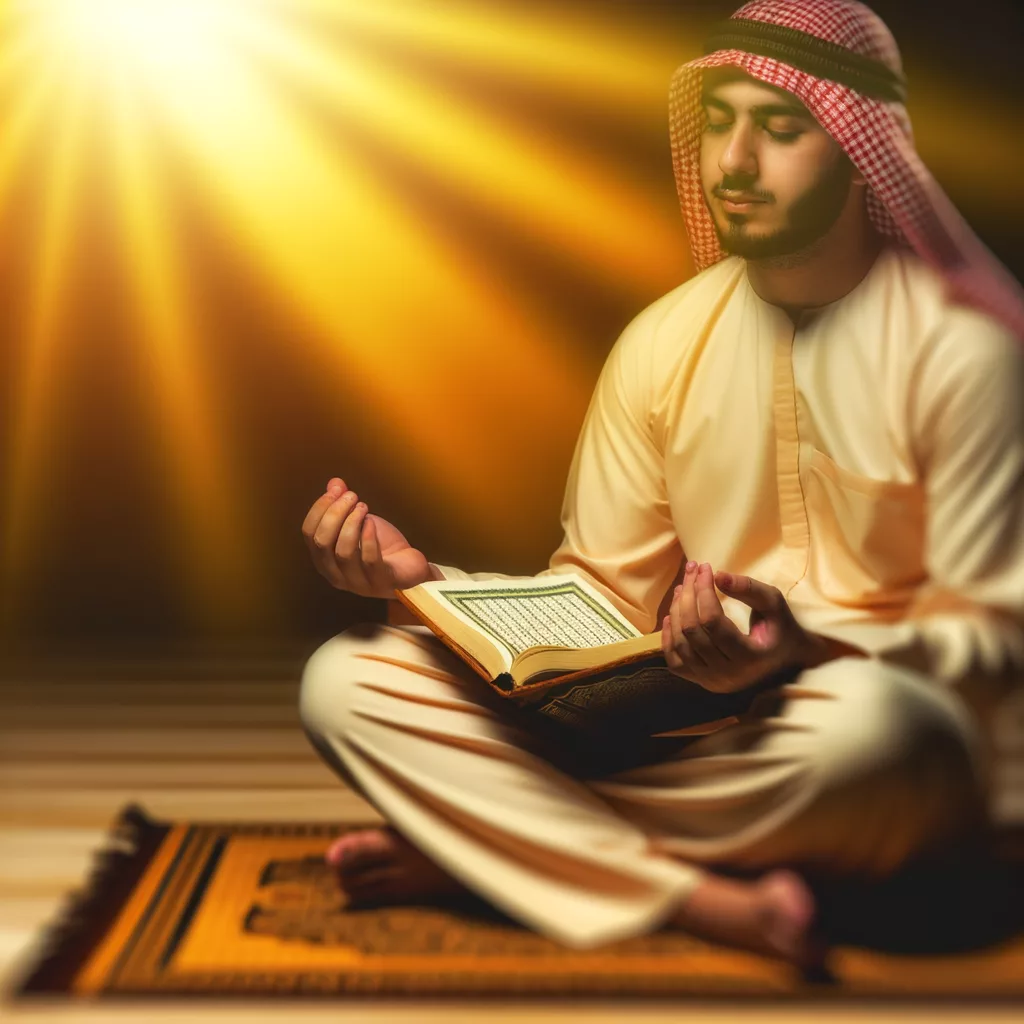
What is it, in our daily life as Muslims, that connects us powerfully to the very essence of our faith, far beyond habits and words? For many, the answer lies in a deep certainty: the names of Allah, bearers of meaning, strength and beauty, infuse every moment with a unique light. But to taste this richness fully and to touch with the heart the intimate dimension of Islamic spirituality, one secret too often remains overlooked: you need to learn Arabic, not as a foreign language to be studied under duress, but as a living path of immersion that opens unexpected doors.
Each name of Allah — Ar-Rahman, Al-Ghafur, Al-‘Alim… — resonates with a particular breath in prayer and dhikr. Yet many believers perceive this resonance as veiled, limited to mere recitation. The cause? A school-style approach, based on translation and mechanical repetition, in which the true meaning, the Qur’anic depth and the power of invocation are reduced to simple rote learning. Learning Arabic through immersion, without going through translation, turns this situation upside down. Literary Arabic becomes the key that makes the Qur’an a living companion, Tajwid a source of beauty, and Tafsir a contemporary spiritual horizon.
In the peaceful routine or the storms of life, the Muslim longs to feel the divine presence and mercy in their invocations. Learning Arabic means breathing the same air as the companions of the Prophet, reliving their energy in Salat, and connecting to the chain of piety, patience and gratitude towards Allah that has spanned the centuries. Understanding the Qur’an in Arabic, grasping the subtlety of the hadiths, tasting the fragrance of Ramadan or the intimacy of Laylat al-Qadr: all of this becomes reality once you cross this linguistic threshold.
This article invites you to dive, step by step, into this transformative experience. We will explore how immersion in literary Arabic, far from conventional methods, can anchor the Names of Allah in every aspect of your journey: from invocations at the heart of daily life to the spontaneous reading of the Qur’an, by way of awareness in dhikr and the serenity of the family spiritual routine. There is no need to translate every word: it is about feeling, meditating and invoking. When learning Arabic becomes fluid and natural, spirituality awakens, faith grows stronger, and the routine takes on a different flavour.
Learning Arabic is therefore not just a skill: it is an inner rebirth, an opening to an age-old tradition, an invitation to love Allah, His Prophet and His Word, lived and savoured at the source. Get ready to rediscover your faith, to weave a living link between the divine names and your life, and to live each day in the light of the language of the Qur’an.
Diving into the names of Allah: learning Arabic to nourish your spirituality every day
Diving into the names of Allah means opening a door to unsuspected treasures of Islamic spirituality and inner peace. But this dive can only be complete when you taste the original language in which these Names were revealed: literary Arabic, vibrant, nuanced and infinitely rich. Learning Arabic means receiving each divine Name—Ar-Rahman, Al-Wadud, Al-Hakim—in all its depth, intensity and original fragrance, far beyond the mere translation that often dilutes its meaning. Learning Arabic through immersion, without systematically going through translation, brings the heart closer to the overall meaning of the Names of Allah, making them a daily source of dhikr, du’a, tawba, patience in Islam or gratitude towards Allah.
Living immersion in Arabic means bringing your practice of Islam to life at every moment and turning routine into conscious worship: when you pronounce the Names of Allah during prayer (salat), when you surrender to khushu in the Friday prayer (jumu’ah), or when you whisper these Names during the Islamic invocations of the night, in Ramadan, on the eve of Laylat al-Qadr, or simply in the hustle and bustle of daily life. Every letter, every precise articulation according to the rules of tajwid, and every one of these subtle sounds of the Qur’an in Arabic touches the soul with a force no other language can equal.
By understanding the Names of Allah in the language of the Qur’an, the whole of the tafsir of the Qur’an, the science of hadith, the sunna, the sira of the Prophet and the words of the companions and the ahl al-bayt are illuminated, bringing you closer to the prophetic model, deepening the Muslim faith, and renewing sincerity and love of Allah and of the Prophet. Learning Arabic, in this context, is no longer just a linguistic study: it is an act of love, humility and the search for truth that nourishes the Islamic education of Muslim children, inspires the Muslim couple, strengthens the Muslim family and shapes Muslim identity in contemporary contexts, including Islam in France.
Through this conscious approach—this desire to understand the Qur’an, the invocations, the sunna and the history of Islam in their original form—immersive learning of Arabic becomes a way of life. It permeates Muslim spiritual life: from Muslim volunteering to community mutual aid, from Ramadan to Eid al-Fitr, from hajj to moderation (wasatiyya)—everything draws its strength from the living, vibrant presence of the Names of Allah, meditated upon and invoked in the language of revelation.
Immersion in Arabic and invocation: linking dhikr, du’a and salat to a deep understanding of the divine names
In the daily practice of dhikr, du’a and salat, there is a deeply transformative dimension when you choose immersion in Arabic and learning Arabic without translation. Approaching the names of Allah through the original language of the Qur’an opens the door to a living understanding, not reduced to words but made of inner sensations that touch the soul. When the believer invokes “Ar-Rahman” in their prayer in Islam, or meditates on “Al-Hakim” during dhikr, they experience the divine presence with an intensity that translation struggles to convey. Through listening and repetition in literary Arabic, these majestic names become familiar and come to dwell in the heart and in everyday spiritual language. Immersion in Arabic then makes it possible to reach khushu in prayer: a deep concentration in which every term invoked in salat, every whispered du’a and every dhikr spoken resonates in all its authenticity. Thus, learning Arabic means making the true significance of Islamic invocations your own, nourishing an embodied Islamic spirituality, and living gratitude towards Allah at an intimate level. This approach to learning Arabic is not aimed only at memorising the Qur’an or mastering tajwid; day after day, it connects all Islamic practices – from reading the Qur’an in Arabic to meditating on authentic hadiths, from the sunna of the Prophet to the education of Muslim children – to their first, sublime and universal source. In every du’a, in the Friday salat or during a moment of repentance in Islam, the beauty of the divine names is lit with a new light, because they are lived, felt and understood in the language that carried them to us.
Meditating on the names of Allah while reading the Qur’an: how literary Arabic opens the doors of tafsir and tajwid
Meditating on the names of Allah while reading the Qur’an means entering a deep dimension of Islamic spirituality, where every letter, every word and every divine name resonates in the believer’s soul. Learning Arabic then becomes more than a simple linguistic goal: it is a door that opens onto the real meaning, beauty and wisdom of the Qur’an in Arabic. Where translation leaves only a limited reflection, immersion in Arabic, without filter or intermediary, gives access to the authentic flavour of the divine message and to the subtlety of the names of Allah mentioned in each verse.
Knowledge of literary Arabic gives access not only to reading the Qur’an, but also to tafsir, the art of explanation and commentary, which illuminates the divine word according to the context of the Prophet, the sunna, the history of revelation, and the lived experience of the companions of the Prophet and the ahl al-bayt. Understanding the Qur’an in its original language makes it possible to grasp the unique nuances of the names of Allah – Ar-Rahman, Al-Wadud, Al-Hakim – and to meditate on their direct impact on the Muslim faith, the practice of Islam and the daily life of the Muslim. Through learning Arabic, each of these names becomes a mirror reflecting patience in Islam, gratitude towards Allah, sincerity in prayer, and mercy in every relationship.
Tajwid, the science of correctly reciting the Qur’an, only takes on its full meaning with access to literary Arabic: the precise pronunciation, the authentic articulation and the sacred melody of each verse make the reader’s heart vibrate and calm the mind in prayer in Islam, bringing khushu, contemplation and inner peace. Through immersion in Arabic while memorising the Qur’an and Islamic invocations (du’a and dhikr), the names of Allah become companions at every moment: they infuse the spiritual routine, guide you in repentance in Islam, recall mercy during the nights of Ramadan or Laylat al-Qadr, and illuminate patience during fasting in Islam.
What is more, understanding the Qur’an in Arabic prepares the heart and the intellect to approach the science of hadith, the sira of the Prophet, fiqh, or even calligraphy and Islamic art, which celebrate the majesty of the names of Allah. Learning Arabic is therefore not a luxury reserved for specialists, but a spiritual pillar, a source of well-being and coherence for the whole Muslim community, for couples, families and Muslim youth in France or elsewhere who seek to live an authentic and enlightened faith, to honour the heritage of the scholars of Islam and to pass on the light of the Qur’an to their Muslim children. Meditating on the names of Allah through mastery of literary Arabic means touching inner peace, moderation in Islam and love of the Prophet, in a sincere impulse of gratitude and submission to divine wisdom.
From knowledge to practice: instilling reverence for Allah in the Muslim family and the spiritual routine
When it comes to the Names of Allah – Al-Asma’ Al-Husna – in daily life, moving from intellectual knowledge to living practice is one of the most beautiful legacies of Islamic education. Understanding the subtle and profound meanings of the Names of Allah is much more than accumulating information. It is about anchoring reverence for Allah in the family spiritual routine and in the practice of Islam, making Islamic spirituality a breath that accompanies every moment of daily life, from waking up to going to bed.
At the heart of this transmission, example plays a fundamental role: when parents in the Muslim family sincerely invoke Ar-Rahman (the Most Merciful) in moments of tenderness, or Al-Ghafur (the All-Forgiving) in moments of repentance, they let their children experience the reality of the divine Names. It is through these gestures, these words and this sincere presence that love of Allah and an awakening to His greatness are infused into the practice of the Muslim faith. Dhikr, Islamic invocations (du’a) and moments of gratitude towards Allah, integrated into the family routine, guide each member towards spiritual well-being and inner peace in Islam.
The link between knowing the Names of Allah and understanding the Qur’an in Arabic deepens when learning Arabic is encouraged in a spirit of immersion in Arabic. Children, immersed in a world where reading the Qur’an, tajwid, the tafsir of the Qur’an and memorising the Qur’an are experienced without translation, gradually perceive the subtleties of literary Arabic, feel the beauty of the sacred text and gain access to the source of the Sunna and the science of hadith. Learning Arabic then becomes much more than a linguistic goal: it is a living bridge between family faith, Islamic culture and the history of Islam.
Instilling reverence for Allah also means shaping shared routines: prayer in Islam (salat) together, teaching khushu in prayer, listening to the adhan, recalling the blessed days of Ramadan, fasting in Islam – so many moments that give substance to a living, confident Muslim identity anchored in the Muslim community. Exploring the stories of the companions of the Prophet and the ahl al-bayt, discovering the sira of the Prophet and discussing sharia and fiqh help the youngest to take on values such as patience in Islam, sincerity in Islam and gratitude towards Allah.
In today’s society, where the temptation of stress and distraction is everywhere, returning to the heart of transmission, through the simplicity of invocations, the soothing rhythm of Islamic reading, the beauty of Islamic calligraphy or the joy of Islamic festivals such as Eid al-Fitr and Eid al-Adha, makes it possible to build a solid spiritual routine. This routine, far from being fixed, evolves and adapts to each stage of the life of the Muslim family: from childhood to Muslim youth, from the Muslim couple to the education of children in Islam, from learning patience and modesty to the serene quest for inner peace in Islam.
Thus, from knowledge to practice, every Muslim home can become a haven of Islamic spirituality where learning Arabic and immersion in Arabic, through familiarity with the Qur’an in Arabic and invocations without translation, become the pillars of an Islamic education that unites heart, intellect and action. A living, luminous, authentic transmission.
Further reading: discover our online Arabic courses for adults, or also read “The Muslim calendar to give rhythm to your faith and your Arabic learning” and “Learning Arabic through the most beautiful mosques in France“.
Conclusion
Over the course of this journey to the heart of the names of Allah and their resonance in the life of every believer, one certainty has emerged: learning Arabic is not a mere intellectual undertaking; it is an act of the heart, a key that opens unsuspected doors to authentic Islamic spirituality. Immersing yourself in literary Arabic, savouring the recitation of the Qur’an in Arabic, and tasting the depth of dhikr and du’a in their original form means connecting intimately to the source of the Muslim faith, without filter or alteration.
When you embrace a method based on immersion in Arabic, without going through translation, each divine name takes on a unique colour: Ar-Rahman, Ar-Rahim, Al-Malik… These Names come alive; they whisper their secret in our prayers, they nourish our patience in Islam, they awaken our gratitude towards Allah. Whether in salat, at the Friday prayer, during Ramadan, through Islamic invocations or in memorising the Qur’an, the deep bond with the names of Allah infuses, day after day, the spiritual routine and family life.
This learning of Arabic does not only bring understanding and presence when reading the Qur’an; it guides towards a sincere practice, anchored in the sunna and the prophetic tradition. The hadiths reveal their light; tajwid colours every word with a singular beauty; the tafsir of the Qur’an opens up to inner reflection. Through the Islamic education of Muslim children, the passing on of values, and the practice of patience and sincerity in Islam, this linguistic treasure acts as a bridge between generations and as a light for contemporary Muslim identity.
And, in this approach, everyone finds their place in the great history of Islam and Islamic civilisation, from the Andalusian caliphate to the life of the Prophet and his companions, from calligraphy and Islamic art to prestigious universities such as Al-Azhar or Qayrawan. Arabic then becomes the common thread, the precious setting in which faith, the science of hadith, love of the Prophet, inner peace, modesty or community engagement find their purest expression.
Ultimately, meditating and invoking through the names of Allah, thanks to immersive learning of Arabic, means cultivating a subtle and deep closeness to your Creator; it means living Islam as close as possible to its source, in all its gentleness, rigour and light. May your path in Arabic be a patient and fruitful ascent, weaving a little more meaning each day into your spiritual routine, your family education and your unique place within the Muslim community. Thus, through sincere effort and the spirit of immersion, the knowledge of the divine names irrigates the life of faith, spiritual well-being and the harmony that every soul thirsting for truth seeks.



