
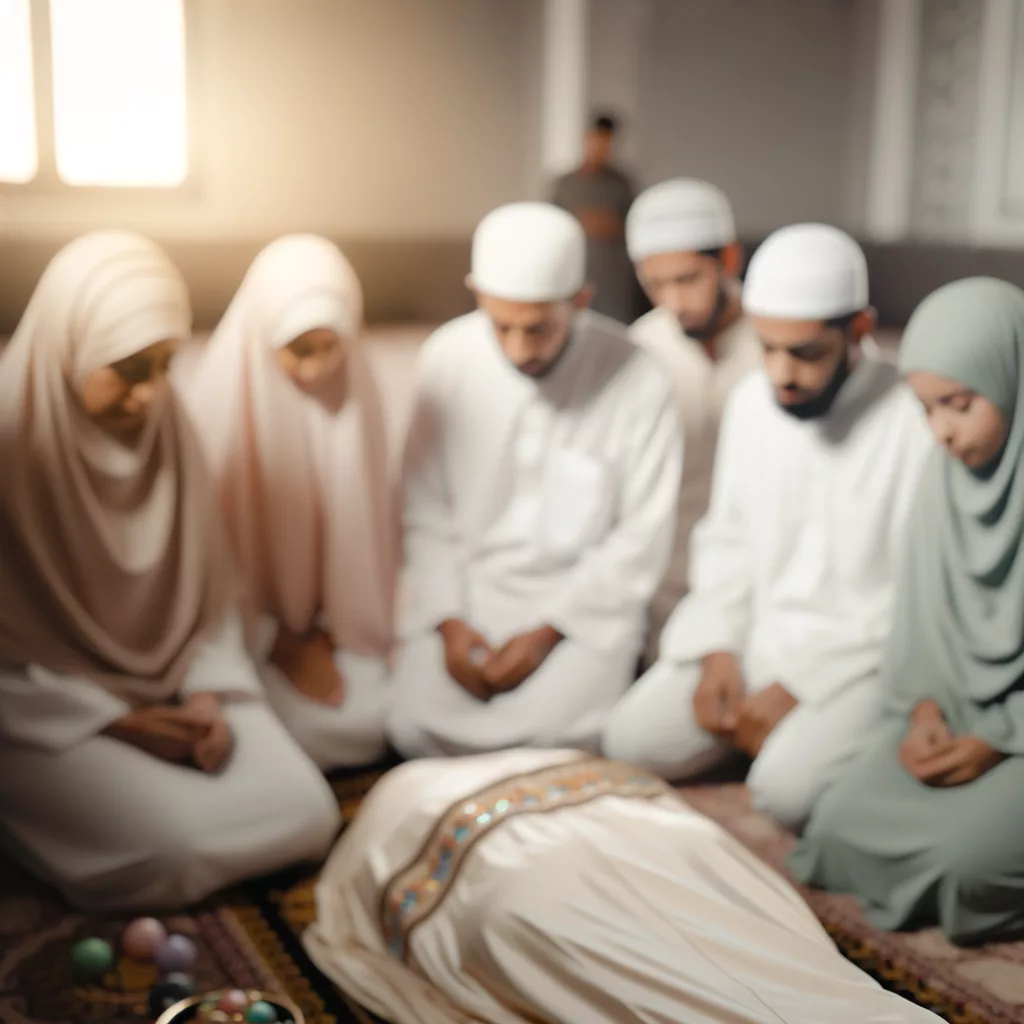
Funeral rites in Islam touch the very essence of the Muslim faith and the depth of Islamic spirituality. When a loved one leaves this world, every gesture and every word takes on a sacred dimension: the prayer for the deceased, Islamic invocations, dhikr, and also the ritual care of the body invite an intimate soothing and gratitude towards Allah. Faced with loss, every Muslim in France instinctively finds themselves reconnecting with the sunna of the Prophet, questioning community tradition and seeking clarity on the essential steps to take. But between French administrative requirements, the diversity of practices and the need to preserve the spiritual dimension, Muslim families often run into particular challenges in which Muslim identity, Islamic culture and the concern for a faith that is truly lived are intertwined.
At such moments, understanding the true meaning of funeral rites in Islam, both in terms of fiqh and of the prophetic tradition, becomes an act of spirituality in itself. It is also here that learning Arabic or immersing yourself in literary Arabic takes on a renewed significance: to grasp the beauty of the Qur’an in Arabic during the janaza prayer, to read with contemplation the invocations dedicated to the deceased, or to pass on to Muslim children the living strength of the sunna and of dhikr. Learning Arabic, immersion in Arabic without translation, reading and memorising the Qur’an, the science of hadith: everything comes together to allow an authentic connection at the very heart of moments of mourning.
This article sets out to explore the richness of funeral rites in Islam through a spiritual, linguistic and community lens, paying particular attention to the experience of Muslims in France. It discusses the importance of solidarity and the role of mosques, the need for patience and sincerity during the trial, and also the art of passing on the essential gestures and words to the next generation. Let us walk this path of meaning and gentleness together, so that every step, every prayer, every Arabic word brought to the lips becomes a source of light, inner peace and hope for the grieving heart.
Understanding funeral rites in Islam: spiritual meaning, procedures and specific features in France
Understanding funeral rites in Islam lies at the crossroads of spirituality, respect for religious prescriptions and the specific reality lived by Muslims in France. In the light of the Muslim faith, the death of a loved one is not only a painful event; it also calls forth hope in divine mercy and deep belief in life after death, the very foundation of Islamic spirituality. Funeral rites in Islam, inspired by the Qur’an and the sunna and rooted in the example magnified by the Prophet and his companions, are designed to accompany the soul with dignity towards its final destination, emphasising patience, sincerity and gratitude towards Allah in the trial.
Performing the salat janaza (funeral prayer), the ritual washing of the body (ghusl), wrapping it in a simple shroud (kafan), and reciting du’a and dhikr bear witness to a deliberate simplicity and a deep humility before death. The practice of Islam in this context rests on understanding the rules of fiqh concerning death and the handling of inheritance, but also the ethics of mourning and community support, reflecting Islamic mutual aid and solidarity among Muslims.
In France, these procedures sometimes come up against cultural, legal and administrative specificities linked to secularism (laïcité), the need to obtain a burial or repatriation permit, and the organisation of funerals within the framework of the Republic. Muslim families then navigate between the wish to perform funeral rites in Islam faithfully to tradition and adapting to the realities of Islam in France. This adaptation is made easier by better Islamic education, consulting imams or scholars of the community, and access to authentic resources through learning literary Arabic. Reading the Qur’an in Arabic, memorising the Qur’an and mastering tajwid make it possible to grasp the depth of the invocations spoken at funerals, shed light on the meaning of departure and foster a peaceful relationship with death. In this way, immersion in Arabic without translation, understanding the Qur’an and studying tafsir or the hadiths strengthen families’ grounding in tradition while supporting their Muslim identity in French society. It is through this living link with the language and the sources that every ritual gesture takes on its full meaning, offering the believer comfort, meaning and hope in divine justice.
Learning Arabic and immersion in Arabic: the key to reading the Qur’an, funeral invocations and prayer for the deceased
In the solemn moments of funeral rites in Islam, the strength of the spiritual union with the deceased is fully expressed through the Arabic language. Learning Arabic, beyond mere language skill, becomes here an intimate access to the prophetic tradition and to the very source of the Muslim faith. When the time comes for the prayer for the deceased, or to recite the Islamic invocations specific to these moments – such as the du’a of the Janaza or the formulas of dhikr calling on divine mercy – the deepest connection is woven through a direct understanding of the sacred words, without the intermediary of translation. Diving into immersion in Arabic then awakens a new awareness: every sentence spoken carries a spiritual meaning, every sound has the power to comfort the living and to honour the passing of the departed.
Learning Arabic, and even more the literary Arabic of the Qur’an, gives the ability to read and feel the authenticity of the prayers and of the revealed passages of the Book. Understanding the Qur’an in Arabic at funerals brings light and serenity, whether you recite surat Ya-Sin in memory of the deceased, meditate on tajwid or savour the harmony of the tafsir of the Qur’an explained as closely as possible to the words of God. Knowing how to memorise the Qur’an makes it possible to recite, verse by verse, invocations rich in meaning and wisdom, while consolidating the practice of Islam in its final stages. Authenticity stands out even more when you grasp the depth of the hadiths on death, patience in Islam, repentance in Islam, or the words of the Prophet addressed to his companions or to the ahl al-bayt about the respect due to every soul returned to Allah.
In sorrow as in hope, immersion in Arabic without translation gives a unique flavour to prayer in Islam: khushu, that humility and concentration of the heart during the salat janaza, takes deep root when you grasp the exact meaning of the invocations of tawba and gratitude towards Allah. This language mastery, patiently acquired, accompanies Muslim spiritual life beyond the rites: it shapes Muslim identity and nourishes Islamic inner peace and Islamic solidarity in times of trial. It weaves a discreet but powerful thread between the Muslim community – whether in France or around the world – and the great moments of the history of Islam, from the teachings of the sira of the Prophet to the practices shared in the mosque, around the imam, Muslim families and Muslim children filled with wonder at hearing the Qur’an in Arabic for the first time.
So learning Arabic in a spirit of total immersion offers the keystone of funeral rites in Islam: the ability to pray authentically, to pass on love of the Prophet and the compassion of the scholars of Islam, and to reaffirm, in the face of death, the luminous continuity of faith, meaning and spiritual transmission.
The role of the Muslim community and mosques in funeral rites: solidarity, the imam and organisation in the French context
In France, funeral rites in Islam are lived above all as a community experience, embodying the deep solidarity that binds the Muslim community together in the heart of adversity. When a death occurs, the mosque becomes an essential point of reference, not only as a place of prayer but also as a centre of organisation, support and comfort. The imam then plays a pivotal role: he guides the family through the complex administrative procedures, explains the ritual steps and recalls the teachings on death drawn from the Qur’an in Arabic, the sunna and the science of hadith. For many Muslims in France, such guidance also has an essential spiritual dimension, all the more meaningful when one strives to learn Arabic or to deepen one’s understanding of the rites by connecting with the original text, without translation. Immersion in Arabic during the funeral prayer (salat janaza), the Islamic invocations and the reading of the Qur’an fosters authentic contemplation and revives attachment to Islamic spirituality and Muslim identity. This moment allows everyone, families, friends and members of the Muslim community, to show mutual aid and kindness, to practise dhikr, and to express patience in Islam, gratitude towards Allah and Islamic solidarity, while drawing from the strength of the group the courage to overcome the trial. Beyond strict observance of funeral rites in Islam, the mosque and its imam remind us that going through the experience of death together also means keeping alive a living tradition, in which learning Arabic, the practice of prayer in Islam, reading and memorising the Qur’an, and knowledge of fiqh and tafsir nourish Muslim faith and inner peace every day. In this constant dialogue between customs, spirituality and transmission, the community truly comes together as one body, embodying the ideal of community mutual aid and Islamic education that shapes Muslim life in France, despite the challenges of the secular context.
Islamic spirituality, patience and sincerity in mourning: invocations, dhikr and passing the rites on to Muslim children
At the heart of Islamic spirituality, mourning is a deeply human and religious stage, in which patience in Islam (sabr) and sincerity in Islam (ikhlas) take on their full meaning. Faced with the loss of a loved one, the tradition encourages the regular practice of Islamic invocations (du’a) and dhikr, and meditation on gratitude towards Allah. These invocations, passed down by the Prophet and rooted in the sunna, are so many anchors for the Muslim faith, making it possible to find inner peace, consolation and hope in divine mercy, even in the trial of separation. Learning Arabic, or perfecting one’s learning of literary Arabic, then offers an invaluable advantage: pronouncing, understanding and meditating on the words of the Qur’an in Arabic in times of mourning, making the beauty of tajwid your own, or grasping the scope of the hadiths on patience, death and the hereafter, without an intermediary.
Immersion in Arabic, favoured by many Muslim families in France, also makes it possible to pass this spiritual and cultural legacy on to Muslim children. By listening to and reciting the surahs related to death, memorising the Qur’an, and discovering the invocations of the companions of the Prophet or the ahl al-bayt, Muslim youth gradually take in the gestures, the words and the intention of funeral rites. This living, embodied Islamic education helps forge a solid Muslim identity in the face of the trials of mourning, and also to perpetuate values of humility, hope, gentleness and solidarity within the Muslim community. Bringing the Muslim family together to read the Qur’an, sharing teachings drawn from the sira of the Prophet, or passing on the meaning of funeral rites in Islam soothes hearts and shapes a spiritual routine that will preserve the memory of the deceased while nourishing the faith of the living. Sincere patience, asking for forgiveness (tawba), oral transmission and attentive listening then create an atmosphere of spiritual well-being and trust in the wisdom of Allah, strengthening the practice of Islam and love of Allah and of His Prophet within the bereaved family.
Death, by its universal and inevitable nature, gathers humanity around essential questions of meaning, transmission and spiritual heritage. At the heart of funeral rites in Islam lies a deep wisdom: to accompany the deceased with modesty and care, to look after their dignity, to offer sincere invocations and to surround the family with human warmth. In France, these procedures take on a particular dimension, where the Muslim community, the commitment of mosques, the guidance of the imam and solidarity together weave a fabric of comfort and hope that respects the specific features of the French context.
Understanding the meaning of funeral rites means reconnecting with the depth of Islamic spirituality. It also means rediscovering the strength of the Muslim faith, the beauty of dhikr and of du’a recited for the departed, and patience in the trial of mourning. At every stage, Islamic education and passing on values to our children make it possible to perpetuate this living heritage so that it remains a source of peace and light for future generations. Learning Arabic then becomes an essential bridge: it is through mastering literary Arabic, through immersion in Arabic, through reading and memorising the Qur’an, that the sublime meaning of the funeral invocations, the beauty of tajwid, the understanding of the tafsir of the Qur’an, of the hadiths and of the sunna of the Prophet, the wisdom of the sira of the Prophet and the example of the companions of the Prophet and the ahl al-bayt fully open up.
On this journey, every believer, every Muslim family and every community in France learns to combine faithfulness to the prophetic tradition, concern for human dignity and respectful adaptation to French society. The practice of Islam, in prayer (salat), patience (sabr), gratitude towards Allah, and love of Allah and of the Prophet, unfolds in the simple gestures of daily life as in the most solemn rites. Whether by taking part in joumoua, through moments of contemplation during Ramadan or on hajj, through the festivals of eid, or in the emotion of a last farewell, everything works to remind us of the reality of fleeting life, the nobility of the journey and the promise of infinite mercy.
True peace of heart in the face of loss is cultivated in the balance between sincerity of faith, active patience, the quest for a deep understanding of the Qur’an in Arabic and the sharing of a rich and living Islamic culture. It is in learning Arabic, without translation, through immersion and listening, that the power of the divine message, the finesse of the scholars’ legacy and the universal dimension of Muslim identity in France are revealed. So passing on and living funeral rites in Islam also means preserving the essence of a civilisation, placing our actions in the continuity of the history of Islam, and taking part, with humility and hope, in building a more brotherly, just and peaceful world.
Further reading: discover our online Arabic courses for adults, or read “Learning Arabic and understanding Muslim funeral rites in France” and “Learning Arabic to strengthen your faith through personal crises“.



