
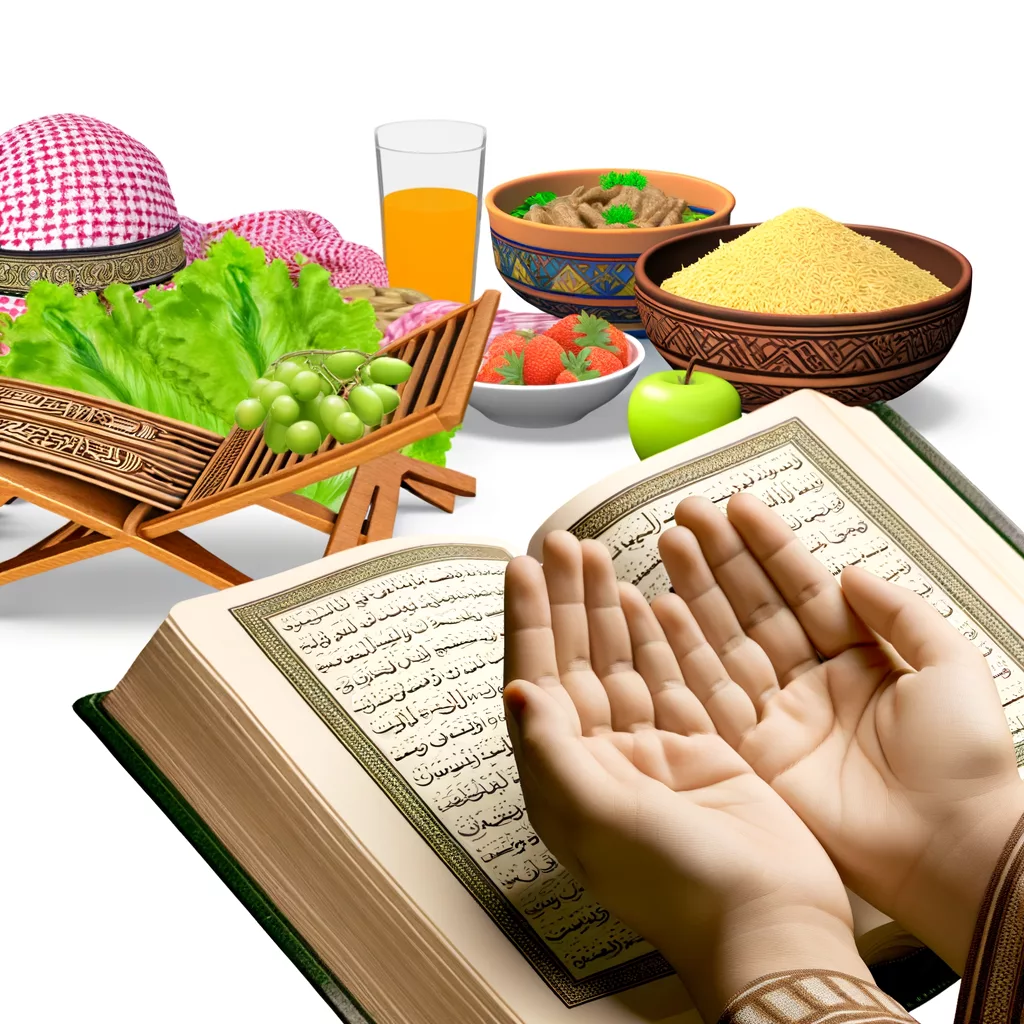
Why are certain foods forbidden in Islam? Beyond a mere list of dietary prohibitions, what do we find in the Qur’an in Arabic and in the sunna? For many, the question of halal food seems to be nothing more than a series of rules to follow. But for anyone seeking a deep understanding of Islamic spirituality, behind every prohibition lies a subtle wisdom, a teaching that touches on the Muslim faith, health, ethics and the elevation of the soul. These wisdoms remain veiled until one opens up to the richness of the Arabic language itself.
Learning Arabic is not simply acquiring a tool for communication: it means stepping through the door of an authentic understanding of the divine messages. It means rediscovering, through reading the Qur’an in Arabic, the exact scope of the words, the nuances and the purposes of Islamic legislation. It also means immersing yourself in the science of hadith and the history of the Companions of the Prophet, grasping what the sunna teaches about well-being, purity and moderation (wasatiyya) in the practice of Islam. Learning Arabic invites us to read, to feel, to honour the beauty of creation through gratitude towards Allah, and to practise sincerity in every aspect of daily life, right down to what is on our plate.
Immersion in Arabic, without the intermediary of translation, positively transforms the way one approaches dietary prohibitions. It sheds light on the meaning of terms such as halal and haram, and connects each prescription to a profound spiritual logic. Understanding the Qur’an in Arabic, exploring Qur’anic tafsir or the science of fiqh, means realising that eating is also an act of faith, a path of purification (tazkiya), and part of the spiritual routine of Muslim life.
In this article, we will dive into the age-old wisdom that runs through the dietary prohibitions in Islam, in the light of literary Arabic. We will discover how learning Arabic reveals the subtle balance between health, spirituality, history and Islamic conduct, and how the conscious practice of eating, inspired by the Qur’an and the sunna, shapes the Muslim family, the community and Islamic civilisation as a whole. Perhaps you will discover, as you read on, that learning Arabic also means learning to taste the divine wisdom that nourishes the body, the mind and the heart.
Understanding dietary prohibitions: diving into the wisdom of the Qur’an in Arabic and the sunna
Understanding the dietary prohibitions in Islam means, above all, diving into the deep ocean of wisdom that runs through the Qur’an in Arabic and the sunna of the Prophet. As soon as one approaches this subject, it becomes clear that only a careful reading of the original text – in the literary Arabic of the Qur’an – makes it possible to grasp the subtlety of the dietary laws and the beauty of their purpose. Far more than a simple code of prescriptions and prohibitions, the Qur’an, through its precise and nuanced language, reveals a subtle balance between the health of the body, the purity of the heart and the elevation of the soul. When one chooses to learn Arabic, or to immerse oneself in Arabic without systematically resorting to translation, one gives oneself the chance to taste the authentic flavour of the verses, to feel their rhythm and overall meaning, and to access their deep wisdom.
Understanding the Qur’an in Arabic then illuminates the inner logic of the dietary prohibitions: protecting physical well-being, safeguarding human dignity, developing patience in Islam, and educating towards gratitude to Allah and a constant awareness of His presence. The Qur’anic words, with the force of their sound and the precision of their meaning, reveal that every prohibition – from pork to alcohol, by way of blood and carrion – aims to raise the practice of Islam from a simple gesture to a true act of faith. Through the study of tajwid and memorising the Qur’an in its original language, every Muslim is invited to meditate on the intimate links between inner purification, halal food and the pursuit of sincerity in Islam. Qur’anic tafsir, traditional exegesis, deepens this reading by drawing on the science of hadith, the words of the sunna, and the living example of the Prophet and the Companions. Learning Arabic is therefore not only a key to understanding the rules, but also to embracing the ethical, spiritual and community dimension of the prohibitions, as lived and passed down through the history of Islam, the sira of the Prophet, the ahl al-bayt, and the scholars of every generation.
By drawing closer to the Qur’anic text in its own language, one discovers that every prescription aims to build Muslim identity on self-mastery, moderation in Islam and gratitude. The dietary prohibitions then become milestones on the path of spiritual well-being, patience and inner peace in daily life. They bear witness to a divine pedagogy in which every detail of the sharia and of fiqh embraces, beyond the norms, Allah’s love for His creatures and His will to preserve them, educate them and raise them towards the best of themselves. That is why learning Arabic and being introduced to authentic immersion in Arabic opens an irreplaceable door: that of a deep understanding of divine wisdom, a wisdom that illuminates Muslim spiritual life as much as the concrete practice of eating and our relationship with Allah’s creation.
Learning Arabic to grasp the deep meaning of halal food and Islamic practices
Diving into the heart of the wisdom behind the dietary prohibitions in Islam requires far more than a simple list of permitted or forbidden foods: it calls for learning Arabic in order to immerse oneself in the deep meaning of the divine commandments and the prophetic tradition. By learning Arabic, one gains direct access to the language of the Qur’an, to literary Arabic, as it was honoured by the revelation. Understanding the Qur’an in Arabic, without translation, makes it possible to perceive the finesse of the terms used, the nuances of meaning, and the beauty of the divine discourse when it speaks of purity, gratitude towards Allah, patience in Islam or the distinction between halal and haram.
Becoming familiar with the Qur’anic vocabulary of halal food invites deep introspection about Islamic spirituality and the practice of Islam in daily life. Reading the Qur’an, memorising the Qur’an, learning tajwid and studying Qur’anic tafsir offer an irreplaceable immersion in Arabic: every verse relating to creation, sustenance and dietary prescriptions then reveals its full scope, in form as well as in substance. Through authentic hadiths and the science of hadith, one discovers the words of the Prophet and the attention he paid to purity, moderation and the health of believers, values that run through the whole tradition, from the sira of the Prophet to the teaching of the Companions of the Prophet and the ahl al-bayt.
This immersive learning reveals the wisdom of the sunna, the importance of tawba and repentance in Islam when one unintentionally strays from the prescriptions, and the link between mindful eating and the state of khushu in prayer. Understanding Arabic without going through translation frees one from the Western filter often placed on fiqh, fatwas, or the main lines of Islamic ethics. It makes it possible to approach, with fresh eyes, fasting in Islam, sobriety during Ramadan, the effort of voluntary fasting, or gratitude at eid al-fitr and eid al-adha.
Finally, by opening up to Islamic culture and the history of Islam through Arabic, one grasps that the dietary prohibitions belong to a broader project: that of a comprehensive Islamic education, shaping the soul, the body and society, inspired by divine mercy and wisdom. Learning Arabic then becomes an act of faith, a quest for coherence between belief and practice, an invitation to savour Muslim spirituality in all its authenticity, and to pass on this precious heritage to Muslim youth, to Muslim children, and to the whole community.
Dietary prohibitions and purification: immersion in Arabic in the service of Islamic spirituality
When one reflects on the depth of the dietary prohibitions in Islam, it becomes clear that they are not limited to the realm of the lawful and the unlawful. These prescriptions engage one’s whole being in a process of purification, in which body, heart and mind are intimately linked to Islamic spirituality. Their wisdom unfolds all the more powerfully when one adopts an immersive approach to learning Arabic. Understanding the verses of the Qur’an in Arabic, without going through translation, makes it possible to taste the subtle meaning of the terms used – whether in the category of pure foods (tayyib) or in references to dhikr, tawba or fasting in Islam. Through immersion in literary Arabic, every word and every construction reveals the spiritual dimension of actions, heightens awareness during Ramadan, ennobles patience in Islam and strengthens the sincerity of Islamic invocations.
Many aspects of the practice of Islam and of Islamic education around food can only be fully internalised by opening up to the original meaning transmitted in the sunna, the hadiths and the sira of the Prophet. By learning Arabic without translation and exposing oneself daily to the Qur’anic text, reading the Qur’an becomes a felt experience, in which listening, pronunciation (tajwid) and memorising the Qur’an merge with Muslim spiritual life. The Companions of the Prophet, the ahl al-bayt and contemporary scholars have all testified that examining every word and meditating on Qur’anic tafsir in Arabic sets in motion a form of authentic inner purification. It is no longer simply a matter of abstaining from certain foods, but of transforming all consumption into a conscious act, imbued with gratitude towards Allah.
Thus a deep understanding of the dietary prohibitions only takes on its full meaning when one learns Arabic in context, integrating it into one’s spiritual routine, prayer in Islam and voluntary fasting. Immersion in the language of the Qur’an sharpens the perception of purity, strengthens the Muslim faith, deepens khushu in salat, and awakens one to the universal dimension of Islamic solidarity – from the sadaqa of Ramadan to the zakat of eid al-fitr, from the community experience of the hajj to the wisdom of the Muslim calendar. Learning Arabic then means rediscovering the source of spiritual well-being, reconciling one’s Muslim identity with the practice of one’s faith, and making every food-related rite an act of inner peace and moderation in Islam.
History, society and nutrition: what learning Arabic reveals about Islamic civilisation and food ethics
When one opens up to learning Arabic, it is far more than a language that is revealed : it is the heart of a civilisation beating before our eyes. Learning Arabic, particularly through authentic immersion in Arabic, makes it possible to discover behind every word and every expression the faithful echo of a history, an ethic and a wisdom rooted over centuries. Understanding the Qur’an in Arabic, reading the sacred text without translation, illuminates the depth of the dietary prohibitions and prescriptions: nothing is arbitrary, everything fits into a comprehensive vision of spiritual and social well-being.
Literary Arabic unfolds the spiritual, but also social and nutritional, scope of the Qur’anic and prophetic recommendations. By studying Qur’anic tafsir or the science of hadith through the original language, one perceives the extreme finesse of Islamic dietary legislation. Respect for halal, the discipline of fasting in Islam, the integrity of halal trade, and also the fight against food waste all draw their strength from meticulous linguistic choices. The vocabulary of the Qur’an and of the sunna of the Prophet invites gratitude towards Allah, moderation, health and respect for life.
Learning Arabic without translation places each person in a posture of humility and curiosity, in direct contact with the ethical norm of Islamic civilisation. One discovers how far halal food goes beyond a simple prohibition : it structures Muslim identity, shapes Islamic solidarity, and frames spiritual and social health. The Companions of the Prophet, the ahl al-bayt, the scholars of Islam and Islamic universities such as Al-Azhar have passed down this holistic relationship with food, reconciling Muslim faith, science and society.
Through the sira of the Prophet or accounts of the Andalusian caliphate, immersion in Arabic reveals a history in which the table was a place of sharing, of ecology in Islam and of mutual aid within the community, but also of educating children in Islam, of modesty and of gratitude. Diving into the founding texts makes clear the intention to protect health, dignity and justice, while integrating spirituality into daily life. Thus the practice of Islam, far from being frozen, is in constant dialogue with the Muslim community and contemporary issues, giving every food and every prohibition the flavour of a living, universal heritage.
Exploring the depths of the dietary prohibitions in Islam, it becomes clear that they are not mere restrictions, but a path towards wisdom, purity and closeness to Allah. Discovering the roots of these prescriptions in the Qur’an in Arabic and the sunna of the Prophet opens a door onto the divine coherence that links faith, well-being, social ethics and inner balance. But this authentic understanding arises above all through learning Arabic, which offers direct access to the founding texts, without the screen of translation.
Immersion in Arabic, natural exposure to literary Arabic and familiarity with the concepts, turns of phrase and subtleties of the Qur’anic message make it possible to grasp the true meaning of halal food, of purification, and of the practices of Islamic spirituality. Understanding the Qur’an in Arabic, meditating on Qur’anic tafsir, exploring the sciences of hadith or rereading the sira of the Prophet and the lives of his Companions, means tasting an invigorating wisdom, nourished by direct experience of the language. Memorising the Qur’an, the precise pronunciation of tajwid and heartfelt recitation of invocations (dhikr, du’a) then take on a dimension of the heart, of khushu in prayer, of sincerity in repentance and of gratitude towards Allah.
Every dietary rule, every mention of halal or of a prohibition, carries a subtle pedagogy: educating in patience and self-mastery (notably through the Ramadan fast or voluntary fasting), cultivating moderation (wasatiyya), community solidarity (sadaqa, zakat), love of Allah and recognition of the blessings received. This heritage, found throughout the history of Islamic civilisation, from the scholars of Islam to the ethics of halal trade, illuminates daily rituals as much as moral commitment towards society, the Muslim family and the preservation of creation.
Diving into learning Arabic means reconnecting with the living sources of Islamic education and with every dimension of the Muslim faith. It means bringing new richness to one’s practice of Islam, in which understanding the sacred words is transformed into inner peace, spiritual well-being and alignment between heart, action and thought. Whether this path is approached out of intellectual curiosity, a thirst for spirituality or the desire to pass something on to one’s family, it becomes an act of sincerity in Islam, of humility and of openness that leads into a universal tradition.
Thus immersing yourself in the Arabic language means discovering that every prescription and every ritual – from the Friday prayer to the celebration of eid al-adha, from sharing within the family to solidarity in the Muslim community – regains its full meaning and radiance. Under the gaze of divine mercy and in the light of the Qur’an in Arabic, the dietary prohibitions reveal themselves as a gift: a path towards purification, spiritual maturity and the rediscovery of the deep peace that Islam promises. Learning Arabic means drawing closer to the original breath of the revelation and experiencing, day by day, the living wisdom that has flowed through the prophetic tradition across the centuries.
To go further: discover our online Arabic courses for adults, or also read “Learning Arabic and understanding the Qur’an: the virtues of patience” and “Learning Arabic to enjoin good and forbid evil“.



