
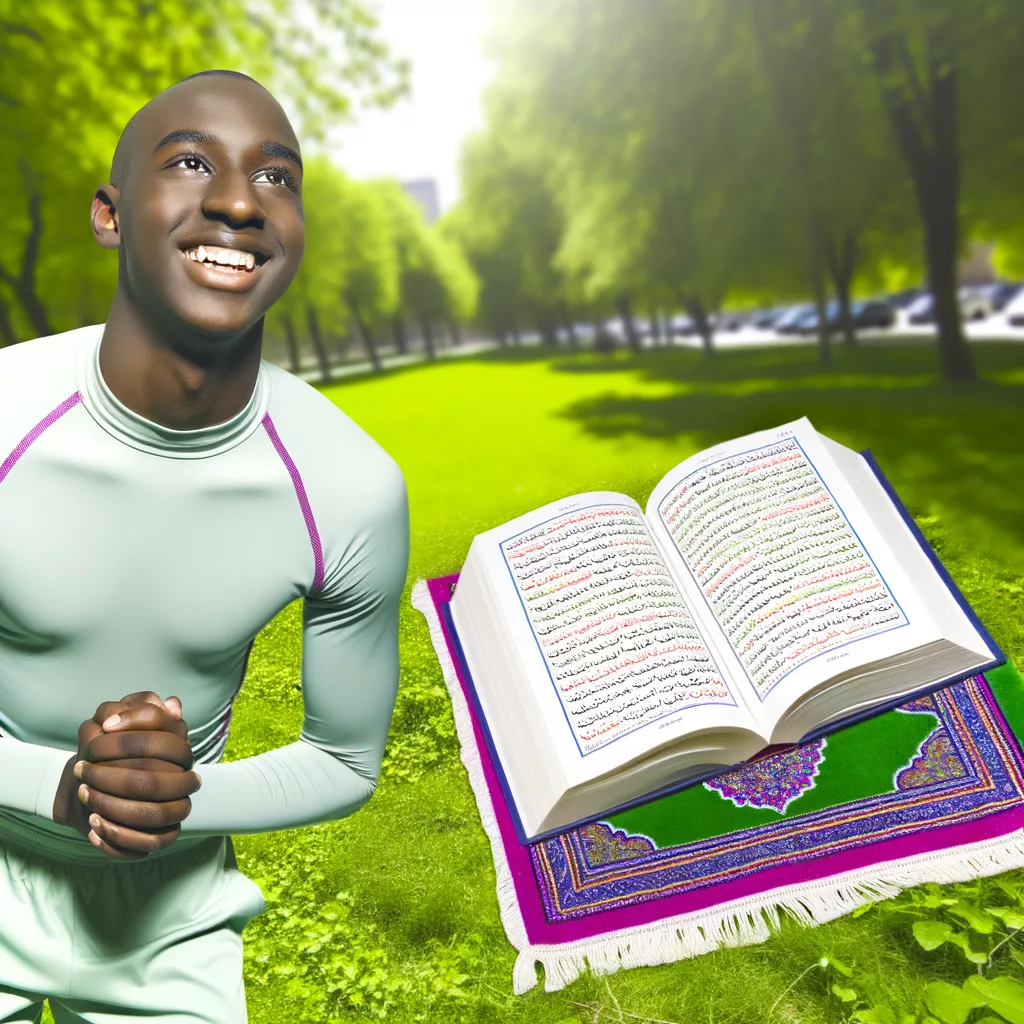
Reconciling sport, halal food and a healthy lifestyle: this challenge resonates today in the hearts of so many Muslims and people committed to the path of Islamic spirituality. How can you find a balance between physical vitality, scrupulous respect for dietary prescriptions, and the preservation of the Muslim faith in a daily life marked by constant demands? This intimate quest, far from being a mere arrangement of eating habits or exercise sessions, is carried by a greater breath: the desire for inner coherence, for alignment between body, soul and intention.
In this landscape shaped by the prophetic tradition, where every everyday gesture can become an act of worship, choosing halal food takes on a deep meaning. It is not only outward conformity with the sharia, but an approach of gratitude towards Allah, a conscious trust that the well-being of the body is an amānah, a sacred trust. The kitchen, the table and even the way we eat then become grounds for spirituality, where baraka finds its place in simplicity, moderation and the constant remembrance of the Creator.
Sport, far from being a superficial luxury, also stands out as a living practice of Islam. You need only recall the vitality of the Prophet and of the companions of the Prophet, the concern for physical well-being passed on by the sunna, or the beauty of the example of the ahl al-bayt, to grasp how much physical activity, discipline and rigour contribute to spiritual health. Patience in Islam, sincerity in Islam and self-mastery in effort find a concrete field of application there. Taking care of your body means honouring this gift from Allah; it means moving towards khushu in prayer, feeling inner peace during dhikr, and finding the energy needed for reading the Qur’an in Arabic, learning Arabic or memorising the Qur’an with refined tajwid.
Beyond performance or appearances, then, lies an invitation to moderation (wasatiyya), anchored in Islamic spirituality. Patience, motivation, discipline, gratitude towards Allah: these values irrigate every healthy lifestyle in the Muslim tradition. Every meal, every breath during exercise, every movement of the body can become a source of strength, humility and love of the Prophet.
What if we made daily life a ground for immersion, linking physical activity, halal food and learning Arabic, to nourish both body and soul? What if every routine became a piece of faith, every effort an invocation, every step a progression towards a true understanding of the Qur’an in Arabic, of the deep meaning of salat, or of the sciences of hadith? Through this article, travel to the heart of a possible harmony, guided by the Qur’an, the sunna and the living traditions of the scholars of Islam: a new way of living coherence, of embodying the beauty of the Islamic way of life, inner well-being and community influence.
Halal food and vitality: reconnecting with Islamic spirituality in every meal
Halal food goes far beyond simple conformity with a list of dietary prohibitions in Islam: it embodies a deep reconnection with Islamic spirituality, infusing every meal with a sacred intention. Eating halal means welcoming into your daily life Islamic ethics, gratitude towards Allah for the blessings granted, and respect for creation. This awareness, which the Prophet and the companions of the Prophet taught us through their akhlaq, transforms the act of eating into a true act of worship, a means of raising your Muslim faith and inviting baraka (blessing) into your life. Every mouthful, chosen and eaten according to the prescriptions of the sunna, nourishes not only the body, meant to be strong and dynamic so as to carry out salat, fasting in Islam or even hajj, but also the soul, which aspires to sincerity in Islam and inner peace.
When you reflect on the vitality that healthy, halal food brings, you better measure its role in the believer’s spiritual well-being and spiritual routine. This is a matter of patience in Islam, moderation in Islam (wasatiyya), and active gratitude for our daily gifts. This relationship with food is reminiscent of learning Arabic: it requires diligence, purity of intention, and immersion in Arabic to feel the depth of the Islamic invocations pronounced before each meal — du’a, dhikr, tawba. In this way, the words pronounced, understood in their literary Arabic, take on a new meaning, connected to reading the Qur’an, to the tafsir of the Qur’an, to memorising the Qur’an or to tajwid, strengthening presence and khushu in prayer.
Adopting conscious halal eating therefore means reconnecting positively with the practice of Islam in daily life: it is woven into family life, shapes Muslim identity and forms part of the education of children in Islam. Being attentive to this heritage means placing yourself in the continuity of the history of Islam and of Islamic civilisation, following the exemplary conduct of the ahl al-bayt and the wisdom of the scholars of Islam, past and present. Through this return to the sources, you discover that halal nourishes the body while elevating the mind, guiding you towards solid spiritual health and a balance in which every action, from the plate to the Friday prayer, becomes a vibrant echo of your love of Allah and of the overall well-being offered by the prophetic way.
Sport, health and balance: the body as a trust from Allah for a living practice of Islam
In the Islamic tradition, the human body is seen as an amana, a precious trust placed in our hands by Allah. This vision brings with it a deep responsibility towards our physical health and our general well-being. Taking care of yourself through sport, halal food and a balanced lifestyle is not just a personal choice: it is an act of gratitude towards Allah and an essential component of a living practice of Islam. When we commit to regular physical activity, we not only honour the trust of our body but also adopt the sunna of the Prophet, who took care of his health, encouraged endurance and recalled the importance of moderation – al-wasatiyya – in all things. This concern for balance is also found in the Muslim’s routine, between prayer in Islam (salat) punctuating the day, dhikr that soothes the heart, and the search for healthy food that conforms to the prescriptions of Islam.
Much more than a simple bodily effort, caring for the body is intimately linked to Islamic spirituality and spiritual health. Sport improves concentration during prayer (khushu in prayer), brings inner peace and fosters patience in Islam in the face of effort. This well-being contributes to the serene practice of fasting in Islam during Ramadan, of voluntary fasts, or during sacred times such as Dhul Hijjah. Making the effort to eat healthily, to observe the dietary prohibitions in Islam and to pay attention to where our food comes from means integrating every daily act into a dynamic of spiritual well-being, sincerity in Islam and gratitude towards Allah. This balance between sport, halal food and religious practice shapes, over the long term, a fulfilled Muslim identity, aware of the value of body and soul in Muslim spiritual life.
This holistic conception of well-being also has repercussions on Islamic education within the Muslim family: passing on to Muslim youth a concern for a healthy body, discipline, perseverance and moderation in Islam means giving them solid foundations for facing contemporary challenges. Caring for the body then becomes a form of silent da’wa, a testimony to the values of Islamic civilisation, which encourages respect, inner strength and balance. Finally, maintaining our health allows us to live the spiritual dimensions of Islam fully, to feel intensely the moments of reading the Qur’an, of the Friday prayer (jumu’ah), of the practice of Islamic invocations, or the unique moments of hajj and Umrah, where every step and every gesture become acts of faith and love of Allah. From this perspective, the balance of body and mind is nourished by a sincere intention and a deep understanding of the meaning of each act, which you also discover by opening yourself to learning Arabic and immersion in Arabic, so as to draw closer to the original message of the Qur’an in Arabic and enrich your spiritual life with an authentic light.
Between patience, motivation and discipline: drawing on Islamic spirituality for the keys to a healthy lifestyle
It is often difficult to stay on course with a healthy lifestyle in a busy daily life, between the temptation to slacken your efforts and the constant demands of modern life. Yet Islamic spirituality offers powerful resources for anchoring patience, stimulating deep motivation and cultivating discipline in the service of health – of the body as of the soul. In the prophetic tradition, every beneficial act, such as taking care of your health or eating halal, becomes an act of worship when the intention – the niyya – is turned towards Allah. The Qur’an in Arabic, read with meditation or learned by heart, recalls the importance of constancy: « Seek help through patience and salat » (Qur’an 2:45). Prayer in Islam, five times a day, structures the day, teaches time management and builds endurance; every rak’a, every prostration, is a training of the will and of khushu in prayer.
Learning Arabic, particularly through immersion in literary Arabic, also becomes an exercise in patience and discipline similar to sport: you progress little by little, without translation, savouring each step forward without being discouraged by difficulties. Memorising the Qur’an, reciting with tajwid, deepening the science of hadith, meditating on the sira of the Prophet or the words of the companions of the Prophet all invite you to persevere despite fatigue, and to get back up after every fall. During Ramadan, fasting in Islam illustrates self-mastery and everyone’s capacity to go beyond their limits, to feel gratitude towards Allah and empathy for the Muslim community. Through dhikr, invocation (du’a) or tawba, the believer learns to channel his energy, to manage his stress and to reconnect with his inner peace as a Muslim.
The example of the Prophet and of the pious generations, related in the sira, the sunna and the hadiths, bears witness to the balance between physical effort, care for the body, halal food and living spirituality. Eating mindfully, avoiding waste in Islam and preserving moderation (wasatiyya) in lawful pleasures lie at the heart of Islamic ethics. Just as in the Islamic education of children or in supporting the Muslim couple, encouragement is mixed with mercy, and discipline is rooted in the love of Allah. This is how the practice of Islam becomes the silent engine of a healthy lifestyle, in which every step, every breath and every meal taken with respect for halal food contributes to the elevation of the whole being.
Daily routine as a ground for immersion: linking physical activity, halal food and learning Arabic to nourish body and soul
In the continuous thread of daily life, every gesture and every choice can become the expression of a deep harmony between body and soul. For the Muslim who cares about his overall well-being, linking physical activity, halal food and learning Arabic proves to be an enriching routine, a true immersion in Arabic that nourishes the mind as much as the body. Taking care of your health through regular sport, while ensuring the balance and purity of your meals according to the prescriptions of halal food, already means honouring the Muslim faith by embodying the prophetic teachings on moderation and respect for the body, that trust for which we will be answerable before Allah.
But this routine takes on its full meaning when you integrate the breath of Islamic spirituality into it. Learning Arabic – and particularly literary Arabic – is no longer an isolated or abstract activity: it becomes part of the rhythm of the day, weaving a golden thread between your actions. Listening to a podcast on the science of hadith during a morning walk, reciting the Qur’an in Arabic between two sets of stretches, learning new expressions over a family breakfast: every moment becomes an opportunity to deepen your knowledge of the sacred language, without compulsory translation, through living repetition and a feel for the overall meaning. In this way, understanding the Qur’an, perfecting tajwid and even memorising verses happen naturally, carried by the physical and mental momentum of daily life.
The benefits of such a routine go beyond a simple concern for physical well-being. They encompass the quest for khushu in prayer, the internalisation of the sunna, the discovery of the sira of the Prophet and the inspiring stories of the companions of the Prophet or of the ahl al-bayt. Through this immersion in Arabic, the practice of Islam becomes harmonious: every sports session becomes a movement of gratitude towards Allah, every meal prepared with respect for the rules of halal food is an opportunity to recall dhikr, and every moment of fatigue carries the memory of patience in Islam and invites repentance (tawba) in humility and sincerity. In this way, the daily routine, focused on balance and coherence, is transformed into a true ground for learning Arabic, in the service of the love of Allah and His Prophet, of the elevation of Muslim spirituality and of the preservation of an authentically healthy way of life.
It is this alignment between intention, actions and knowledge that allows the Muslim to fully embody Islamic ethics, to anchor Islamic culture in everyday life, and to inscribe the memory of the sacred texts – from the Qur’an to the hadiths – even in daily gestures. It is no longer simply a question of health or knowledge; it is a walk, humble and determined, on the path to the inner peace made possible by the wisdom of Islam, respect for the body and the timeless beauty of the prophetic language.
Further reading: discover our online Arabic courses for adults, or also read “Learning Arabic to rediscover sincerity in worship” and “Learning Arabic in the light of the Prophet’s sira“.
Conclusion
Reconciling sport, halal food and a healthy lifestyle is not only a modern challenge; it is an aspiration deeply rooted in Islamic spirituality and the prophetic tradition. Through every carefully chosen meal, every moment of discipline on the mat, under the morning sun or in the silent gym, the beauty of an embodied practice of Islam takes shape: living, vibrant with love for the Creator.
Applying awareness and gratitude towards Allah to the act of eating – respecting the principles of halal food and rejecting waste – already means reconnecting with centuries of Islamic wisdom. Through this approach, the memory of the companions of the Prophet, of the ahl al-bayt and of the first generations is revived, when food, spirituality and health answered one another in perfect harmony. Taking care of your body, this amāna entrusted by Allah, also means taking part in building a strong Muslim community, inspired by the sunna, attentive to justice and moderation (wasatiyya), and active in mutual aid.
Committing to regular sport is no longer a simple search for performance or fitness. It is an act of worship, an expression of shukr – of gratitude for divine generosity. Effort, patience in Islam, and managing motivation and trials are part of a wider movement: that of jihād an-nafs, the inner quest for sincerity and inner peace in Islam, for developing discipline and surpassing oneself. In every controlled gesture, every deep breath, there is a share of dhikr, an opportunity to meditate on the perfection of creation.
The daily routine then becomes a ground for immersion – a favourable ecosystem in which learning Arabic fits in quite naturally. Imagine combining the preparation of a meal with the discovery of new words, listening to hadiths in literary Arabic while stretching, following the recitation of the Qur’an in Arabic during a peaceful break, or meditating on the tafsir of the Qur’an or the lives of the scholars of Islam on the way to the mosque: so many opportunities to make immersion in Arabic a living, present element of Muslim daily life.
From memorising the Qur’an to understanding the sciences of hadith, from khushu in prayer to reflecting on the history of Islam, from preparing for Ramadan to the morning invocations, every moment becomes a precious brick in the building of a balanced existence. Arabic, the language of the Qur’an, becomes the common thread linking food, sport and spiritual life, allowing you to taste the sweetness of prayer in Islam, the beauty of dhikr, sincerity and patience, and the strength of the community.
Living in this way means honouring the heritage and civilisation of Islam, walking humbly in the footsteps of the pious predecessors, and drawing inspiration from the great contemporary scholars such as those of the historic Islamic universities, from Al-Azhar to Qayrawan. It means giving meaning back to every gesture of daily life, and reviving Muslim faith, Muslim identity, spiritual health and bodily well-being, in a simple and luminous harmony.
By weaving together sport, halal food, learning Arabic, spiritual practices and community life, the believer places his routine within a dynamic of inner growth, balance and wisdom. He then gradually becomes that serene and radiant Muslim for whom every movement, every mouthful, every word learned in literary Arabic and every shared smile are so many paths leading to the love of Allah and to excellence in the practice of Islam.



