
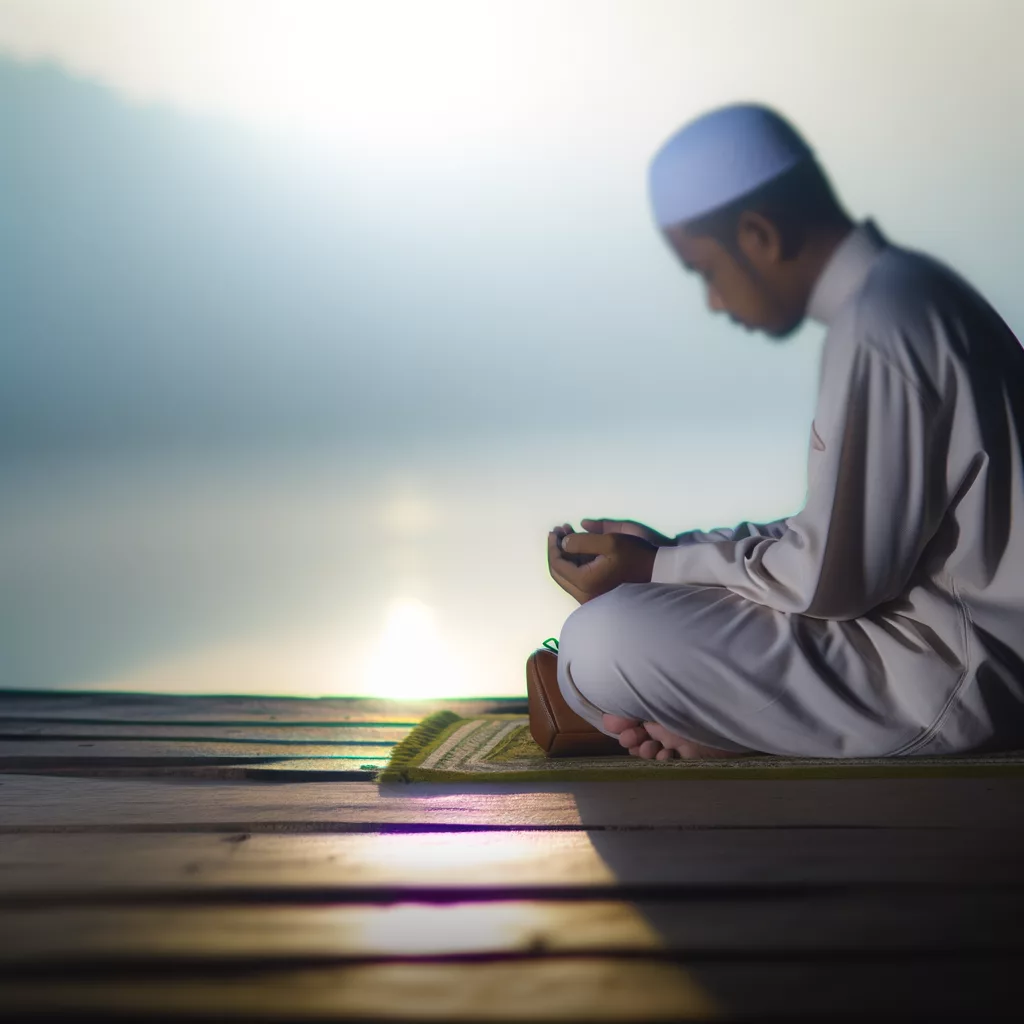
Rising at the very start of the day, when calm still wraps the world, or sitting in the serenity of the evening as the light fades… These are precious moments when the believer’s heart seeks refuge, comfort and guidance with Allah. The morning and evening invocations, those timeless formulas that the Prophet Muhammad ﷺ passed on to his companions and his family, are far more than a pious routine. They are a breath of spiritual life, a compass for the Muslim faith, a subtle bridge between earth and heaven. In every word of these Islamic invocations (du’a, dhikr) vibrates the light of the Qur’an and the echo of the sunna; in every syllable resounds the age-old history of Islamic spirituality.
Yet how many of us, French-speaking Muslims, feel that deep frustration at not being able to fully grasp the meaning of the invocations in Arabic? Learning Arabic opens the door to a living understanding of the Qur’an in Arabic, to the unique flavour of the hadiths, to the intimacy of the words of prayer in Islam (salat), and to the hidden beauty of the morning and evening formulas. It is far more than academic learning or a simple translation: it is an immersion in Arabic, a plunge into the revealed language, to savour dhikr as the Prophet ﷺ did, to listen to the adhan with a heart vibrating with meaning, to feel khushu in prayer, and to pass on to our Muslim children a deep and authentic Islamic education.
In our modern lives, saturated with information and demands, reconnecting with the real experience of dhikr and everyday du’a is an anchor. Memorising the invocations in Arabic, reciting them consciously, and a deep understanding of tajwid, of the tafsir of the Qur’an, or an intimate connection with the sira of the Prophet are keys to inner peace, resilience and spiritual growth. It is also an immense cultural heritage, rooted in the history of Islam, Islamic civilisation and the Muslim spiritual life passed on through the generations, from contemporary scholars back to the first companions of the Prophet, from the plains of Medina to the universities of Zaytuna or Al-Azhar.
This article invites you to (re)discover the power of the morning and evening invocations: why they are at the heart of the practice of Islam, how to live them with presence thanks to learning Arabic without translation, what concrete benefits they bring to your spirituality, and how memorising them can transform your routine as well as your heart. Let yourself be guided, step by step, into the living world of dhikr, to meet yourself, your Creator and the prophetic tradition. For learning Arabic is not just learning a language: it is drawing from the source, drinking from the cup of meaning, and cultivating the love of Allah and of the Prophet at every sunrise and every sunset.
Why the morning and evening invocations are essential to the practice of Islam and to Islamic spirituality
The morning and evening invocations hold a central place in the practice of Islam and in Islamic spirituality. They are far more than words recited mechanically: they are a true refuge, a spiritual shield and an act of love towards Allah, allowing the believer to begin and end the day in the light of divine remembrance. Dhikr, the remembrance of God, intrinsically sets the rhythm of the Muslim’s life, turning every breath and every moment into an opportunity for authentic connection with the Creator. These invocations offer a precious balance between salat, the ritual prayer, and du’a, personal prayer, creating a continuity of Allah’s presence in daily life, beyond the formal moments of religious practice alone.
Reciting the invocations at dawn and at dusk, according to the sunna of the Prophet, means placing your life in the footsteps of the sira of the Prophet and his companions, who neither began nor ended their day without this act of authentic faith. Through their regularity, these acts of worship foster sincerity in Islam and strengthen patience, gratitude and trust in the wisdom of Allah. They fortify the Muslim faith in a world where stress, distraction and the loss of meaning become real trials for many. It is a spiritual routine that soothes the soul, develops khushu in prayer, and unites the Muslim family around the collective remembrance of Allah.
Learning Arabic and progressing in it, particularly through immersion in Arabic, allows you to taste deeply the meaning, the sound beauty and the power of the invocations drawn from the Qur’an in Arabic or from the hadiths. The morning and evening invocations are not just formulas: they are living teachings from the revelation, calls to tawba, to repentance in Islam, to gratitude towards Allah and to inner peace. Anchoring yourself daily in these rites gradually opens the doors to an intimate understanding of the tafsir of the Qur’an and the science of hadith, and makes literary Arabic resonate in everyday life, far from a translated and distorted Arabic.
The benefits of this practice cross time and the cultural diversity of the Muslim community, whether it lives in France or elsewhere. It connects the believer to the history of Islam and the lived experience of the scholars of Islam, irrigates their spiritual health, and protects their Muslim identity in a world where secularism, Islamophobia and the search for meaning shake convictions. The daily invocations recall the example of Islamic conduct marked by modesty, kindness and wasatiyya — the middle way — and are part of that community kindness found in the mosque, during the adhan, around Islamic solidarity or at the high points of Ramadan and the hajj.
Learning to memorise and recite these invocations in their original language, through literary Arabic, also means absorbing the living breath of the revelation, entering the rhythm of Islamic civilisation, drawing inspiration from the companions of the Prophet and the ahl al-bayt, and weaving a direct relationship with the sacred text, without filter or loss of meaning. Finally, it means placing your practice of Islam in the continuity of an age-old tradition, a guarantee of balance, serenity and inner fulfilment.
Learning Arabic to memorise and live dhikr: immersion in Arabic and spiritual benefits
Learning Arabic gives your heart a precious key to enter the most authentic dimension of dhikr, those morning and evening invocations that nourish the Muslim faith and strengthen Islamic spirituality. When you commit to learning Arabic, and even more so to immersion in Arabic, you open yourself to the very essence of the words the Prophet whispered at dawn or at dusk. Listening to, repeating and feeling these Islamic invocations in their original language lets you absorb intimately the beauty of literary Arabic, without the limiting mediation of translation. In this way, every la ilaha illa Allah penetrates the soul, every alhamdulillah arouses a deeper gratitude towards Allah, every astaghfirullah purifies the conscience and invites repentance in Islam. Immersion in Arabic turns simple recitation into lived experience: the sounds, the rhythms and the images carried by the Qur’an in Arabic settle lastingly in the memory and in the heart.
Memorising the Qur’an, du’a and the formulas of dhikr through learning Arabic is not a purely intellectual undertaking; it is an act of presence, a path towards khushu in prayer and Islamic inner peace. The whole body becomes a receptacle for the Word: the tongue pronounces, the mind meditates, the heart opens. The spiritual benefits of this immersive method are immense. When you recite an invocation while understanding its overall meaning – even gradually – salat, patience in Islam and gratitude take on a new flavour. The love of Allah, the love of the Prophet and the bond with the companions of the Prophet shine through every word of dhikr. Gradually, each du’a teaches you to converse with divine mercy, to taste sincerity in Islam and to grow your daily spiritual routine.
By rediscovering the Qur’an in Arabic, perfecting your pronunciation with tajwid, and marvelling at the nuances of the tafsir of the Qur’an or of hadith, the light of dhikr illuminates Muslim spiritual life in a new way. Whether you are a parent keen to pass dhikr on to your Muslim children, a young person searching for Muslim identity, or a believer wishing to strengthen your practice of Islam, learning Arabic without translation invites you to taste the depth of the sunna, to relive the sira of the Prophet and to integrate the wisdom of the scholars of Islam into your life. Immersion in Arabic, far from being a mere language skill, then becomes the vehicle of an inner transformation. The morning and evening invocations stop being mere words: they become breath, energy, refuge and a source of light for the believer’s heart, connected to the prophetic tradition and to the universal spirituality of Islam.
Memorising the invocations: methods, tips and the link with understanding the Qur’an in literary Arabic
Memorising the morning and evening invocations, or adhkar, is far more than an intellectual exercise: it is a journey to the heart of Islamic spirituality and a gateway to a deep understanding of the Qur’an in literary Arabic. For many Muslims, learning Arabic is an essential step towards making the authentic meaning of the invocations their own and feeling a real closeness to the divine word. Learning Arabic, especially when approached through immersion in Arabic and practice without translation, naturally speeds up memorisation. The ear then gets used to the musicality of Qur’anic language, the heart grasps the overall meaning, and the tongue is trained to recite with sincerity and khushu, that humble presence sought in prayer.
Among the effective methods, auditory repetition remains a pillar. Listening to the invocations every day, whether in slow recitation or following an imam in the mosque, gradually builds familiarity with the words and rhythms specific to dhikr. Arabic audio materials, when used without systematically resorting to translation, nourish a natural learning process, similar to that of a child acquiring their mother tongue. Combining this listening with careful reading of the written text, preferably in literary Arabic as revealed in the Qur’an, strengthens visual memory and correct pronunciation, which is essential for tajwid and the beauty of recitation. Taking the time to repeat each invocation, in small groups of words and out loud, lets you anchor yourself in the meaning without losing the thread of spirituality.
Bringing contextual meaning into memorisation transforms the experience: understanding the context of each du’a, and linking its words to a scene from the sira of the Prophet or to a great moment in the lives of the companions of the Prophet, brings the vocabulary back to life. This encourages you to go beyond simple mechanical recitation and rise towards sincere internalisation, gratitude towards Allah, lived patience in Islam and heartfelt repentance in Islam. The invocations thus become living landmarks, reminders amid the daily tumult, bringing inner peace. Studying the tafsir of the Qur’an and the science of hadith in Arabic offers the most dedicated an opening onto Islamic culture and the history of Islam, and makes every morning and every evening an appointment with their own Muslim identity.
Finally, involving Muslim children in memorising the adhkar from a very young age, through games, songs or as a family, creates a nourishing spiritual routine. Encouragement, everyday example and shared joy at each step forward foster in Muslim youth the love of Allah, the love of the Prophet and a sense of belonging to the Muslim community. Starting to memorise the invocations in Arabic thus opens the way to memorising the Qur’an, mastering fiqh, discovering the madhahib, exploring Islamic art, calligraphy and far beyond: it gives you the opportunity to live a rooted Muslim faith, a renewed spiritual health, and a practice of Islam authentically connected to its sources.
The invocations in the prophetic tradition: hadiths, the science of hadith and connection with the sira of the Prophet
In the prophetic tradition, the morning and evening invocations hold a central place. Their authentic origin is found in the collections of hadiths carefully transmitted and analysed for centuries by specialists in the science of hadith. There we discover that the Prophet Muhammad, peace and blessings be upon him, had established these moments of remembrance of Allah in the daily rhythm of Muslims, firmly linking them to the sunna and to the sira of the Prophet. These invocations are not mere formulas; they are the living expression of Islamic spirituality, carried by sincere intention (ikhlas) and awareness of Allah’s presence (taqwa).
Understanding these du’a and reciting them as they were passed down, in literary Arabic, allows you to resonate directly with the prophetic practice as it was lived by the companions of the Prophet and the ahl al-bayt. Here, learning Arabic takes on its full meaning: diving into immersion in Arabic and listening to the invocations without translation means reconnecting with the original freshness of these words, with their sound and spiritual beauty, and developing an intimate relationship with daily dhikr.
Beyond hadith, the sira of the Prophet outlines a spiritual routine anchored in every key moment of the day. The Qur’an in Arabic and the sunna converse harmoniously in this weaving of the Muslim faith: each invocation reveals how to live fully patience in Islam, gratitude towards Allah, sincerity in Islam and tawakkul (trusting reliance on God). The traditions report that many companions of the Prophet vied with one another in memorising the Qur’an and the invocations, eager to walk in the footsteps of the Messenger, to nourish their khushu in prayer, to deepen their tafsir of the Qur’an and to attain authentic Islamic inner peace.
The science of hadith guarantees the authenticity of these formulas and their faithful preservation through the ages, and it is an invaluable pillar of Islamic education and Muslim spiritual life. Starting to learn Arabic in this context transcends mere linguistic knowledge: it means opening up to the living heritage of Islamic civilisation, to a path towards spiritual well-being, a spiritual routine and the perpetuation of this heritage within the Muslim family, Muslim youth and the whole Muslim community.
Every morning and every evening, through this prophetic transmission, the whole history of Islam, the generosity of the scholars of Islam, the depth of Sufism and the harmony of the Muslim calendar are offered to anyone who humbly wishes to learn Arabic and absorb the essence of the Islamic invocations in the light of the love of Allah and the love of the Prophet.
The morning and evening invocations turn out to be far more than a simple routine: they embody a living bridge between Islamic spirituality, the practice of Islam and the quest for deep meaning in every moment of daily life. Each of these formulas of dhikr, drawn from the Qur’an in literary Arabic and the sunna of the Prophet, invites the believer to intimacy with Allah, to patience, sincerity, gratitude and repentance. They weave an invisible but powerful bond between the science of hadith, the aqida, fiqh and lived reality, leading little by little towards the inner peace every Muslim seeks.
Choosing to learn Arabic means opening yourself fully to the authentic taste of these invocations, without depending on a translation that is sometimes reductive. Immersion in Arabic allows you to inhabit every word of the du’a, and to taste the richness of the tafsir of the Qur’an or of the accounts of the sira of the Prophet and the companions with clarity and depth. Memorising the invocations then takes on a new dimension: it becomes an act of love for Allah and the Prophet, an effort that shapes the Muslim faith, develops patience in Islam and heightens awareness of every prayer in Islam, from the daily salat to the Friday prayer, from Ramadan to Laylat al-Qadr, from family life to the whole Muslim community.
Understanding the Qur’an without an intermediary, reading the Qur’an in Arabic, perfecting your tajwid, discovering the subtleties of hadith and of Islamic science in their original language: these are spiritual and intellectual privileges of rare intensity. Learning Arabic then becomes part of the tradition of the scholars of Islam, of prestigious universities such as Al-Azhar or Zaytuna, and of the Muslim families who pass on from generation to generation the beauty of Islamic reading, calligraphy, art and the culture that have shaped Muslim identity across centuries and civilisations.
Every invocation recited with presence, every verse of the Qur’an memorised, every word of the tashahhud articulated with khushu in prayer, becomes a source of spiritual well-being, a refuge from stress and trials, an act of modesty and inner peace. Dhikr then becomes a rampart against wasted time, a constant reminder of Islamic solidarity, zakat, patience, mutual help within the community and respect for creation.
In the morning and evening routine, in the simplicity of the Islamic invocations, lie hidden the treasures of prophetic wisdom, of tafsir, and of the collective spiritual memory of the Muslim community. Whether you are a Muslim child or an adult, a beginner in learning Arabic or passionate about Islamic studies, each recitation nourishes the inner light and strengthens the love of Allah.
The morning and evening invocations are not only meant for the baraka of the moment ; they are the golden thread connecting each person to the tradition, to prophetic guidance and to hope, whatever the challenges of modern life, the questions of secularism or identity, or the diversity of the Muslim community around the world. Absorbing their resonance at the very heart of literary Arabic means reconnecting fully with faith, giving the practice of Islam all its depth and Muslim spirituality its full living and universal dimension.
Further reading: discover our programme for learning to read Arabic (adults), or also read “Learning Arabic to live the ten days of Dhul Hijjah” and “Overcoming trials: learning Arabic to find patience“.



