
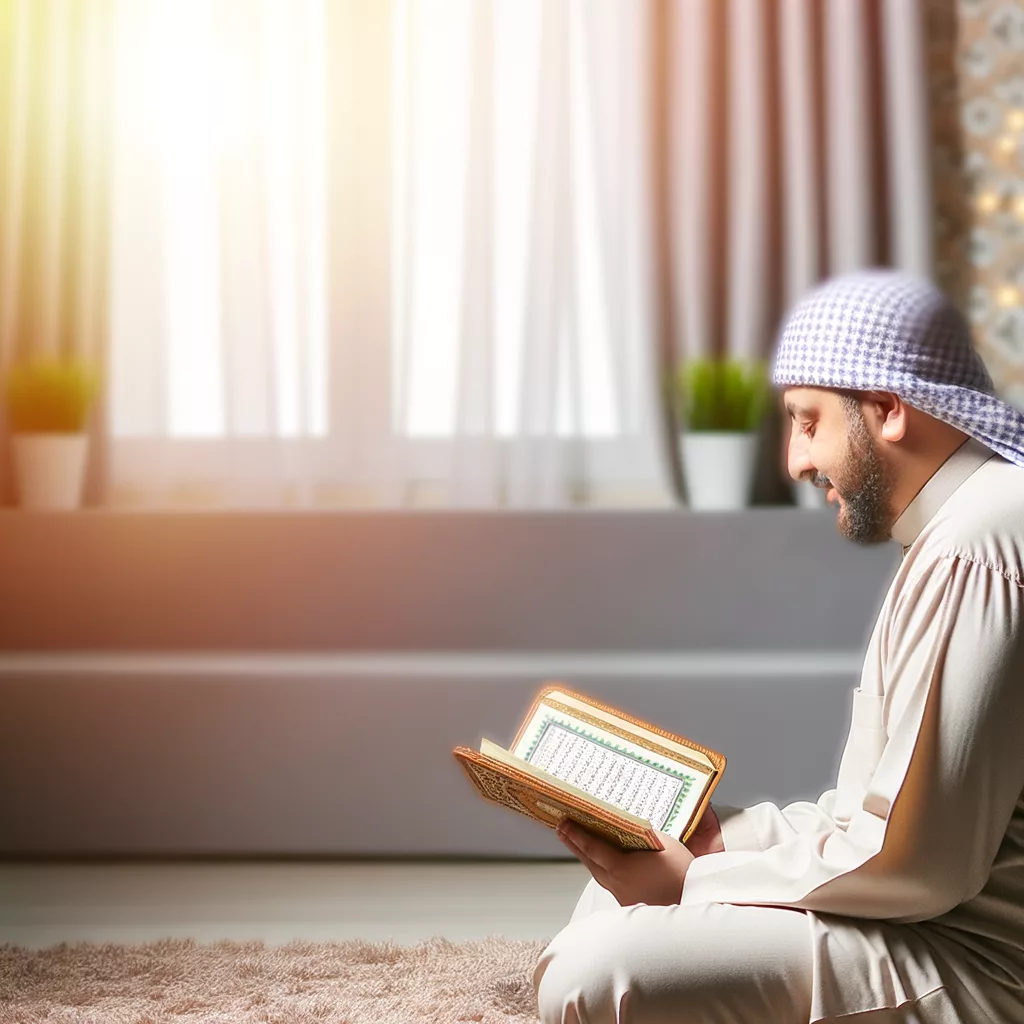
Who has never put off a prayer, postponed reading the Qur’an or left memorising a verse for later, promising to devote themselves to it fully “tomorrow” ? Procrastination, that discreet enemy of good, sometimes creeps into the noblest of activities : the practice of Islam and the care of our spirituality. It veils the light of dhikr, dulls the flavour of salat, blocks access to the serenity promised by the Qur’an in Arabic and delays our finest impulses towards Allah. Because the Muslim faith is not simply a sum of outward acts, but an inner journey towards peace, delaying practice, even unintentionally, can open an insidious distance between the heart and the Creator.
But where does this tendency to defer what actually nourishes our soul come from ? Modern life, fast and fragmented, multiplies the calls that run counter to a spiritual routine : incessant notifications, stress, fatigue, doubts or misunderstandings. Sometimes it is even the difficulty of learning Arabic, of understanding the Qur’an in its original literary Arabic or of grasping the deep meaning of the words of the Prophet that breeds discouragement and postponement. As if Arabic without translation, this language of the Revelation, were to remain forever distant from us, when it is a key to khushu in prayer, to sincerity in Islam, to patience, to gratitude, to the love of Allah and to a living knowledge of the sunna.
Yet down the ages, generations of Muslims have risen to this challenge. The companions of the Prophet and the scholars of Islam, from the first caliphs to Andalusian civilisation, constantly managed to rekindle the flame of motivation in the face of the obstacles of spiritual life. Their secret ? A living vision of faith, nourished by immersion in Arabic, familiarity with the tafsir of the Qur’an, careful recitation with tajwid, meditation on the hadiths and a daily routine woven from prayers, du’a, repentance, ethics and kindness towards the Muslim community.
This article reveals how to outwit, with clarity and gentleness, the many traps of procrastination in Muslim spiritual life. We will first explore the roots of this tendency to defer what matters most, in order to better understand its causes and overcome them. We will then see how learning Arabic and immersion in Arabic can rekindle motivation and transform reading the Qur’an and the practice of prayer, by reconciling heart and language. Next, we will build together an effective spiritual routine, without guilt or rigidity, but with constancy and love : prayer in Islam, dhikr, meditation, memorising the Qur’an, moments of silence and inspiration. Finally, we will draw from the companions of the Prophet and the great figures of the Islamic sciences a source of luminous examples, to face procrastination with confidence, patience and faith.
The path to a living, authentic, peaceful spirituality rooted in learning Arabic and understanding the Revelation is within reach of anyone who humbly wishes to commit to it. Overcoming procrastination means learning again to taste the sweetness of remembrance, and moving forward each day, towards Allah and towards yourself.
The roots of procrastination in the practice of Islam: understanding its causes to better overcome them
Procrastination in the practice of Islam is often rooted in inner fragilities that run through the believer’s mind and heart. It sometimes results from a kind of apprehension at the scale of what you wish to accomplish: reading the Qur’an, learning literary Arabic to understand the Qur’an in Arabic, or memorising the Qur’an with precise tajwid. This hesitation is born of doubts, shaky self-esteem or fear of failure, especially when one idealises without nuance the spiritual life of the companions of the Prophet and the first generations. Sometimes procrastination hides behind the illusion of infinite time, pushing salat, dhikr or a deeper study of fiqh and the tafsir of the Qur’an back to “later”, despite a sincere awareness of their importance. The distractions of modern life, mental overload, stress or doubt about being able to reconcile professional obligations, family life and Islamic spirituality add a further layer of complexity. A lack of real immersion in Islamic culture – for example, practising Arabic without translation in order to taste the depth of the surahs as they were revealed – can also distance you from the meaning and the authentic joy of practice, reducing the rituals to automatic habits. By understanding that procrastination is often rooted in a lack of clarity about the why of each act – love of Allah, gratitude towards Allah, the quest for inner peace, sincerity in Islam and the search for khushu in prayer – it becomes easier to overcome these obstacles. Returning to a pure intention, surrounding yourself with a caring Muslim community, drawing inspiration from the history of Islam and the accounts of the sira of the Prophet, or integrating immersive learning of Arabic into your daily life gradually lifts the veil of procrastination and allows you to approach the practice of Islam with renewed energy and an invigorating faith.
How immersion in Arabic and understanding the Qur’an strengthen spiritual motivation
Diving into learning Arabic through real immersion in Arabic, far from the barriers of translation, opens an unsuspected door to motivation and perseverance in religious practice. Understanding the Qur’an in Arabic, in its original language, is not only accessing a text; it is tasting the depth of the revelation, feeling the subtlety of the divine word, perceiving the musicality of tajwid, and experiencing the reading of the Qur’an as a living experience. Every verse, every word recited or memorised then takes on a personal and vibrant meaning. The hadiths, the sira of the Prophet and the history of the companions of the Prophet, discovered in literary Arabic, take on a new dimension through the prism of Islamic spirituality: they become direct sources of inspiration, concrete models for patience in Islam, gratitude towards Allah and love of the Prophet.
This learning of Arabic without translation frees you from the trap of mechanical routine and spiritual laziness. It naturally sparks a surge of desire and a renewed sincerity in Islam: every step forward in understanding the tafsir of the Qur’an, every new Islamic invocation understood, brings you back to a deeper and more embodied Muslim faith. Prayer in Islam and khushu in salat gain in authenticity, because the words of praise, of tawba or of dhikr now resonate within. Spiritual motivation, which sometimes wavers amid repetition and procrastination, regenerates itself through the intimate feeling of being connected to the great chain of the Islamic tradition, at the heart of Islamic civilisation. Even the times of fasting in Islam, Ramadan, the Friday prayer, or preparing for the hajj and the umrah are transformed, because literary Arabic gives the rites and the wisdom of the sunna their full meaning.
For Muslims in France or elsewhere, learning Arabic through immersion brings Muslim identity back to life, encourages integration into the Muslim community and allows active participation in exchanges at the mosque, during jumu’a, or on hearing the adhan. It is a key to passing on to the Muslim family, to Muslim children and to Muslim youth a renewed love for the practice of Islam and for Islamic spirituality. Thanks to direct understanding, procrastination recedes and gives way to an invigorated spiritual routine, a more stable spiritual well-being, and an inner peace nourished daily by the living Word of Allah, in its original beauty.
Building an effective spiritual routine: prayer in Islam, dhikr and memorising the Qur’an without procrastination
To build an effective spiritual routine that truly outwits the traps of procrastination, it is essential to give religious practice a central and living place in your daily life. Prayer in Islam (salat), for example, is far more than a simple repetitive ritual: it shapes our day, structures our time and tirelessly brings us back to the Presence of Allah. The regularity of salat, dhikr and Islamic invocations creates an atmosphere of inner peace, discipline and gratitude towards Allah. Integrating dhikr and du’a before and after each prayer, even with a few simple words, anchors the remembrance of Allah in each of our actions and thoughts, strengthening sincerity in Islam and khushu (contemplation) during prayer.
Memorising the Qur’an then takes on a new dimension, rooted in the pleasure of recitation and not in pressure or obligation. Relying on immersion in Arabic, even gradually, fosters understanding and feeling: seeking to learn Arabic without translation, absorbing literary Arabic and listening to passages of the Qur’an in Arabic every day turns memorisation into an act of closeness, rich in meaning and Islamic spirituality. Learning Arabic in a peaceful climate, without excessive demands, creates a space conducive to patience in Islam and to constancy. It becomes easier to dive into tajwid, to deepen the tafsir of the Qur’an, to meditate on the sunna and the hadiths, or to connect with the sira of the Prophet and the history of Islam, discovering the echoes of these teachings in every aspect of daily life.
Structuring your day around small, regular actions – reading a verse, repeating a divine name, revising the science of hadith, reflecting on modesty or gratitude – becomes a kindly spiritual routine that naturally fights procrastination. It also opens the door to moments of intimacy with Allah during Ramadan or the night of Laylat al-Qadr, at the Friday prayer, during the hajj, or simply at the heart of the Muslim home. In this dynamic, every prayer, every word recited, every step towards understanding the Qur’an in Arabic or towards the Islamic education of children becomes an act of love for the Prophet, a deep bond with the Muslim community and a constant path towards the flourishing of the soul and the preservation of Muslim identity, far from the dispersion and stress of the modern world.
The inspiration of the companions of the Prophet and the scholars of Islam in the face of procrastination in spiritual life
When procrastination threatens our spiritual life, we need only observe the luminous attitude of the companions of the Prophet and the scholars of Islam to draw from it an inexhaustible source of inspiration. The companions of the Prophet, may Allah be pleased with them, lived every moment with an acute awareness of the value of time, and the certainty that every act brought them closer to Allah. Faced with the temptation to put things off, they recalled the words of the Prophet Muhammad, who recommended performing prayer in Islam at the start of its time, increasing dhikr and Islamic invocations, and never delaying repentance in Islam. Their love of the Prophet nourished a deep motivation to seek sincerity in Islam and to constantly renew their intention, even in the simplest routine of daily life.
The scholars of Islam, whether from Al-Azhar, Zaytuna or the historic Islamic universities of Islamic civilisation, have always regarded learning Arabic, memorising the Qur’an, studying tajwid, the tafsir of the Qur’an or the science of hadith not as burdens to be postponed, but as honours and paths of spiritual elevation. Many of them report having devoted hours to immersion in Arabic and to reading the Qur’an in literary Arabic without translation, in order to grasp the unique beauty of the verses and touch the depth of a meaning that cannot be captured any other way. This discipline, nourished by patience in Islam and gratitude towards Allah, guided them against laziness and dispersion, reminding them that life is short and opportunities precious.
In the sira of the Prophet, the example of his companions such as ‘Abdallah ibn Mas’ud or Uthman ibn ‘Affan, known for their devotion to Islamic reading, to the Friday prayer and to memorising the whole Qur’an, shows that sincere Islamic spirituality is built on small, regular and constant efforts, more than on grand resolutions with no follow-through. They knew that putting off a good deed could mean losing it forever. Their spiritual routine, set to the rhythm of salat at the mosque, the recitation of dhikr, the search for khushu in prayer, fasting in Islam and charitable works such as sadaqa or zakat, still inspires the Muslim community today to cultivate deep spiritual well-being, to find Islamic inner peace and to turn each day into one more step on the path of drawing closer to Allah. Living forces of the Muslim faith, these models remind us that outwitting procrastination means, above all, choosing each day to sow good, with sincerity and constancy, driven by the love of Allah and the search for light, here and in the hereafter.
Further reading: discover our online Arabic courses for adults, or also read “Learning Arabic in the light of the Prophet and Islamic civilisation” and “Learning Arabic to better understand Qadr and destiny in Islam“.
Conclusion
In the sincere quest for a deep spiritual life, every Muslim sooner or later faces the difficulty of putting off their religious commitments until tomorrow. But by understanding the roots of procrastination and through the light of the prophetic tradition, it becomes possible to turn the practice of Islam into a source of inner peace and constancy. Immersion in Arabic, learning literary Arabic and reading the Qur’an without translation play an essential role here: they reconnect the heart to the original meaning of the revelation, bring to life the verses recited in prayer, and foster concentration (khushu) and sincerity in every salat.
Learning Arabic is not reduced to an academic exercise; it means drawing intimately closer to the Qur’an in Arabic, better savouring tajwid, the sweetness of dhikr and the strength of the invocations. Understanding the Qur’an in its language also means opening up to the subtleties of the sunna, the science of hadith and the tafsir of the Qur’an, and to the wisdom of the sira of the Prophet and of the companions who embodied spiritual perseverance every day. The example of the ahl al-bayt, the scholars of Islam and the first Muslims teaches us the importance of a balanced routine, nourished by patience, gratitude towards Allah and attachment to the love of the Prophet.
Outwitting procrastination in religious practice ultimately means shaping a gentle but firm discipline, adapted to your daily life, whether you are a young Muslim, a parent or an engaged member of the community. This involves making peace with time and anchoring your habits in the light of the Qur’an, from the Friday prayer to the daily salat, in memorising verses, Islamic invocations, tawba and acts of kindness. Every step taken towards Allah, however modest, helps to build a path of return to Him, marked by peace, simplicity, spiritual well-being and elevation.
On this journey, constancy is not synonymous with perfection, but with humility and sincerity in Islam. With every verse learned, every dhikr breathed between the lips, every reading of tafsir, every day of Ramadan or of voluntary fasting, the believer renews their faith and finds their place in the history of Islam, within the rich Islamic civilisation and a caring Muslim community. Whether by teaching your children, sharing knowledge at the mosque, or embodying patience in the face of obstacles, everyone can draw on the wisdom of the tradition and the living treasure of the Arabic language to re-enchant their spiritual routine.
So overcoming procrastination in the practice of Islam does not mean banishing all fatigue or difficulty, but learning to draw strength, motivation and inspiration from the divine Word, the prophetic model, and the companions whose entire lives shine with coherence and constancy. Where learning Arabic and immersion in reading the Qur’an weave a unique bond with faith, every Muslim can hope to savour fully the beauty of Islamic spirituality, the sweetness of inner well-being and the light that illuminates every life turned towards the Essential.



