
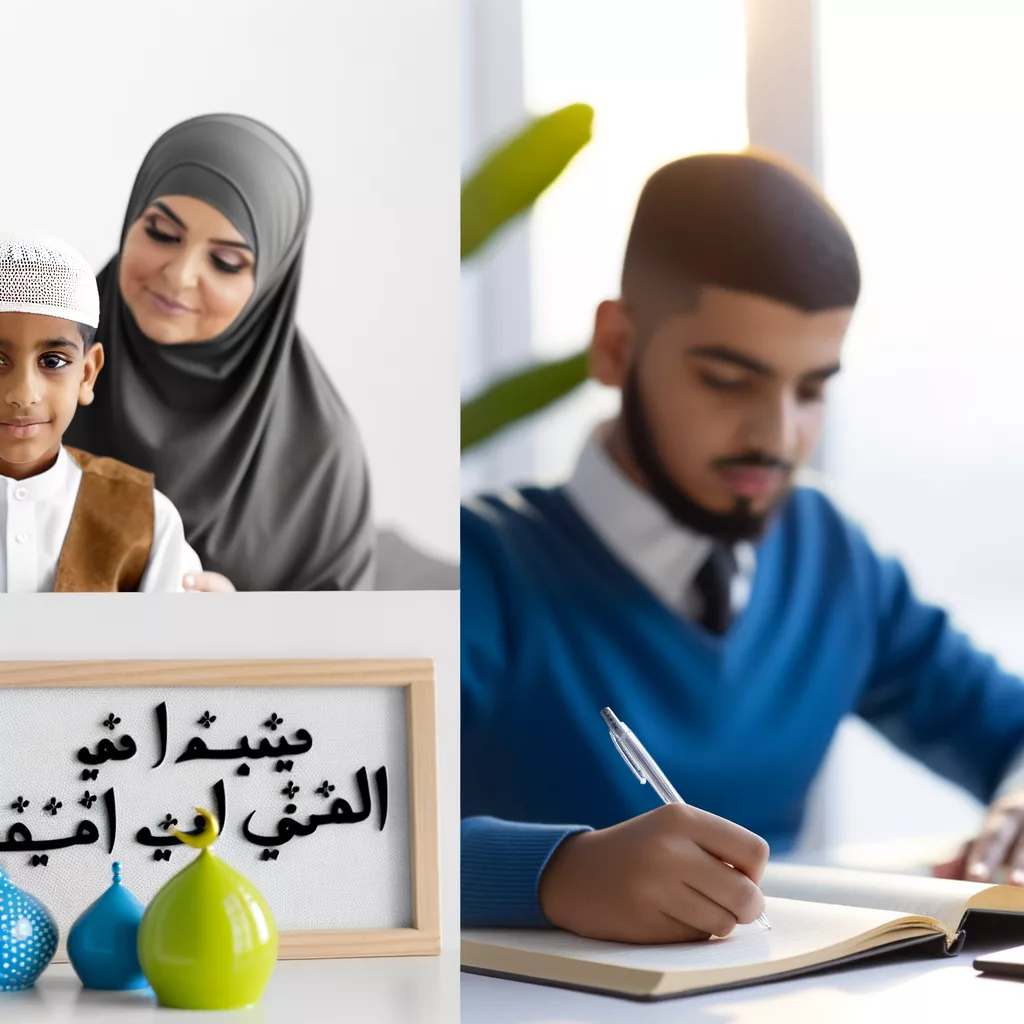
Preparing for Eid: traditions, decoration and family activities – Dive into the soul of the festival by reconnecting with the Arabic language and Islamic spirituality
Every year, as Eid al-Fitr or Eid al-Adha approaches, a singular atmosphere envelops Muslim homes all over the world. The streets are adorned with lights, houses fill with the scent of incense and pastries, and hearts beat faster, stirred by the joy of celebrating one of the greatest festivals of Islam. But beyond the material preparations and culinary traditions, this sacred period offers a unique opportunity: to reconnect, as a family, with the depth of Islamic spirituality and to revive the beauty of the Arabic language, a treasure passed down from generation to generation.
Preparing for Eid is not just about choosing pretty clothes or coming up with new decorations. It is also a precious moment to strengthen Muslim identity together, to return to the Qur’an in Arabic, to relive the story of the sunna of the Prophet and to pass on to our children the eternal values of gratitude towards Allah, love of the Prophet and community cohesion. If you feel a deep desire to draw closer to the true meaning of Eid and to cultivate the Muslim faith through simple and sincere gestures, learning Arabic as a family then becomes an essential bridge between traditions, knowledge and living spirituality.
Why not extend the magic of this festival through immersion in Arabic, the true key to understanding the Qur’an and the hadiths, and experience Eid differently? Decorations and activities, chosen mindfully, can become authentic rituals, awakening hearts to Islamic art, to calligraphy, to shared dhikr and to Islamic invocations recited together. Far from a mere succession of habits, preparing for Eid thus becomes an immersive, sensory and spiritual experience, weaving unforgettable family memories.
In a world where cultural and linguistic heritage is sometimes diluted over the generations, learning Arabic without conventional translation, reconnecting with literary Arabic and rediscovering the Muslim calendar together means offering our Muslim children much more than words: it means passing on to them the beauty of a civilisation, and opening their hearts to the science of hadith, to the sira of the Prophet and to the Muslim faith in its most authentic light.
Whether you are looking for decorating ideas, for educational games that combine fun with learning Arabic, or simply wish to give meaning to every family preparation, this article guides you step by step to celebrate Eid with depth, gentleness and sincerity. Let yourself be carried by the vitality of the Arabic language, the warmth of the Muslim community and the serenity of a spirituality lived day to day, to the rhythm of dhikr, invocations and gratitude towards Allah. Preparing for Eid then becomes much more than a festival: an invitation to live Islam in all its richness, hand in hand, heart to heart.
Learning Arabic as a family as Eid approaches: reconnecting with traditions and Islamic spirituality
As Eid approaches, every Muslim family feels a deep desire to reconnect with its roots, its traditions and the Islamic spirituality that gives the festival its meaning. It is at this unique moment of the year that learning Arabic takes on its full nobility: learning Arabic as a family becomes much more than an educational project; it is a wonderful bridge to the heart of the Muslim faith, to understanding the Qur’an in Arabic and to a living rediscovery of the prophetic traditions. Far from being a mere linguistic acquisition, immersion in Arabic, without translation, invites young and old to feel the authentic atmosphere of Eid, to absorb the deep meaning of the invocations (du’a), the calls of the adhan, the sunna of the Prophet, and the stories of his companions and his family (ahl al-bayt).
Around the family table, everyone helps one another to pronounce, read or memorise even a single verse of the Qur’an, a surah or an invocation of gratitude towards Allah, discovering together the miracle of revelation and the beauty of literary Arabic. Muslim children awaken to Islamic spirituality through stories from the sira of the Prophet, the science of hadith, the customs of jumu’ah, the formulas of dhikr or the prayers of Ramadan, woven naturally into the language of the Book. Teenagers, for their part, become fascinated by the meaning of hajj and the rites of Eid al-Adha, or get started with tajwid, the sublime art of reading the Qur’an and preserving its authentic pronunciation.
As a family, learning Arabic makes it possible to better understand prayer in Islam, to deepen khushu during salat, and to grasp the wisdom of the tafsir of the Qur’an and the meaning of forgiveness (tawba), patience and gratitude. It is in this warm climate, bathed in spirituality, that Arabic breathes new life into the decorations and rituals of Eid: every word and every formula takes on the flavour of an oriental fragrance, of a living prayer whispered in the language of the Prophet. In this way, Islamic education is no longer limited to abstract lessons, but becomes part of daily life, embodying Islamic culture, ethics, modesty and solidarity, and weaving between the generations a deep bond, that of Muslim identity.
Preparing for Eid also means offering your children a magnificent heritage: the ability to taste the inner peace of Islam by understanding its founding texts, its poetry, its songs, and even its calligraphy and art. Learning Arabic as a family, through immersion and living practice, means passing on to Muslim youth the secret of spiritual happiness, of serenity amid everyday stress, of strength through trials, and of the pure joy of celebrating the most beautiful festivals of Islam together.
Passing on the language of the Qur’an as a family as Eid approaches
As Eid approaches, every detail of the preparations takes on a particular depth for the Muslim family. Beyond the festive traditions and decoration, this sacred period invites us to reconnect with the roots of our Islamic spirituality and to strengthen family ties around the authentic meaning of the Muslim faith. At the heart of this approach, learning Arabic takes on a precious dimension: it is not only about acquiring a linguistic skill, but about giving Muslim children and adults alike direct access to literary Arabic, the language of the Qur’an, of hadith, of the sunna and of the whole rich Islamic tradition. Diving into immersion in Arabic and living Arabic without translation allows family Islamic education to take root in a true understanding of the rites, invocations and stories that mark our festivals, from the words of dhikr to the du’a of Eid.
Reading the Qur’an in Arabic, absorbing its sounds, attempting to memorise its verses or getting started with tajwid as a family are all acts that shape Muslim identity and turn these moments into steps towards greater khushu in prayer, gratitude towards Allah and love of the Prophet. When parents and children discover together the meaning of Eid al-Fitr or Eid al-Adha through the sira of the Prophet and the history of Islam, the house becomes a home of knowledge, Islamic ethics and shared joy. Awakening to the Arabic language, to the tafsir of the Qur’an, to the science of hadith or to the history of the companions of the Prophet then nourishes much more than the intellect: it feeds inner peace, pride in a spiritual identity, and the balance between tradition and contemporary life, while placing learning Arabic at the centre of the transmission and practice of Islam within the Muslim family.
Eid decoration and atmosphere: immersion in Arabic to rediscover Islamic art and culture
Filling your home with the lights of Eid is much more than a simple matter of decoration: it means creating an atmosphere where every object tells a story and every detail invites spirituality. In many Muslim homes, garlands, colourful hangings, lanterns and calligraphy dress the house in a unique atmosphere that awakens faith and conviviality. But imagine that every hanging word, every pattern on a plate, every banner wishes Eid Mubarak in literary Arabic, in the very language of the Prophet and of revelation. Eid then becomes the point where beauty, identity and spirituality meet.
Taking part in this immersion in Arabic means rediscovering Islamic art in all its depth. Every piece of calligraphy carries the breath of the Qur’an in Arabic, and every arabesque or geometric pattern recalls the harmony of creation and the refinement of Islamic civilisation through the centuries. Muslim children, faced with these sinuous, sparkling letters, wonder, ask and learn: “What does this mean? How do you read it?” Learning Arabic is then no longer a school effort, but a living key, offered to understand Islamic invocations, to pronounce a du’a, and to recognise the name of Allah decorating a canvas. The whole house becomes a school of Islamic spirituality and shared meaning.
When you choose to learn Arabic without translation, immersing yourself in the language that reigns over these decorations, eyes and hearts open to a new dimension. Reading the Qur’an, memorising the Qur’an, dhikr and even listening to the adhan take on a more intense flavour, charged with meaning, because they resonate with what you see and touch during these blessed days. The traditional arts of Islamic calligraphy, passed down from generation to generation in the Muslim world, also tell us of the treasures of the science of hadith, the sira of the Prophet, and the wisdom of the companions of the Prophet and the ahl al-bayt engraved in the visual memory of peoples.
Preparing the Eid decorations as a family is then a precious moment of Islamic education. You give yourself the pleasure of passing on to your children the beauty of the prophetic language, while sharing stories about the Muslim calendar, the Islamic festivals, the rites and the universal vocation of Islam through art, writing and culture. It means marvelling at the modesty of the forms and the richness of the colours, and feeling in every symbol the breath of a love of Allah and of the Prophet embodied in the daily life of the Muslim family.
By experiencing this immersion in Arabic during Eid, decorating becomes an act of gratitude towards Allah, a visual reminder of patience in Islam and sincerity in Islam. The house, a small family mosque, becomes a home of inner peace where Muslim identity asserts itself without excess, in the rediscovered joy of traditions. Thus, preparing the festive atmosphere is no longer separate from learning Arabic, but becomes its natural soil, invigorating and deeply rooted in Islamic spirituality and the culture of the ummah.
Eid, a living immersion in Islamic culture and art
Preparing for Eid, whether Eid al-Fitr or Eid al-Adha, is a true journey to the heart of Islamic culture, a living and joyful immersion in Arabic where language, traditions and spirituality are subtly intertwined. Muslim families decorate their homes with lanterns and Islamic calligraphy, inviting Islamic art to express itself in every detail of daily life, while the words of literary Arabic resonate through the invocations (du’a) and the calls of the adhan. Muslim children thus learn, almost without realising it, the first letters of the sacred language, gradually opening up to reading the Qur’an in Arabic, to memorising verses while observing tajwid, and to understanding the sunna.
During Eid, every gesture becomes an occasion to pass on essential values of the Muslim faith such as gratitude towards Allah, patience and sincerity, as well as love of the Prophet and attachment to the companions of the Prophet or to the ahl al-bayt. Linking learning Arabic with the practice of Islam happens naturally: preparing sweets, reciting the Qur’an together in the morning, the communal salat at the mosque, and exchanging greetings in classical Arabic weave the precious threads of Muslim identity within the family and among Muslim youth.
Through decoration and the passing on of stories inspired by the sira of the Prophet and accounts of Islamic civilisation, Eid also becomes a space for authentic Islamic education—far from detached school methods, and carried instead by life, emotions, community and beauty. The spirit of immersion in Arabic without translation guides every moment: you discover the meaning of traditional expressions, learn to recognise the geometric patterns of Islamic art, and absorb the linguistic and cultural subtleties to the rhythm of the festival. Preparing for Eid, then, is not only about celebrating; it is also about cultivating, for young and old, a deep Islamic spirituality and a living understanding of the Qur’an and of Muslim practice, in a natural transmission where learning Arabic becomes a heritage as joyful as it is sacred.
As Eid approaches, every Muslim home feels that unique thrill where the joy of the festival, the warmth of reunions and the depth of Islamic spirituality intertwine. Preparing for Eid is not only about making your home beautiful or striving to bring the family together around festive activities. It is also, and above all, a wonderful opportunity to reconnect with our linguistic, cultural and spiritual roots – and to breathe new life into the Muslim faith within the home.
By choosing to learn Arabic together, as a family, Eid becomes much more than a succession of rites and customs. You dive into an immersion in Arabic that revives the bond with the Qur’an, the sunna of the Prophet and the whole heritage of Islamic civilisation. This approach goes beyond mere language practice: it makes it possible to understand the Qur’an in Arabic, to taste the beauty of tajwid while reading, to deepen your knowledge of tafsir, to grasp the deep significance of the hadiths, and even to bring more khushu and attention to prayer (salat). When every word of dhikr and every du’a is spoken in the language of the Revelation, the heart is imbued differently with patience, gratitude and sincerity towards Allah.
Rediscovering Islamic art and culture together through the decorations and atmosphere of Eid offers a natural and living way of learning Arabic, where children and adults alike rediscover the richness of Islamic calligraphy, the symbolism of architecture, and the beauty of songs and of the adhan, while weaving an unbreakable bond with past generations: the companions of the Prophet, the ahl al-bayt, but also the whole history of Islam, from the universities of Al-Azhar and Zaytuna to the splendour of the Andalusian caliphate.
Preparing for Eid in this way means choosing a peaceful path, full of meaning, where you raise your children in a deep love of literary Arabic, an intimate understanding of the Qur’an, a living practice of prayer, and a truly enlightened awareness of the values of the Muslim faith. Immersion in Arabic, without translation, places every festival, every ornament and every ritual in an authentic and warm perspective: that of a Muslim spiritual life in harmony with the beauty of the Qur’anic message.
Thus, Eid becomes once again what it has never ceased to be: a moment of light, learning, sharing and deep inner peace. By cultivating this family life nourished by love of the language, pride in Islamic culture and the joy of passing things on, everyone finds their full place, soothing the heart with the beauty of tradition and hope for the future.
Further reading: discover our Arabic programmes for children, or also read “Learning Arabic and raising Muslim children in a secular environment” and “Learning Arabic to choose a meaningful Muslim name“.



