
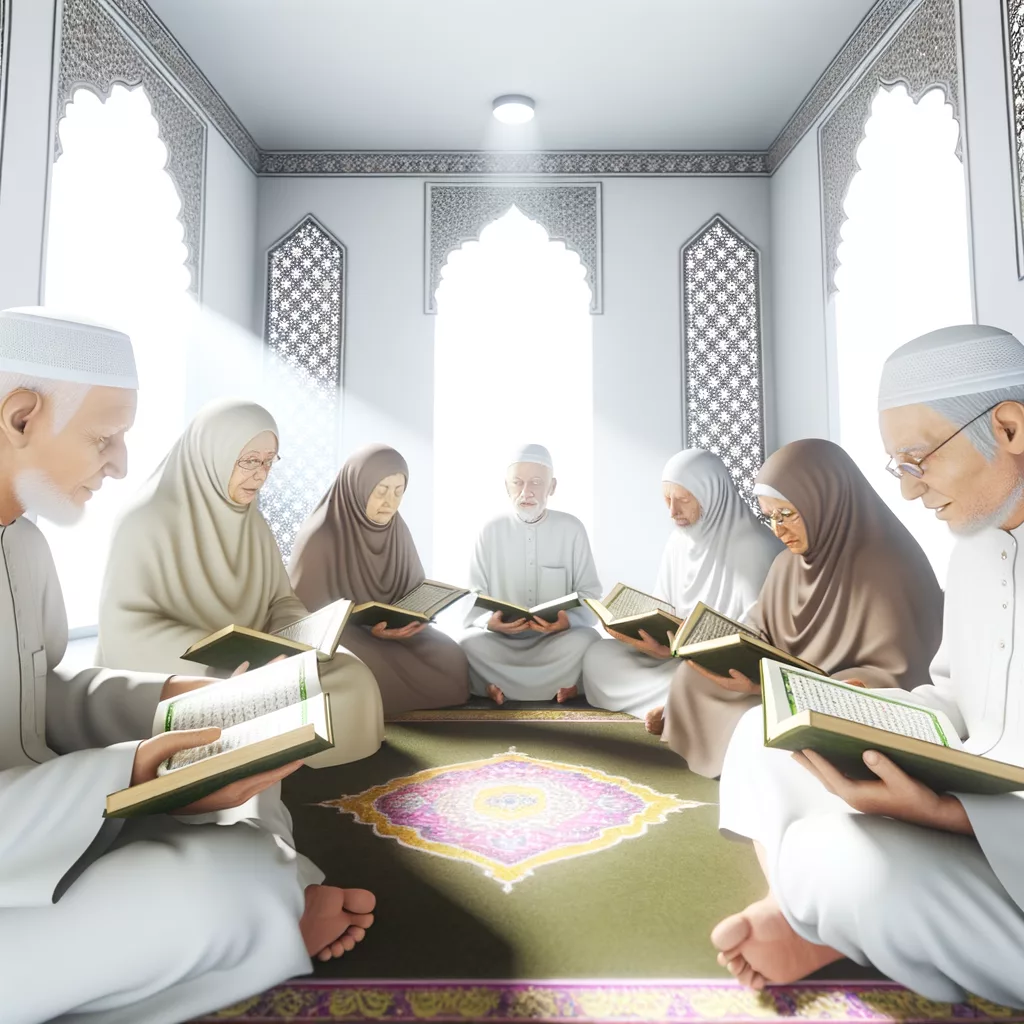
The lines of time are the silent archives of our communities. In every look we give our elders lies the echo of our values, the living trace of the Muslim faith and the collective memory of our Islamic history. Supporting older people in the Muslim community is not only a duty of kindness: it is an act of piety, a legacy of love and a concrete expression of our Islamic spirituality.
Over the years, many men and women who have carried Islam in their hearts long to reconnect with the source. They wish to find in learning Arabic and reading the Qur’an a familiar and profound light, one that soothes, nourishes patience and silent dhikr, and invites greater gratitude towards Allah. Yet the language barrier, the fear of learning Arabic at an advanced age or the difficulty of understanding the Qur’an in Arabic can sometimes cloud this impulse of the heart.
How can we honour our elders? By opening the way for them to immersion in Arabic, stripped of the heaviness of translations, so that they can reach the living meaning of the Qur’an and savour the beauty of tajwid, the tafsir of the Qur’an and Islamic supplications. This path, far from being reserved for the young, invites every believer to cultivate sincerity and humility in the practice of Islam and to rediscover khushu in prayer, whether at jumu’a, within the Muslim family or at the mosque alongside the imam.
The Muslim community possesses an irreplaceable treasure: the wisdom and experience of its seniors, a precious link between past and future. Their memories point back to the sira of the Prophet and to the edifying lives of the companions of the Prophet and the ahl al-bayt. Encouraging elders to learn Classical Arabic allows them to relive the stories of Ramadan, understand the deep meaning of the adhan, and join fully in the Friday prayer and the joy of Eid al-Fitr or Eid al-Adha.
But beyond language, this is a community commitment. Mutual help and Islamic solidarity are the soul of living together: celebrating the kindly shade of our seniors, fostering intergenerational bonds between Muslim children, Muslim youth and older people, and restoring meaning to the spiritual routine and to Muslim identity in today’s society.
This article explores how we can go about supporting our elders on this journey of spiritual renewal: preserving their dignity, making it easier to learn Arabic without translation, weaving bonds of mutual help and respect, and creating, at the heart of the Muslim community, a warm space of listening, inner peace and love of Allah. Because a community only lives fully when each member, whatever their age, can rise in the light of the Qur’an and the sunna and feel, to their last breath, the sweetness of being useful, honoured and infinitely loved.
Preserving the dignity and strengthening the spirituality of elders: the importance of support in the Muslim community
Within the Muslim community, supporting older people goes far beyond material assistance: it is above all about preserving their dignity and nourishing their spirituality. The elder, often the bearer of a rich experience of Islamic life, remains a living pillar of transmission, a witness of the Muslim faith and a silent guide for the young. Supporting them means recognising the value of their journey and giving them attention, respect and gratitude, in keeping with the sunna of the Prophet and the example of the companions of the Prophet, whose care for their elders reflected their love of Allah. It also means encouraging their active involvement in Muslim spiritual life: reading the Qur’an, memorising the Qur’an according to the rules of tajwid, sharing around the tafsir of the Qur’an, and reminders drawn from the sira of the Prophet, the hadiths and the science of hadith. Spiritual support encourages the regular practice of dhikr and participation in prayer in Islam, particularly the Friday prayer (jumu’a), and revives patience in Islam, sincerity in Islam and gratitude towards Allah. Allowing our elders to access immersion in Arabic, to continue or begin learning Classical Arabic – even without translation – gives them the opportunity to understand the Qur’an in Arabic, to taste the depth of Islamic supplications (du’a) in the original language, and to cultivate authentic khushu in prayer. This living bond with the sacred language, Islamic culture and the Muslim community strengthens their spiritual well-being, their inner peace and their sense of being useful within the Muslim family. Preserving the dignity of elders therefore also means helping them shine until the last stage of their life, fostering the transmission of the Islamic heritage, moderation (wasatiyya), Islamic ethics and love of the Prophet. This path of support embodies a community mutual help faithful to the values of the Qur’an and the prophetic tradition, ensuring that every generation can benefit from the wisdom and light of its elders.
Learning Arabic and reading the Qur’an for older people: reconnecting with the source and cultivating Muslim faith
For many older people in the Muslim community, learning Arabic or taking it up again represents a genuine return to the source of their faith and a precious opportunity to cultivate their Islamic spirituality. This drive towards Classical Arabic, often nourished by a deep desire to understand the Qur’an in its original language, is in no way limited by age. On the contrary, it becomes an act of sincerity in Islam, an expression of love of Allah and of the Prophet, and a living testimony of patience in Islam and of hope.
Immersion in Arabic, even late in life, gives more intimate access to the beauty of reading the Qur’an, the musicality of tajwid and the depth of the tafsir of the Qur’an. Hearing and pronouncing the verses in the revealed language nourishes khushu in prayer, strengthens concentration during the salat and awakens renewed gratitude towards Allah in the heart. Many describe the gentle emotion they feel when reciting surahs learnt in childhood, or when taking up memorising the Qur’an again as a soothing and rewarding daily exercise.
Opening up to Arabic without translation, even gradually, also makes it possible to explore the sunna and the sira of the Prophet with fresh eyes: the hadiths gain their full relief, and the lives of the companions of the Prophet and the ahl al-bayt resonate with a more striking humanity and closeness. It is an invitation to connect with the history of Islam, with the great Islamic civilisation and with the whole of Islamic culture handed down through the centuries, from the Andalusian caliphate to illustrious Islamic universities such as Al-Azhar and Zaytuna.
For older people, learning Arabic also becomes a path to a better practice of Islam: Islamic supplications, dhikr and du’a take on a unique meaning when expressed in Classical Arabic, carried by the chosen words of the revelation. The understanding of fasting in Islam, the rites of Ramadan, tawba, jumu’a, the hajj or the umrah reveals its depth thanks to this rediscovered or newly acquired skill.
Finally, returning to learning Arabic means becoming part of the dynamic of the Muslim community and passing on to Muslim children and grandchildren respect for Muslim spiritual life and the treasures of a living Islamic education. It means helping, by example, to maintain the balance of the Muslim family in a world where Muslim identity, Islamic culture and the history of Islam are too often reduced to a few words or images. Through this linguistic and spiritual journey, the older person gives themselves a space of inner peace, develops their spiritual routine, strengthens their spiritual health and turns every moment of Islamic reading into an act of gratitude and spiritual well-being, in the rediscovered intimacy of the divine message.
Immersion in Arabic without translation: how to foster understanding of the Qur’an and spiritual well-being in our elders
For our elders, immersion in Arabic without translation is a unique gateway to a deep understanding of the Qur’an and renewed spiritual well-being. Learning Classical Arabic through direct contact with the language of the sacred Book not only lets them taste the authentic beauty of the verses but also nourishes a real closeness to the Word of Allah. In many Muslim families, grandparents carried within them the living memory of reading the Qur’an in Arabic, reciting with tajwid and the daily practice of dhikr and Islamic supplications. Learning Arabic without systematically resorting to translation lets our elders immerse themselves in the sound and spiritual world of the text and perceive the musicality, subtleties and power of the words chosen by Allah, which deepens their khushu in prayer and their reflection during the salat, at jumu’a and on the blessed nights of Ramadan, especially when reading the Qur’an on Laylat al-Qadr.
This approach fosters a global and intuitive understanding of the Qur’anic message: by following an immersion method in Arabic, even older people who never went to school in an Arab country gain confidence in their ability to understand the general meaning of the Qur’an in Arabic, to memorise verses and to savour Islamic spirituality fully. Without the reductive filter of translation, many elders speak of a deeper feeling when reciting the Qur’an and greater emotion on hearing the prophetic words of the hadiths or reflecting on the teachings of the Sunna, the sira of the Prophet Muhammad, and even the accounts of the lives of the companions of the Prophet and the ahl al-bayt.
This immersion, far from being a barrier, becomes a source of spiritual well-being and inner peace. It allows our elders to approach prayer, repentance (tawba), patience in Islam or gratitude towards Allah with a serene and fully engaged heart. Listening to the adhan at the mosque or Islamic reading within the family become moments of grounding, transmission and renewal in the light of a practice of Islam lived in all its linguistic and cultural richness. This intimate bond with the original language of the sacred texts helps calm questions about Muslim identity, fortify the Muslim faith in the face of trials, and strengthen the spirit of Islamic solidarity and community mutual help, which is particularly precious within the Muslim community in France. Learning Arabic through immersion, without translation, thus honours the living memory of the history of Islam, of the values handed down by the scholars of Islam and of the essential rites of Muslim spiritual life, offering our elders the renewed pleasure of reading the Qur’an, the tafsir of the Qur’an, the sciences of hadith and contemplation at the very heart of Islamic civilisation.
Community mutual help and Islamic solidarity: valuing the role of seniors and weaving intergenerational bonds
At the heart of the Muslim community, mutual help and Islamic solidarity are deeply rooted values that have come through generations and trials. Within this dynamic, older people hold a precious place, not only as guardians of the living memory of Islam but also as invaluable sources of wisdom, experience and Islamic spirituality. Valuing the role of seniors means drawing on the stories of the Qur’an in Arabic, advice drawn from the sunna, memories of reading the Qur’an during Ramadan, and striking memories of the sira of the Prophet and the companions of the Prophet. Intergenerational bonds form naturally around moments of sharing: collective recitation with tajwid, oral transmission of the tafsir of the Qur’an, conversations about the history of Islam, or memorising the Qur’an as a family. These opportunities for learning Arabic, often through immersion in Arabic without translation, foster a deeper understanding of the Muslim faith and nourish khushu in prayer. Older people thus become pivots of Islamic education: they introduce the young to the practice of the salat, Islamic supplications, dhikr, patience in Islam and gratitude towards Allah. In mosques, during the Friday prayer and at the great Islamic festivals such as Eid al-Fitr or Eid al-Adha, supporting our elders offers an opportunity to strengthen this Islamic solidarity. They remind the community of the importance of respect for the ahl al-bayt and for tradition, but also of renewing sincerity in Islam and love of the Prophet, by living the history and culture of Islam together. Weaving intergenerational bonds breathes new energy into the Muslim community, where every age, every voice and every story enriches collective spirituality, Muslim identity and the well-being of all.
Further reading: discover our programme for learning to read Arabic (adults), or read “Learning Arabic and knowing the best times for supplication” and “Learning Arabic to protect yourself from the evil eye and envy“.
Conclusion
Supporting older people within the Muslim community is far more than a social duty or a mark of respect: it is a profound gesture of love rooted in the prophetic tradition and strengthened by Islamic spirituality. Through every reassuring smile, every hand held out during prayer and every moment shared around reading the Qur’an, we live the sunna of the Prophet and the teachings handed down by the companions of the Prophet and the ahl al-bayt. Taking care of our elders revives the bonds of Islamic solidarity, energises community mutual help and makes mercy shine at its heart.
For many seniors, learning Arabic or reconnecting with the beauty of Classical Arabic is an inexhaustible source of joy and renewal. Approaching the Qur’an in Arabic without translation, immersing yourself in tajwid, reflecting on the tafsir of the Qur’an or reliving the sira of the Prophet is not only an intellectual act: it means rediscovering closeness to Allah, anchoring the Muslim faith, experiencing gratitude towards Allah and living a deep spiritual well-being. Learning Arabic, even when begun at an advanced age, calls for patience in Islam, sincerity in Islam and perseverance, values dear to the heart of every believer.
Immersion in Arabic, a source of intuitive understanding of the divine message, restores confidence and autonomy to our elders in their practice of Islam. By reclaiming prayer in Islam and rediscovering khushu in prayer or the flavour of dhikr and du’a, they nourish an intimate bond with the Creator, especially at key times such as Ramadan, the Friday prayer (jumu’a), Laylat al-Qadr, the hajj or the umrah. Memorising the Qur’an, even a few verses, or familiarity with hadith and its science, brings new light to daily and collective life, from the home to the mosque, from the Islamic festivals to times of mourning or Islamic supplication.
Cultivating this richness is neither reserved for an elite nor limited by age. It is in the diversity of life journeys that the vitality of the Muslim community is written, between Muslim children and seniors, around the values of the Muslim family, Islamic education and noble character (akhlaq). Rooting our elders in Muslim spiritual life, allowing them to preserve their dignity and express their love of Allah and of the Prophet, means passing on a living heritage to Muslim youth and forging an authentic and peaceful Muslim identity, here and now, whatever the reality of Islam in France.
Ultimately, making learning Arabic accessible, valuing immersion in Arabic, creating circles of memory and storytelling around the Qur’an, the hadiths and the sira, and encouraging a soothing spiritual routine and intergenerational transmission bring us closer to the model of Islamic civilisation, a model of balance, moderation (wasatiyya), solidarity and ethics, inspired by the breath of Sufism and the wisdom of the scholars of Islam of yesterday and today — from Al-Azhar to Zaytuna and Qayrawan, from Ibn ‘Ashir to our contemporary imams.
Every gesture made to support our elders, whether it concerns language, spirituality or daily life, not only illuminates the lives of those who have given so much but also uplifts every member of the Muslim community. In this way, through the light of the Qur’an in Arabic, listening to the adhan and love of the good, lives on the gentle wisdom of an Islam that has always honoured old age, built bridges between generations and founded its future on gratitude and inner peace.



