
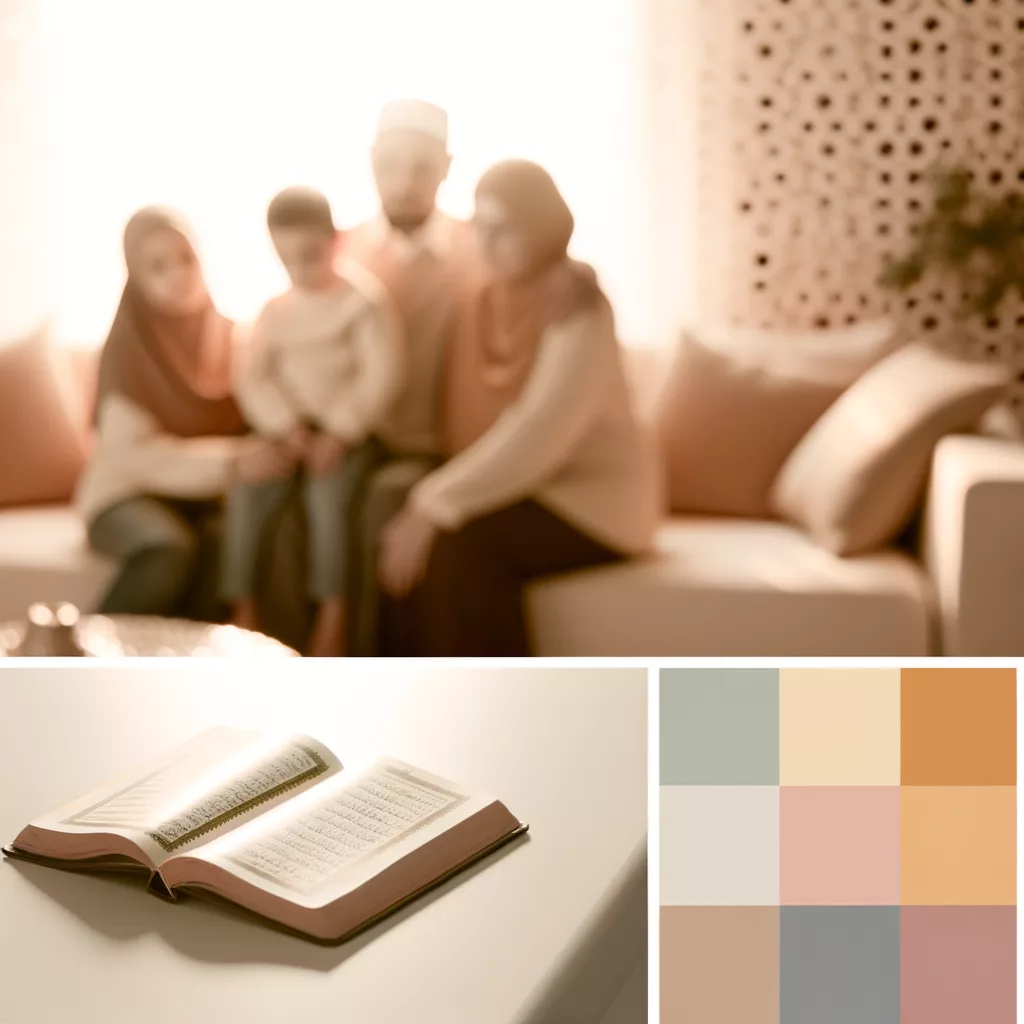
Organising a family Qur’an reading circle: bringing the light of the Revelation back to the heart of the home
Imagine a home where, every week, the Word of Allah resonates in Classical Arabic. Where parents, children and grandparents, gathered around the same book — the Qur’an —, weave unique bonds between heart, faith and knowledge. In this intimate space, reading the Qur’an becomes much more than a spiritual act: it is a path of unity, a living school for learning Arabic, and a source of fulfilment for the Muslim identity of every member of the family.
In a world saturated with screens and distractions, a family Qur’an reading circle offers a haven where Islamic spirituality takes root naturally in daily life. It is there that the deep desire to understand the Qur’an in Arabic is cultivated, without depending on translations, and to taste the intimacy that only immersion in Arabic can bring. This shared moment becomes a workshop of Islamic education, in which tajwid, memorising the Qur’an, listening to the verses, recalling the stories of the prophets and exploring the teachings of the sunna take on their full meaning, anchored in the language of the Revelation.
For many Muslims in France and in Europe, the question of passing on the Qur’an and the Muslim faith in the modern context is not only a matter of heritage: it touches the very soul of the family and the future of Muslim youth. How can we give reading the Qur’an its full place in family life again? How can we engage children and adults in learning Arabic in a way that is simple, lively and meaningful? How can we pass on the beauty of prayer in Islam, the secret of khushu, the power of dhikr, a taste for the science of hadith or the wisdom of the Companions of the Prophet and the ahl al-bayt through a natural immersion in the language and in Islamic values?
These questions, and many others, will guide our reflection step by step in this article. We invite you to explore, gently and clearly, how to set up and grow a family Qur’an reading circle: a moment of authentic sharing that nourishes spirituality, awakens gratitude towards Allah and weaves the living memory of Islam at home. Whether you are a beginner or already engaged in recitation, whether you are seeking inner peace or strong cultural and spiritual roots, this journey will show you that learning Arabic and reading the Qur’an together as a family is much more than a language goal: it is a promise of unity, growth and hope for today and tomorrow.
Establishing family Qur’an reading: a path of unity, spirituality and learning Arabic
When the family gathers to read the Qur’an, it is more than a simple ritual: it is a luminous path in which unity, spirituality and deep learning come together. This shared moment becomes a powerful bond that unites hearts around the word of Allah, strengthening the solidarity of the Muslim family and nourishing the Muslim faith day after day. The living experience of reading the Qur’an in Classical Arabic, even for the youngest, naturally weaves an immersion in Arabic, allowing everyone to taste the beauty of the sacred language without depending on translation. Learning Arabic thus takes on a new dimension: it is no longer just about memorising the Qur’an or school studies, but about an intimate awakening to Islamic spirituality, to the practice of Islam and to a direct understanding of the Qur’an in Arabic.
Verse after verse, parents and children can explore the science of tajwid, improve their pronunciation and feel the subtlety of the divine message, while sharing moments of dhikr, du’a, gratitude towards Allah or Islamic invocations as a family. These moments of transmission are naturally enriched by the tafsir of the Qur’an, the hadiths and the history of the Companions of the Prophet and the ahl al-bayt, anchoring Islamic education in real life while giving access to the heritage of Islamic civilisation. Each reading becomes a step towards khushu in prayer and towards strengthening patience, sincerity, tawba and spiritual well-being. Whether during Ramadan, while fasting in Islam, to prepare for the Friday prayer (joumoua), or simply in the spiritual routine of the home, reading the Qur’an fosters inner peace, modesty, Islamic solidarity and the sharing of deep values.
Establishing this family gathering means offering a space conducive to the education of children in Islam – a setting where immersion in Arabic happens gently and naturally, far from the stress of conventional methods in which every sentence calls for its translation. By listening to and reciting the divine text, young and old learn to understand the Qur’an without translation, to grasp the overall meaning and to be introduced to the tradition of fiqh, aqida or Sufism through the authentic words of the revelation. In this caring atmosphere, Muslim youth are also prepared for their place in the Muslim community, to cultivate their Muslim identity and to keep their balance in the face of today’s challenges, in France or elsewhere.
Through reading the Qur’an as a family, Classical Arabic becomes a companion and a living key for entering the treasure of Islamic studies, the sira of the Prophet, the values of marriage in Islam, or the history of Islam and its scholars. This reading circle introduces everyone to the taste for knowledge, the beauty of Islamic calligraphy and the depth of the practice of Islam within the home – a light that brightens days of celebration, hajj, eid al-fitr or eid al-adha, and that irrigates the life of the Muslim family throughout the year.
Immersion in Arabic and passing on the Qur’an: building a living Islamic education at the heart of the home
At the heart of a Muslim family, immersion in Arabic acts as a living source of Islamic education, nourishing the soul and the intellect of each member around reading the Qur’an. Learning Arabic, and Classical Arabic in particular, brings young and old into the original language of the revelation, the one that the Prophet ﷺ passed on to his Companions and to the ahl al-bayt. This approach goes beyond accumulating knowledge: it establishes Islamic spirituality within the home and weaves a living link between the science of hadith, the treasures of the tafsir of the Qur’an and an authentic understanding of the sunna. When family Qur’an reading is done directly in the divine language, without systematic use of translation, the experience is transformed. The sounds of tajwid, the beauty of dhikr and the depth of du’a resonate closer to the heart and awaken a new awareness of the Muslim faith. Muslim children, immersed from their earliest years in this living learning of Arabic, naturally absorb the essential notions of patience in Islam, gratitude towards Allah, repentance and love of Allah and His Messenger. This setting creates a solid foundation for khushu in prayer, memorising the Qur’an and all the practices of Islam: salat, joumoua, Ramadan, fasting, festivals and rites. Family immersion prepares each generation to explore fiqh and aqida, to reflect on secularism and Islam, and to root themselves in contemporary Muslim identity while honouring Islamic civilisation and its scholars. Nothing replaces living transmission: an Islamic education lived in Arabic, in the warmth of the home, plants the seeds of moderation, inner peace and authentic spiritual well-being in daily life.
Understanding the Qur’an in Arabic without translation: practical tips for learning, memorisation and tajwid as a family
Sitting around the Qur’an as a family means opening a door to the intelligence of the heart and the awakening of Islamic spirituality. Yet understanding the Qur’an in Arabic without translation sometimes brings a feeling of dizziness: the language seems distant, the words mysterious, the musicality intoxicating but impenetrable. This challenge is not insurmountable, however, as long as we adopt an authentic approach based on immersion in Arabic and shared practice.
Within the family circle, favouring a reading of the Qur’an in Classical Arabic creates a caring atmosphere that respects the revelation. Learning Arabic, even gradually, creates a direct link with the word of Allah — without filter or detour, awakening a touch of emotion that translation cannot offer. For beginners, start with a selection of short and familiar surahs, often recited during salat, such as Al-Fatiha, Al-Ikhlas or Al-Falaq. Let each member read a verse aloud, then listen to the recitation of a renowned qari: attentive listening, without translation, is a first step towards naturally absorbing the meaning. Little by little, the Qur’anic vocabulary sinks in, the musicality of tajwid takes root, and memorising the Qur’an as a family becomes a game of echo and harmonious repetition.
Add to this ritual the discovery of key expressions frequently encountered when reading the Qur’an. Collect them in a notebook written together, so that everyone makes the sacred language their own. These words, linked to strong moments in the practice of Islam — patience in Islam, sincerity in Islam, gratitude towards Allah, tawba, khushu in prayer —, take on their full scope as the Muslim child or the adult grasps the overall meaning through context, listening and repetition.
To reinforce learning, introduce tajwid methodically: take the time to break down the rules together, illustrating each new notion with an example from the Qur’an in Arabic. Give yourselves the freedom to make mistakes and learn collectively: smiling in the face of difficulty creates an atmosphere conducive to transmission, the foundation of Islamic education and family spirituality.
Complete this immersion in Arabic with short moments of tafsir of the Qur’an, adapted to your level. Rather than systematically resorting to translation, favour questions: « What do you feel when you hear this verse? Which words do you recognise? How does this verse shed light on our practice of prayer in Islam, our patience or our love of Allah? » These exchanges, rooted in the daily life of the Muslim family, naturally reconnect with the prophetic tradition, the sira of the Prophet, the words of the Companions of the Prophet and the wisdom of the ahl al-bayt.
Let the family circle be enriched by hadiths in Arabic on kindness within the family, perseverance or inner peace in Islam, to strengthen language acquisition and connect the science of hadith with the deep meaning of the Qur’an. By favouring this immersion, the Qur’an in Arabic ceases to be a static text: it is embodied in the spiritual routine, in dhikr, invocation, repentance and gratitude, guiding the Muslim community through every Ramadan, every Friday prayer and every moment of the Muslim calendar.
With this living approach, learning Arabic becomes an act of faith, a heritage passed on day after day, a perpetual source of spiritual well-being for young and old, weaving memory, understanding and love of the Qur’an at every stage of life.
Spirituality and community life: the reading circle as a lever for love of Allah and the Prophet and for passing on the Muslim faith
When the family gathers around a circle for reading the Qur’an in Arabic, something deeply spiritual and communal emerges. Reciting the Qur’an in Classical Arabic, according to the rules of tajwid, is much more than a simple intellectual exercise: it becomes an act of love for Allah and the Prophet, a living invocation and a breath of Muslim faith passed on from heart to heart. In this atmosphere of immersion in Arabic, parents and children, each at their own pace, savour the beauty of the verses, marvel at the precision of the revealed language and perceive the overall meaning of the divine message without going through the reductive filter of translation.
This family learning of Arabic, when it is integrated into reading the Qur’an, opens the door to direct understanding: the Qur’an in Arabic then takes on another dimension, that of an intimate dialogue with Allah, and every word becomes a source of inspiration for prayer in Islam, dhikr, du’a or patience in Islam in the trials of daily life. The reading circle also fosters the transmission of Islamic spirituality, the teachings of the sunna, the tafsir of the Qur’an, and the living wisdom drawn from the hadiths, the sira of the Prophet, the Companions and the ahl al-bayt.
Within this dynamic, a genuine climate of Islamic solidarity and mutual support takes shape at the scale of the home. It is a melting pot in which love of Allah, gratitude towards Him, respect for the practice of Islam, listening to the adhan and care for salat take root from the earliest age. Parents and children become aware that their Muslim identity is a living heritage, both inner and shared. The reading circle then becomes a lever for Islamic education, intergenerational dialogue and rootedness in the Muslim community, preparing each member of the family to radiate this light around them, from the mosque to daily life, from Ramadan to the festivals of ‘Eid, but also in times of trial, in patience and sincerity, repentance and inner peace.
In this circle, the history of Islam, the wisdom of the scholars, and the values of Islamic ethics and solidarity take shape in lived experience. Reading, reciting, meditating on and memorising the Qur’an together means weaving a spiritual routine in kindness. It also means awakening in Muslim children a curiosity about Islamic culture, Islamic art and calligraphy, and making them want to deepen their knowledge of the Islamic sciences, fiqh or aqida in a spirit of authentic spiritual quest. Thus the family Qur’an reading circle is a founding act, which anchors love of the Book, of the Prophet and of the language in individual and community life, and passes on the Muslim faith like a light from generation to generation.
When you organise a family Qur’an reading circle, it is much more than a moment shared around a revealed book. It is a deep undertaking, a bridge between hearts and generations that gently shapes the identity, the Muslim faith and the Islamic spirituality of every member of the household. By immersing yourselves together in Classical Arabic, without going through systematic translation, you open the door to a living Islamic education in which every word of the Qur’an resonates in its authenticity, in which the melody of tajwid carries the soul and in which understanding the Qur’an becomes light, yet ever more illuminating.
Learning Arabic then becomes natural, rooted in everyday experience and carried by love of Allah and of the Prophet Mohammed. The reading circle invites you to discover little by little the sciences of hadith, the tafsir of the Qur’an, the sunna, the sira of the Prophet, the wisdom of the Companions and of the ahl al-bayt, weaving the link with the history of Islam and all the richness of Islamic civilisation. This family gathering goes beyond simple reading: it gives meaning to prayer in Islam, nourishes khushu in salat, and brings to life Islamic invocations, dhikr, gratitude towards Allah, patience, modesty, Islamic ethics and adab in daily life.
Muslim spiritual life, lived in this family cocoon, is enriched by a soothing routine inspired by reading the Qur’an: memorising the Qur’an, precise tajwid, authentic understanding, a practice of Islam that is uplifted, the passing on of values and faith to Muslim children, sincere dialogue between spouses, attentive listening to Muslim youth, calm preparation for Ramadan, hajj or the Friday prayer, and sharing stories from the sira of the Prophet, the words of contemporary scholars or the masterpieces of the Islamic library.
Session after session, the reading circle becomes a bulwark against stress, a source of inner peace and spiritual well-being, an island of Islamic solidarity for the Muslim family, a model of mutual support, but also a school of life in which one learns sincerity, repentance, constancy in dhikr, the power of du’a, the ethics of halal, the beauty of Islamic calligraphy, openness to dialogue and pride in Muslim identity, even in the context of Islam in France.
Opening yourself in this way to learning Arabic through immersion in Arabic means giving every member of the family this unique gift: being able to taste the flavour of a divine word, unfiltered, and making reading the Qur’an a founding ritual, a foundation for faith, piety, solidarity and moral excellence. The Qur’an, beyond generations and trials, continues to gather, guide, soothe and inspire – within the home, it becomes light, mercy and strength for everyone. That is the secret of a reading circle that uplifts and transforms, in the quiet gentleness of a home inhabited by the presence of the Qur’an in Arabic.
Further reading: discover our programme for learning to read Arabic (children).



