
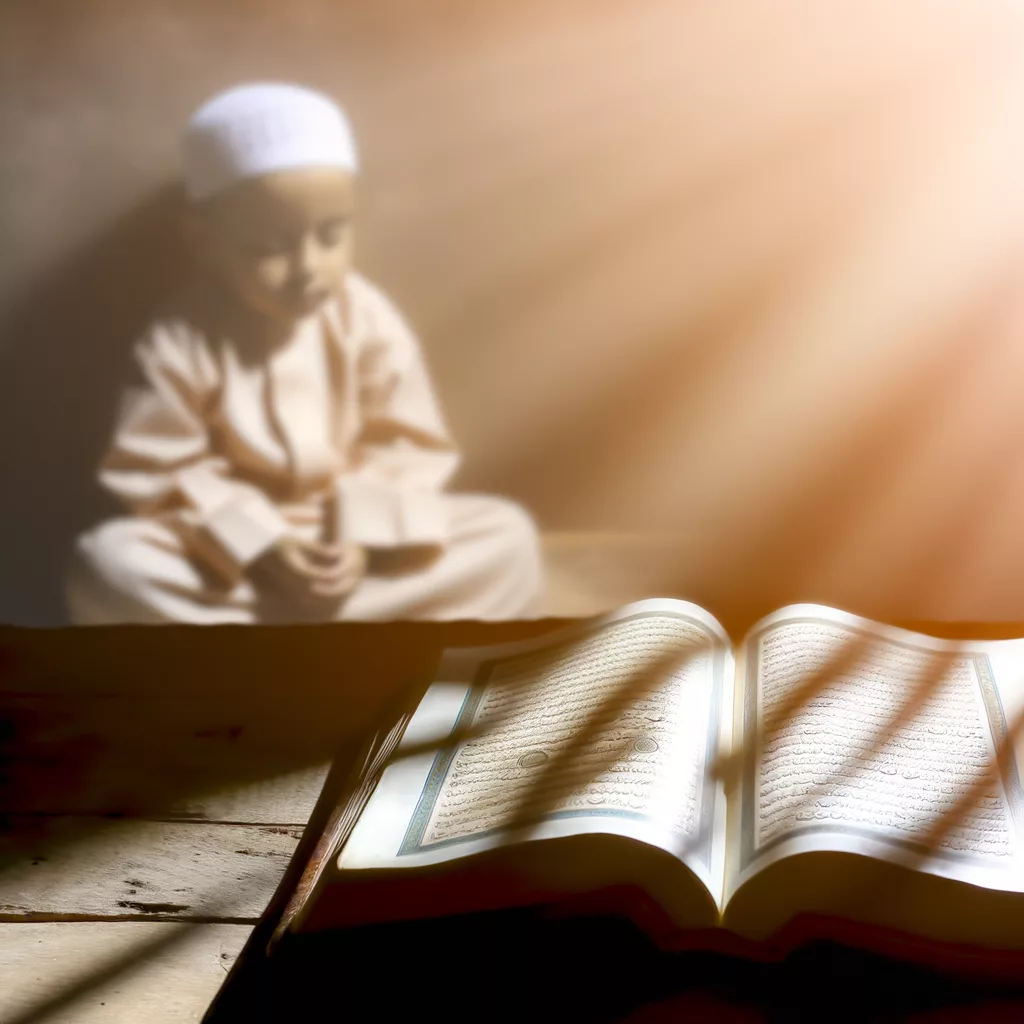
Learning Arabic means opening the door to an unsuspected world, an immersion at the heart of meaning and beauty, where every word of the Qur’an resonates like a living spring that purifies the heart and enlightens the mind. How many Muslims feel deep inside this profound desire to memorise the Qur’an and draw daily guidance from it, yet feel held back by the language barrier, fatigue or the difficulty of keeping going over time? And yet memorising the Qur’an, far from being a mere memory exercise, becomes a true inner journey when you choose to embrace learning Arabic without translation: literary Arabic, sacred and vibrant, the language in which the Qur’an was revealed.
It is an often overlooked secret: understanding the Qur’an in Arabic radically transforms your relationship with the divine Word. Immersion in Arabic, attentive listening and regular contact with the sacred text bring forth a spiritual flavour that translation can never fully capture. In reading the Qur’an in the original Arabic there is a light that fills the believer’s heart, making memorisation more natural, more authentic and more deeply rooted. Succeeding in memorising the Qur’an for the long term is therefore not only a matter of technique, but of inner transformation, a path guided by sincerity, patience and the love of Allah.
This article invites you to explore this living path: how immersion in Arabic can bring new life to your learning, strengthen your practice of tajwid and tafsir of the Qur’an, and connect each of your efforts to the prophetic tradition, to the history of Islam, and to the life and wisdom of the Prophet’s companions, the ahl al-bayt and the scholars of Islamic civilisation. Through concrete advice and inspiring perspectives, you will discover how to make memorising the Qur’an a source of spiritual well-being and inner peace, not only for yourself, but for your Muslim family, your community and every moment of your life.
Let us dive together into this spiritual and human adventure, where the Arabic language is no longer a barrier but the key that opens the treasure of meaning, of the Muslim faith and of true Islamic spirituality.
Diving into Qur’an memorisation through immersion in Arabic: Why understanding the Qur’an in literary Arabic transforms your learning for the long term
Diving into memorising the Qur’an through direct immersion in literary Arabic means choosing to live each verse as a living experience, rather than a simple string of words to repeat. When you learn Arabic without translation, something profound happens: you stop seeing the Qur’an as a text outside yourself, and you begin to embody it from within, to feel it in your skin, in your heart, in your breath. This immersion in Arabic, far from being only a question of language, is a key to understanding the Qur’an in its original form: the form willed by Allah, recited by the Prophet and passed on to the companions, to the ahl al-bayt and to the whole Muslim community for fourteen centuries.
When you make the Qur’an your own in literary Arabic, you gain access to the richness of each word, the musicality of tajwid, the elegance of its imagery, the power of dhikr and the subtleties of Islamic supplications. Little by little, reading the Qur’an no longer consists of translating line by line, but of feeling the meaning directly, vibrating with the sounds, and discovering the precious wisdom of the tafsir of the Qur’an in its source language. You understand patience in Islam differently when you hear sabr in its context, you sense sincerity in Islam through the formulas of entreaty, and you taste the beauty of prayer in Islam as you feel the words of the salat reflected in daily life.
Over the long term, learning Arabic through immersion, with no filter or barrier, turns memorising the Qur’an into a natural practice: the meaning clings to the words, the heart opens to Islamic spirituality, and the energy to keep progressing in your learning is renewed every day. This method gently nourishes the Muslim faith, deepens the connection with the history of Islam, illuminates Muslim spiritual life, and nourishes khushu in prayer, especially during the Friday prayer, Ramadan or blessed nights such as laylat al-qadr. Even the study of the hadiths, the sira of the Prophet and the Islamic sciences takes on a whole new dimension: you no longer seek only to memorise, you seek to taste, to love, to pass on.
This is how memorising the Qur’an takes lasting root: it is no longer a dreaded obligation, but a source of love for Allah and the Prophet, a bridge between the divine text and the real life of the believer, from the Muslim couple to the child who is learning, from the Muslim family to the whole community. Learning Arabic through immersion then carries a promise: that of an inner transformation, of a serene Muslim identity that finds its joy and strength in the word of Allah, recited and lived in its original beauty.
Learning Arabic without translation: The keys to success for memorising the Qur’an lastingly and tasting true Islamic spirituality
Memorising the Qur’an solidly means opening yourself to a light that goes beyond words: it means touching the living meaning of the divine message, as it was revealed in literary Arabic. Yet many people meet a major obstacle when they try to learn and retain the verses only through translation. This approach can give the illusion of understanding, but it deprives memory and heart of the original flavour of the Qur’an in Arabic. Learning Arabic, without systematically going through the filter of translation, then becomes the true key to a deep and stable memorisation of the Qur’an that carries true Islamic spirituality.
Immersion in Arabic means diving into the source: listening, reciting, meditating and memorising while letting yourself be imbued with the rhythm, the melody, the imagery and the power of the Qur’anic words. The language of the Qur’an, with its harmony, its precise tajwid, its nuances and its richness, directly shapes the way the message is imprinted in memory and in spirituality. Understanding the Qur’an in its original language, even before grasping all the details of the tafsir of the Qur’an or the science of hadith, means weaving a deep, vibrant bond with the Word of Allah. Immersive learning of literary Arabic helps anchor the sacred text in the soul, far beyond a mere formal recitation.
When you repeat each ayah without mental back-and-forth with the translation, you free your mind to rediscover the original taste of reading the Qur’an. You develop an intuitive memory, much more solid over the long term, based on the overall meaning and the sound of the text. This method draws on the practice of Muslim children throughout the history of Islam: from the Andalusian caliphate to the traditional schools of Al-Azhar, true Islamic education has always begun with this immersion, preparing the later understanding of fiqh, aqida, the sunna of the Prophet and even the subtleties of Sufism and dhikr.
Learning Arabic through immersion also breathes new spiritual life into daily practice: the salat becomes more alive, khushu in prayer grows stronger, and dhikr and Islamic supplications take on an unsuspected depth. This choice awakens patience in Islam and sincerity in Islam, cultivates gratitude to Allah and sustains the love of Allah and the Prophet. When each memorised verse resonates unfiltered in your heart, repentance in Islam, tawba, conviction during Ramadan or the beauty of the Friday prayer take on a new dimension.
From recitation to daily life, during fasting in Islam, on hajj, when listening to the adhan in the mosque or sharing during Islamic festivals such as eid al-fitr, understanding and practising the words of the Qur’an in Arabic makes every moment more meaningful and richer for the Muslim family, Muslim youth and the whole Muslim community. Learning Arabic without translation also restores the place of Islamic ethics, social justice, Islamic solidarity, inner peace and spiritual well-being, of which the Qur’an is a timeless source.
So, by favouring learning Arabic through immersion to memorise the Qur’an, you choose a method that is both ancestral and deeply human: you connect with history, with the living practice of Islam, with the blessed chain of the Prophet’s companions and the ahl al-bayt, right up to contemporary scholars and the whole of Islamic civilisation. You lay the foundations of an authentic Muslim faith, within a serene Muslim identity made of moderation, light and presence in every moment.
Tajwid, tafsir and the Islamic sciences: Strengthening Qur’an memorisation in the light of the prophetic tradition and the history of Islam
Understanding the Qur’an deeply, memorising it with stability and rooting its recitation in your heart require much more than simply repeating the verses. It is a journey in the light of the prophetic tradition, where learning Arabic, and in particular immersion in Arabic without translation, becomes a key to lasting memorisation. The beauty of literary Arabic, the original language of the Qur’an, only fully reveals itself to those who expose themselves to it naturally, by listening, pronouncing and feeling. The study of tajwid, that subtle art of recitation, is not only a question of rules; it is about preserving the authentic form of the divine Word as the Prophet Muhammad, peace and blessings be upon him, taught it to his companions. Mastering tajwid makes the reading of the Qur’an vibrate to the rhythm of the Muslim faith and of khushu in prayer, raising the daily salat to a conscious and revitalising act of worship.
But memorising the Qur’an only has a deep flavour if you also immerse yourself in its tafsir, that is, its meaning and its secrets, revealed through the patient study of the scholars of Islam. Learning Arabic without translation lets you taste the intensity of the text and meditate on its wisdom in the light of the Islamic sciences: the science of hadith, fiqh, aqida and the sira of the Prophet. Through the accounts of the Prophet’s companions and the ahl al-bayt, you discover how memorising the Qur’an was lived throughout the history of Islam; it was at the heart of the pilgrimage of hearts, of Ramadan, of the nights of laylat al-qadr, and of the Friday prayer. The science of tafsir of the Qur’an takes you across time and connects the verses you read every day to original Islamic spirituality, to the practice of Islam lived by the first generation and passed on by word of mouth throughout the Muslim community.
It is in this balance between form and meaning, between perfected tajwid and deepened tafsir, that memorising the Qur’an for the long term truly takes root in your Muslim spiritual life. Immersing yourself in literary Arabic and understanding the Qur’an directly in its language means honouring the living memory of Islamic civilisation. It means linking daily recitation with the serenity of prayer, attentive repetition with the deep breath of gratitude to Allah. Finally, it means placing your heart in the golden chain of knowledge, where patience in Islam, sincerity in Islam and love of the Prophet trace the path to success, both in memorising the Qur’an and in all religious and spiritual practice.
Patience, sincerity and spiritual routines: Cultivating endurance in Qur’an memorisation for a flourishing Muslim faith and a well-rooted practice of Islam
Cultivating patience and sincerity in memorising the Qur’an means giving yourself much more than a mere intellectual feat: it means nourishing your Muslim faith every day and anchoring each verse in the depths of your heart. This commitment is like a seed you water every day with constancy, even when the fruits are slow to appear. Learning Arabic, immersion in Arabic and understanding the Qur’an in literary Arabic sometimes demand patient effort, often against the current of an “everything, right now” society. Yet it is in this slow maturing that a flourishing and lasting Islamic spirituality blossoms.
Memorising the Qur’an is not linear: some days the pages seem to let themselves be tamed gently, other times the tongue feels heavy and motivation runs out of breath. Here, patience in Islam is not resignation, but an inner strength that invites you to persevere, to accept repetition, and to see each revision as an act of worship and trust. Accepting your limits is also a way of cultivating sincerity in Islam. Memorisation takes on a deep dimension when it is carried by a pure intention: seeking closeness to Allah, hoping for His pleasure, living the divine words through tajwid and meditating on the tafsir of the Qur’an to grasp the overall meaning, far from the mechanics of mere recitation.
Spiritual routines, daily habits firmly anchored in the believer’s day, then offer a caring framework for this effort. Reading the Qur’an at dawn, repetition during the salat, dhikr after prayer, or attentive listening to the Qur’an in Arabic during quiet moments support learning and strengthen the bond between heart, tongue and intellect. These regular practices extend the presence of the Qur’an throughout life, beyond the classroom or study time, and fit naturally into the practice of Islam, nourishing khushu in prayer, sincerity in du’a, gratitude to Allah and love of the Prophet Muhammad.
Surrounding yourself with a Muslim community that shares the same aspirations, at the mosque, at the Friday prayer, during Ramadan or the great festivals such as eid al-fitr and eid al-adha, also lets you take part in a collective dynamic, where every step forward is celebrated and every difficulty shared. The inspiring stories of those who memorised the Qur’an, whether companions of the Prophet, members of the ahl al-bayt, scholars of Islam or contemporary Muslims, remind us that success comes from constancy far more than from genius.
Thus, memorising the Qur’an for the long term is a journey in which patience, sincerity and spiritual routines trace the path to a well-rooted practice of Islam, a growing love for the Arabic language and a Muslim faith that flourishes, day after day, to the rhythm of dhikr and the light of the Qur’an.
Further reading: discover our programme for learning to read Arabic (adults), or also read “Learning Arabic to develop khushu in prayer” and “Learning Arabic to live dhikr and find emotional stability“.
Conclusion
The path of memorising the Qur’an is much more than a simple memory exercise: it is a spiritual, intellectual and cultural adventure that profoundly transforms the Muslim faith and our relationship with the sacred Book. When we choose to learn Arabic, particularly through immersion in Arabic and learning Arabic without translation, each verse takes on a more living, stronger meaning. The melody of tajwid, the light of the tafsir of the Qur’an, the wisdom of the hadiths, the depth of the sunna and the example of the Prophet’s companions open the doors to an intimate understanding of the divine message and a flourishing Islamic spirituality.
Bringing literary Arabic into your daily practice means choosing to understand the Qur’an in Arabic as it was revealed, and to savour the original beauty of the word of Allah when reading the Qur’an, during the salat or in Islamic supplications. Spiritual routines, patience in Islam and sincerity in every act of worship then become solid pillars on which a Muslim spiritual life deeply rooted in authenticity is built. Whether during Ramadan, while fasting in Islam, at the Friday prayer, in moments of dhikr, on the blessed nights of laylat al-qadr or in the days of dhul hijjah, every verse learned in the language of the Qur’an accompanies you, encourages you and reminds you of the love of Allah and the Prophet.
Memorising the Qur’an through this immersive approach connects the heart to the Muslim community, to the history of Islam and to the singularity of Islamic civilisation, and nourishes Muslim identity in every generation. The values passed on to our Muslim children, sharing during Islamic festivals such as eid al-fitr and eid al-adha, the education of children in Islam, the life of the Muslim couple and Islamic solidarity take on a new dimension when the Qur’an becomes a living companion, understood and meditated upon in its original language.
It is in this union of learning Arabic, the Islamic sciences, the love of Allah and the Prophet, gratitude to Allah and the search for a balanced practice of Islam that memorising the Qur’an bears its fruit: spiritual well-being, inner calm, intellectual clarity and the radiance of a sincere faith in the service of the whole community. So every page memorised brings the soul closer to the light of the Qur’an, awakens inner peace and guides you step by step along the path of knowledge, patience and gratitude towards the One who revealed this eternal guidance.



