
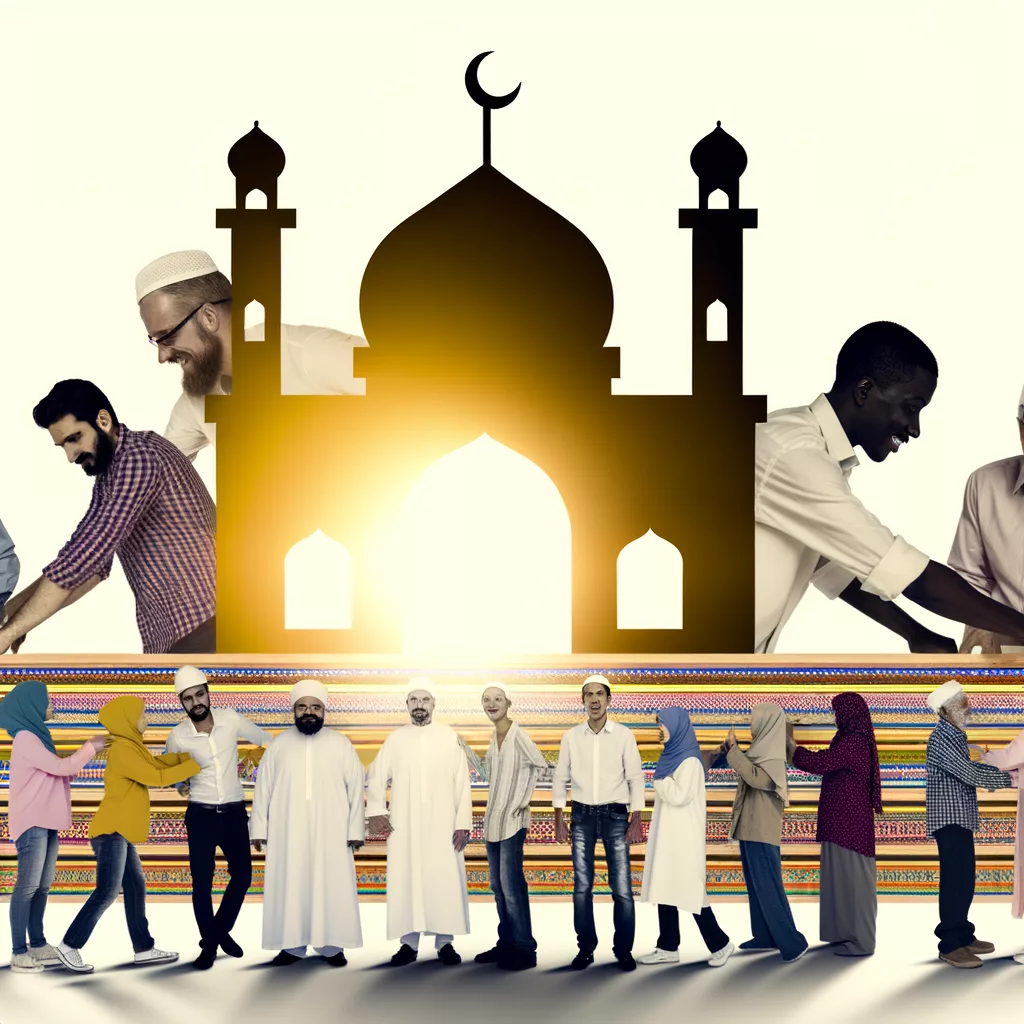
Taking part in building a mosque: simply mentioning this project awakens in many hearts a deep aspiration, made of light, memory and future. The mosque is not only a building of stone and prayer; for the Muslim community it embodies a true beating heart, where faith takes root, where the practice of Islam takes shape every day, and where young and old draw the strength to move forward together on the path of Allah. In every mosque, the voice of the adhan rings out as a call to gather, to inner peace, to Islamic spirituality. But beyond the walls and the carpets, the mosque is also the school of the soul, the cradle of learning Arabic, that linguistic treasure which opens the doors to understanding the Qur’an, the sunna of the Prophet, the teachings of the scholars and the wonders of Islamic civilisation.
Supporting or taking part in building a mosque is much more than a material act. It means taking part in the living transmission of the Muslim faith, weaving Islamic solidarity between families, children and generations, and offering a safe home where every Muslim can learn Arabic without translation, get started with memorising the Qur’an, taste the sweetness of dhikr, deepen the science of hadith and the sira of the Prophet, discover the beauty of tajwid and of the tafsir of the Qur’an, or join the imam for the Friday prayer, Joumoua or Ramadan. It means founding a place where the great Islamic festivals such as eid al-fitr and eid al-adha can be shared, where Muslim youth build their identity, and where Islamic education shines on couples, children and families in a climate of peace and spiritual well-being.
Building a mosque also means growing love of Allah and of the Prophet, strengthening patience and gratitude, carrying the light of Islam into our times, responding to secularism (laïcité) with nobility, and opening the way to dialogue and inner peace. Everyone, at their own level, can act: through sadaqa, zakat, volunteering or educational commitment. But why does this act have such value? How, in practice, can you become a builder of mosques, of knowledge and of spirituality? And how does this collective project foster an intimate and living bond with the Arabic language, the understanding of the founding texts and the authentic practice of Islam in France and elsewhere?
Through this article, let us discover together how to take part in building a mosque – and why this gesture, private or public, opens to each of us the doors to an invaluable spiritual, linguistic and cultural heritage.
The mosque, heart of spiritual life and of learning Arabic within the Muslim community
The mosque is much more than a simple place of prayer: it embodies the beating heart of the spiritual and social life of the Muslim community. From the dawn of Islam, the mosque was the school, the university and the centre from which sacred knowledge spread. It is in this sanctuary that the faithful, young and adult, come to learn Arabic in order to better understand the Qur’an in Arabic, to savour the beauty of reading the Qur’an and to master tajwid, the science of perfect recitation. Every stone, every carpet, every corner of the mosque nourishes immersion in Arabic, offering an authentic environment where it becomes natural to speak, listen and think in Arabic without translation.
Here, literary Arabic is not only a language but a bridge to a deep understanding of the revelation, the sunna, the tafsir of the Qur’an, the science of hadith and the history of the companions of the Prophet and the ahl al-bayt. Study circles (halaqat), Friday sermons (joumoua) and classes in fiqh or aqida help shape a comprehensive and living Islamic education. There are workshops for memorising the Qur’an, discussion groups on the sira of the Prophet, classes for Muslim youth, and also spaces of Islamic spirituality where patience, sincerity and love of Allah and of the Prophet are cultivated.
The mosque then becomes the home where one grows up with the practice of Islam, prayer in Islam (salat), Islamic invocations (dhikr, du’a), repentance (tawba) and gratitude towards Allah. It is a place of transmission where the Muslim faith blossoms through festivals such as Ramadan, eid al-fitr and eid al-adha, where Islamic solidarity is expressed through zakat and sadaqa, and where community mutual aid takes on its full meaning. Parents, children, grandparents, couples: the whole Muslim family gathers around the mosque to deepen Islamic culture, absorb the history of Islam, recall the greatness of the Andalusian caliphate, discover the madhahib and draw inspiration from the scholars of Islam.
By taking part in the life of the mosque, every believer contributes not only to the spiritual well-being of the community, but also to building a strong Muslim identity in a plural society, sometimes marked by secularism, racism or Islamophobia. The mosque protects, elevates, gathers and radiates inner peace, Islamic ethics, solidarity and Islamic culture. It is there that the light of knowledge and mercy grows, for today and for future generations.
Taking part in building a mosque: an act of worship, solidarity and spiritual enrichment
Taking part in building a mosque goes far beyond a simple material or financial gesture. It is above all an act of worship rooted in the Muslim faith, a concrete form of sadaqa that connects every donor to an immense spiritual heritage. When you get involved in building a mosque, you do much more than put up walls: you help raise a living sanctuary dedicated to prayer in Islam, to dhikr, to Islamic invocations, to the circulation of the Qur’an in Arabic and to the transmission of the sunna. Every stone laid, every cent given, takes part in Muslim spiritual life and fosters congregational salat, Friday joumoua, the night vigils of Ramadan, the adhan ringing out, the festivals of eid and moments of soothing and of repentance in Islam.
It is in the mosque that we learn to love learning Arabic, to taste the subtleties of literary Arabic without going through translation, to perfect tajwid in reading the Qur’an, and to get started with the tafsir of the Qur’an and the history of Islam by drawing on authentic sources. Muslim children grow up there to the rhythm of the evening and morning invocations, and discover the Islamic sciences, Islamic ethics and respect for the Muslim calendar. Young people draw from it their Muslim identity and a model of spiritual well-being, while Muslim families meet there and support each other during funeral rites, Islamic festivals or preparation for hajj and umrah.
Supporting such an institution also means affirming a deep Islamic solidarity, a community mutual aid that transcends social differences, origins and ages. The mosque protects against isolation, makes da’wa and interfaith dialogue possible, fights racism and Islamophobia, and embodies the indissoluble link between the practice of Islam, Muslim youth and the values of peace, patience and sincerity in Islam. Each of these gestures, however modest, is recorded with Allah and benefits generations to come, consolidates Islamic culture, perpetuates the teachings of the companions of the Prophet and the ahl al-bayt, and connects our daily lives to the sira of the Prophet and the richness of Islamic civilisation.
So taking part in building a mosque means placing your life in a continuous chain of good deeds, multiplying your spiritual resources and sowing seeds of light for yourself and for the whole Muslim community. It is an invitation to feel gratitude towards Allah, to strengthen love of the Prophet, to develop patience and inner peace, and to taste a living Islamic spirituality, rooted in history and turned towards the future.
Linking support for a mosque to understanding the Qur’an in Arabic, memorisation and the practice of prayer
Supporting the construction of a mosque goes well beyond a material act: it means contributing to the flourishing of the Muslim faith within your community and to direct access to the primary source of Islamic spirituality, the Qur’an in Arabic. At the heart of the mosque, learning Arabic takes on its full meaning: hearing literary Arabic during prayer in Islam, tajwid during the reading of the Qur’an, or in immersion classes in Arabic, without going through translation, offers an authentic connection to the Words of Allah. Through this regular exposure to the revealed language, Muslim children, young people and adults can learn Arabic in a living way: repeating the verses, refining their pronunciation through tajwid, understanding the deep meanings during tafsir of the Qur’an, and living khushu in prayer and recitation. The mosque then becomes a space for acquiring the Islamic sciences, memorising the Qur’an, the hadith, the sunna, the history of the companions and the ahl al-bayt, but also for daily practice: salat, dhikr, du’a, repentance in Islam and Islamic solidarity through collective invocations. This immersion in Islamic language and culture fosters intergenerational transmission, the Islamic education of children, the formation of Muslim identity and the strengthening of community bonds, especially for Muslims in France, where the mosque is a lighthouse in an ocean of diversity. By helping to build or strengthen a place of prayer, you help bring Islamic spirituality to life, encourage patience, sincerity, gratitude towards Allah and love of the Prophet, and cultivate inner peace in Islam, for your own heart and for that of every believer gathered there.
How to contribute in practice to this noble project: volunteering, sadaqa, zakat and the Islamic education of future generations
Contributing to the construction of a mosque is not limited to a simple financial donation: it is a comprehensive approach, an act of faith rooted in the heart and values of the Muslim community. A concrete contribution to this noble project can take varied and complementary forms, drawing their inspiration from the richness of the Islamic tradition. Volunteering, for example, embodies the spirit of Islamic solidarity and community mutual aid of which the Prophet spoke and to which the companions of the Prophet bore witness. Offering your time, skills or energy to help organise, build, teach or lead activities means placing your action within the living practice of the sunna and of khidma, selfless service for the love of Allah.
On the material level, sadaqa, the voluntary donation, and zakat, a fundamental pillar of Islam, are powerful levers for financing the mosque: it is a lasting spiritual investment whose effects accompany you well beyond this life. In the blessed periods of Ramadan, during the Friday prayer, or on the sacred days of dhul hijjah, generosity reaches its peak: every euro devoted to the house of Allah contributes to the vitality of the Muslim community and supports prayer in Islam, joumoua, Islamic invocations and the transmission of the Islamic sciences to future generations.
But the most precious stone laid in the foundation of a mosque is perhaps investment in passing on knowledge, in particular the Islamic education of Muslim children. Here, learning Arabic holds a central place: enabling young people to immerse themselves naturally in the language of the Qur’an by encouraging immersion in literary Arabic, reading the Qur’an without translation, memorising the Qur’an with tajwid, understanding the tafsir of the Qur’an, or discovering the sira of the Prophet and the hadiths. This is how a living bond is built with the Muslim faith, Islamic spirituality and the history of Islam. What could be more moving than hearing a child recite a surah, give the adhan, or ask questions about the life of the ahl al-bayt or the scholars of Islam? That is what securing the future of the community means: offering every generation the chance to reconnect with its Muslim identity, to cultivate gratitude towards Allah, modesty in Islam, inner peace and patience in Islam, and also to meet the challenges of society, of racism and Islamophobia, of secularism and modern Islam with intelligence and dignity.
By contributing to the construction of a mosque through volunteering, sadaqa, zakat or commitment to Islamic education, everyone finds their place in the service of a great collective cause. It is an act of tawba and of sincerity, a source of spiritual well-being and of a spiritual routine that nourishes the Muslim family and Muslim youth and strengthens brotherhood in Islam. Through these many facets, your participation irrigates the vibrant heart of the community and is part of the tradition of transmission, knowledge and love of the Prophet so dear to Islamic civilisation.
At the end of this reflection on the importance of taking part in building a mosque, a deep message emerges: it is not only an architectural project, nor a simple one-off act of generosity. It is a concrete commitment that shapes the Muslim community and irrigates the spiritual life of each person. The mosque is the living heart where the Muslim faith is nourished, where dhikr and prayer in Islam bring souls together, and where Muslim youth and elders alike draw strength and inspiration to move forward on the path of Islam.
By helping to build or support a mosque, we take part in passing on the Qur’an in Arabic, rooting the sunna, giving access to the sciences of hadith and learning Arabic, that luminous language which gives meaning to the verses, to salat, to tajwid and to the tafsir of the Qur’an. The mosque is not only a place of prayer; it is a space of immersion in Arabic, of rich encounters around the sira of the Prophet and Islamic culture, where the motivation awakens to understand the Qur’an, to memorise and to learn literary Arabic, without constantly resorting to translation.
Supporting the mosque also means offering a solid foundation for the Islamic education of Muslim children. This opens the door to a generation able to live its Muslim identity with balance, modesty, akhlaq and inner peace. It means ensuring that the Muslim family and the Muslim couple find in this place the light of a soothing spiritual routine, the warmth of Islamic solidarity, the authenticity of Islamic invocations, the wisdom of patience, gratitude towards Allah and love of the Prophet.
Every contribution, whether it takes the form of sadaqa, zakat, volunteering or even a simple kind word, supports much more than a building: it carries the tradition of a living Islam, anchored in Islamic civilisation and the history of Islam, open to interfaith dialogue and community mutual aid, able to withstand the trials of the times such as secularism, the challenges of Islam in France, racism or Islamophobia.
Through this gesture there is also an invitation to wasatiyya, to moderation, to sincerity, and to reflection on halal trade, Islamic finance, respect for creation and ecology in Islam, and all the values that raise the practice of Islam beyond ritual into a daily ethic.
By helping to build a mosque, everyone sows a seed for a community that endures, where we learn to love one another for the sake of Allah, to walk in the footsteps of the Prophet, to draw inspiration from the companions of the Prophet and the ahl al-bayt, and to remember Ramadan, hajj, dhul hijjah, laylat al-qadr, the eids and all those blessed moments that give rhythm to Muslim life. Finally, it is a chance to live learning Arabic and understanding the Qur’an in closeness, serenity and hope, certain that every act accomplished with sincerity in Islam is a source of spiritual well-being, of eased stress and of renewed patience. In this way the mosque becomes a lighthouse: a place where meaning, faith and language unite to illuminate every heart, today and for generations to come.
Further reading: discover our online Arabic courses for adults, or read “Learning Arabic and understanding Muslim funeral rites in France” and “Learning Arabic to understand funeral rites in Islam“.



