
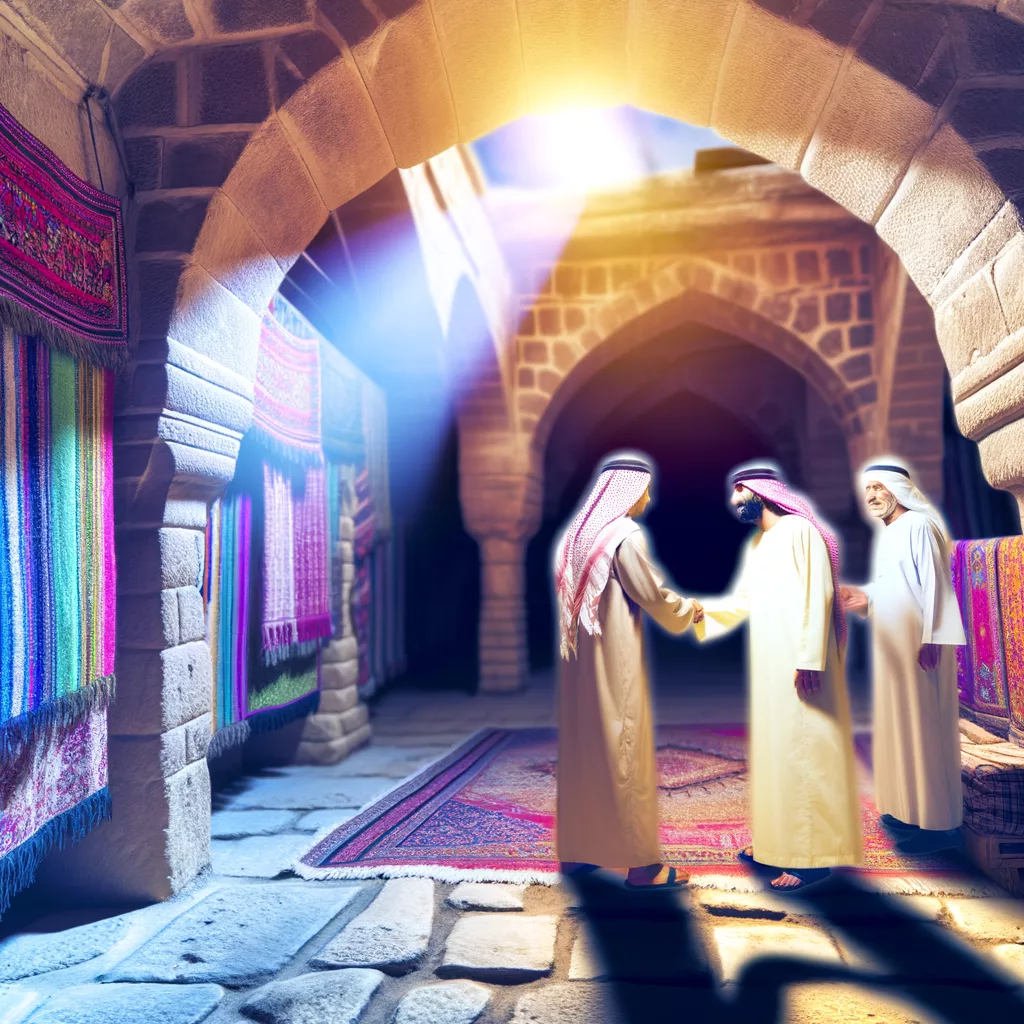
Some scenes are unforgettable: the scent of musk in the souk of Medina, the warm salams between merchants at sunrise, the silent trust that turns a simple exchange of hands into a promise before Allah. Trade, at the heart of Islamic history, has never been a mere material transaction. It is infused with ethics, spirituality and inner commitment, with every contract, every sale and every word spoken drawn from the light of the Qur’an and the sunna. But do we truly grasp the depth of these teachings if we do not immerse ourselves in the language that carries them? Learning Arabic means rediscovering trade not as accumulation, but as an act of worship, justice and sincerity under the divine Gaze.
In a world where speed, profit and pressure sometimes hinder the deeper meaning of commercial commitment, Islamic spirituality recalls the central place of intention, fairness and gratitude to Allah. But to penetrate this ancestral wisdom, to taste the subtle meaning of trust (amana), truthfulness (sidq) and justice (adl) inscribed in every verse and every hadith, mastering literary Arabic becomes the key. A passage of the Qur’an in Arabic, reading tafsir, or memorising the Qur’an and practising tajwid reveal a new depth and relevance: the vocabulary of fiqh, the science of hadith and the sunna of the Prophet turn the act of trading into a school of patience, modesty and love of Allah, and of sincere service within the Muslim community.
This article offers you an immersion in Arabic to explore how ethical trade is rooted in Islamic spirituality. We will go to the source of the texts, without impoverishing translations or detours, to better understand the Qur’an in Arabic and let the wisdom of the sunna, the nobility of the sira of the Prophet and his companions, the teaching of the scholars and the memory of Islamic civilisations resonate within us. Whether you are a trader, a student, a parent, or simply looking for deeper meaning in your practice of Islam, let yourself be guided along this path where learning Arabic and spiritual growth are one. For professional life, however ordinary, can become one of the most beautiful gardens of the Muslim faith, if its meaning is cultivated with knowledge, sincerity and love.
Ethical trade and Islamic spirituality: understanding the Qur’an in Arabic to grasp the deeper meaning of transactions
Trade in Islam holds a special place, because it is never limited to a mere material transaction: it is rooted at the heart of Islamic spirituality and ethical refinement. Yet how many Muslims who aspire to fair trade realise that the deep essence of this ethic lies directly in the Qur’an in Arabic? Learning literary Arabic means crossing the threshold of authentic understanding, well beyond translations, to absorb the revealed divine wisdom. When you read the verses on sincerity in Islam, on trust, on the prohibition of deception or on managing debt, their deeper meaning only fully unfolds through immersion in Arabic. Every word, every linguistic nuance carries a carefully weighed moral and spiritual charge that shapes the conduct of the Muslim trader.
By investing in learning Arabic, you discover, for example, that honesty (sidq), faithfulness (amana), excellence and kindness (ihsan) and justice (‘adl) are not mere recommendations, but divine requirements governed by the sharia and fiqh and anchored in the sacred text. Carrying out halal trade then takes on a sacred dimension: the study of the tafsir of the Qur’an and the science of hadith, accessible in Arabic without translation, make it possible to understand accurately the boundaries between the permitted (halal) and the forbidden (haram).
Taking the time to immerse yourself in reading the Qur’an, to perfect your tajwid and your memorisation of the Qur’an, means giving yourself the opportunity to draw directly from the primary source of Islamic ethics. The stories of the Prophet’s companions and their commercial integrity, reported in Arabic by the sira of the Prophet, become living, tangible models to imitate in your own professional life. A verse such as “O you who believe! Do not consume one another’s wealth by unlawful means…” (Qur’an 4:29) takes on a unique force when you grasp its rhythm, its scope and its original intention without the filter of another language.
This immersion is not only an intellectual journey: it nourishes the Muslim faith, purifies the intention, allows sincere gratitude to Allah and brings the inner peace so precious to the ethical trader. The rituals of Ramadan and zakat, and the practice of patience in Islam in the face of market difficulties, all take on another meaning. Learning Arabic is therefore not a scholarly luxury but a necessity for anchoring every commercial act in the will of Allah, drawing inspiration from the models of the past (the ahl al-bayt, the scholars of Islam, the Andalusian caliphate) and embodying true kindness in economic life as in Islamic spirituality.
The teachings of the hadiths and the sunna: immersion in Arabic to live the ethics of prophetic trade
Diving into the teachings of the hadiths and the sunna means accessing the very source of the ethics of trade in Islam. But to taste the depth and wisdom of these teachings, learning Arabic, and more particularly immersion in Arabic, radically transforms the experience. Hearing a hadith in the original language of the Prophet, feeling the subtle weight of the words, their cadence and their nobility, gives the heart direct access to the meaning and the light that radiate from the prophetic word. Literary Arabic, without filter or translation, lets you grasp the nuances of the science of hadith, taste the truth of a piece of advice on honesty or the beauty of a warning against usury or injustice. Very often, a simple translation is not enough to convey the ethical scope, the delicacy of sincerity in Islam or the demand for justice that runs through the sunna. It is in contact with these authentic words, closely studied in their context, that the Islamic spirituality of trade takes on its full relief and becomes an art of living together, marked by patience, gratitude to Allah and moderation.
Through immersion in Arabic, the Muslim discovers the direct link between the practice of Islam in trade and the message passed on by the Prophet to his companions, to the ahl al-bayt and to the whole Muslim community down to the present day. The words drawn from the sira of the Prophet or from the accounts of his companions invite a commercial life in which the Muslim faith shines in every transaction, through trust, transparency and justice. Learning Arabic means listening to, understanding and embodying the example of Muhammad in every area of daily life, including professional dealings, Islamic finance and the management of contracts. It nourishes taqwa, inspires patience in Islam, encourages tawba and repentance in case of error, and motivates sincerity and integrity, all without compromising on Islamic ethics.
This path towards an authentic understanding of halal trade is not reduced to a list of rules or prohibitions; it is lived inwardly through direct exposure to the language that carried the revelation of the Qur’an in Arabic, its exhortations, its reminders of dhikr, its calls to istikhara and to community solidarity through zakat and sadaqa. Nourishing your faith by learning Arabic means gradually seeing your practice of trade align with the sunna, from the smallest exchange to the large enterprise, so that work becomes worship and a path to spiritual well-being and inner peace.
Halal finance, solidarity and justice: why learning Arabic matters for accessing Islamic jurisprudence (fiqh)
In the fascinating world of Islamic finance and halal trade, learning Arabic stands out as an essential bridge to authentic justice, solidarity and ethics. Without access to the language of the Qur’an and literary Arabic, it becomes difficult to grasp in depth the subtle rules of fiqh, the Islamic jurisprudence that frames every dimension of a transaction, from the commercial contract to zakat, from the interest-free loan to the management of common goods. Through immersion in Arabic, far from the shortcuts of translation, you discover the richness of concepts such as riba, the prohibition of usury, the notion of baraka in trade, and the waqf, the charitable endowment: elements that irrigate the Muslim economy with values of fairness and sharing.
This is not simply about studying normative texts; understanding the Qur’an in Arabic, beginning to study the tafsir of the Qur’an, and exploring the hadith collections and the science of hadith in their original language means opening yourself to a nuanced reading that illuminates the overall meaning and purpose of the laws. The legal schools, the madhahib, then reveal their diversity and depth: the sharia and fiqh, far from being frozen, come alive through the words of the scholars of Islam, from the Prophet’s companions to contemporary scholars.
This mastery of Arabic without translation also encourages a practice of Islam that is both spiritual and anchored in social reality. It makes it possible to connect the commercial act to prayer in Islam, to sincerity in Islam and to gratitude to Allah. You perceive the Friday prayer (jumu’a) not only as a ritual, but also as a weekly reminder of Islamic solidarity and of the duty of fairness in our daily dealings. Islamic supplications, dhikr, sadaqa and zakat thus become acts of trade for the hereafter, investments in social justice and inner peace.
Finally, learning Arabic to open yourself to jurisprudence is not reserved for the learned or for specialists; it is a commitment within reach of every believer, every Muslim family and every young person seeking a Muslim identity in contemporary society, whether in France or elsewhere. Immersion in Arabic, from childhood or in adulthood, strengthens the sense of belonging to the worldwide Muslim community, while fostering a fine understanding of Islamic ethics: an ethic that places justice, solidarity and responsibility at the heart of trade and collective life. Thus Islamic finance, much more than a mere instrument, becomes a path towards a more humane society, inspired by Islamic spirituality, the sunna and the love of Allah for those whose professional life is guided by sincerity, patience and respect for the prophetic teachings.
The virtues of the Muslim trader: gratitude to Allah, sincerity in Islam and spiritual well-being in professional practice
The sincere Muslim trader stands out through a set of human and spiritual qualities that make trade a true path of worship. Gratitude to Allah holds a central place in their professional approach: every success, every gain, every satisfied customer is first perceived as a blessing granted by the Creator. This deep gratitude nourishes humility, protects against pride and constantly recalls the noble intention that must preside over every transaction: seeking divine approval before material interest. Sincerity in Islam, ikhlas, then becomes the driving force of daily activity. It is embodied both in honest dealings and in keeping promises. Being faithful to your commitments and refusing deception and concealment means following the sunna of the Prophet Muhammad and the shining example of the Prophet’s companions, many of whom were themselves great traders. This attachment to Islamic ethics draws its strength from Islamic spirituality and from an understanding of the Muslim faith, nourished by the practice of prayer in Islam, reading the Qur’an in Arabic and immersion in literary Arabic to grasp the depth of the very first revealed message.
The trader who makes their activity a form of perpetual dhikr, remembering Allah before every agreement and every negotiation, discovers an unsuspected source of inner peace and spiritual well-being. They remember that this was the practice of the pious predecessors, whose Islamic education went through learning Arabic and knowing the divine teachings, not only through translations or outward formulas, but through a sincere immersion in the deep meaning of the texts and the values passed down. This vision of trade, centred on fervent sincerity, gratitude and the quest for spiritual well-being, is in reality a natural extension of the practice of the salat, of patience in Islam, of modesty in Islam and of the constant search for khushu in prayer. Thus, by making trade an act of worship, the Muslim takes part in building an ethical economy for the good of the Muslim community while cultivating their own spiritual health. They shape their Muslim identity in the coherence between faith, pure intention and professional life, in the light of the science of hadith, the teachings of the tafsir of the Qur’an and the living tradition of Islam.
Further reading: discover our online Arabic courses for adults, or also read “Learning Arabic and succeeding in your Hajj: preparation and spirituality” and “Learning Arabic to live the Islamic festivals in depth“.
Conclusion
Trade, in Islam, is not simply a material exchange: it is a mirror of the deep values that drive the Muslim faith. Through the Qur’an in Arabic and the prophetic wisdom passed on in the hadiths, every Muslim discovers that buying, selling and working are much more than everyday acts: they become a path to Islamic spirituality, sincerity in Islam and gratitude to Allah.
Learning Arabic in its literary dimension, without going through translation, offers an inexhaustible source of understanding. It gives access, in all their clarity, to the tajwid of Qur’an recitation and the subtlety of the tafsir of the Qur’an, as well as to the depth of the sciences of hadith and the sunna of the Prophet. Living this immersion in Arabic means entering the very heart of Islamic jurisprudence (fiqh), the principles of Islamic finance and the subtleties that govern halal trade and Islamic ethics in daily life.
Every term of the Qur’an, every word of the sunna, every virtue of the Prophet’s companions or the ahl al-bayt reveals the nobility of the fair transaction and the necessary kindness towards the Muslim family, young people and the Muslim community. Grasping this meaning without a filter also means committing to justice, Islamic solidarity and mutual aid within the community, to zakat, sadaqa and the inner peace born of spiritual well-being in professional practice.
Along this quest, learning Arabic becomes a key. It opens the doors to reading and memorising the Qur’an, deepens contemplation (khushu) in prayer, and enriches the salat, the Friday prayer and Islamic supplications (dhikr, du’a, tawba). It also sheds light on Ramadan, hajj, the great festivals such as eid al-fitr and eid al-adha, and even everyday moments, in their dimensions of moderation (wasatiyya), patience and modesty in Islam.
The sincere Muslim trader embodies these teachings: they hold fast to justice, transparency and the love of Allah and the Prophet, cultivate gratitude and humility, educate themselves and their children, take care to respect what is halal and to care for the environment in Islam, and fight all waste. They become a pillar for society, defending the sharia and fiqh with intelligence and relying on the scholars of Islam and the Islamic universities, from Al-Azhar to Zaytouna and from Qayrawan to contemporary Muslim communities.
Learning Arabic thus means embracing a living ethic and a luminous heritage, and joining that chain of men and women who, through the centuries, have known how to unite faith and professional life, spirituality and success, the history of Islam and modernity. It means weaving, every day, in trade as in prayer, that invisible but indestructible bond connecting the heart, actions and inner peace, so as to take a humble part in the elevation of Islamic civilisation and of all humanity.



