
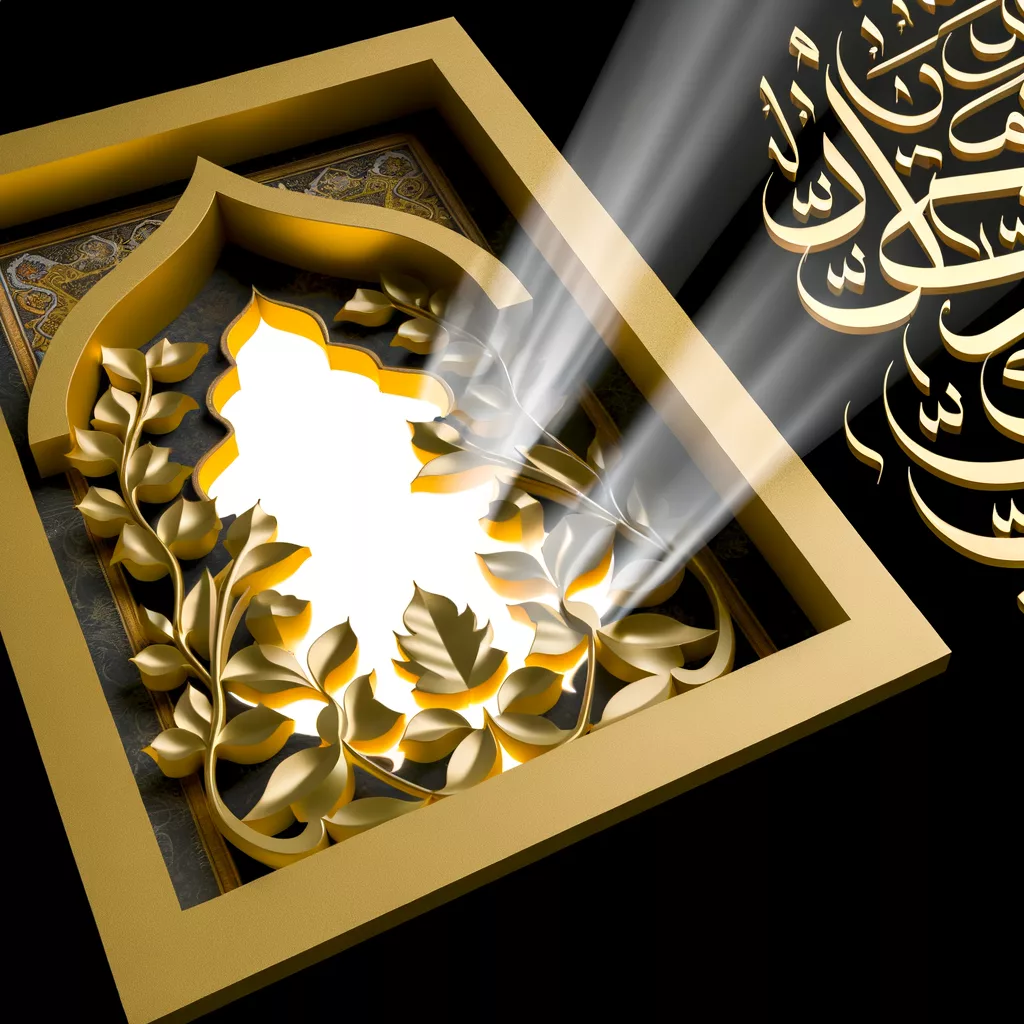
Discovering Islamic art: a living journey, an immersion in the light of faith and beauty
Learning Arabic is not only opening the door to a language; it is entering a vast garden where the spirituality, intelligence and artistic sensitivity of the Muslim world intertwine. A place where words take the form of prayer, where science converses with beauty, where the most intimate expression of faith takes shape… in Islamic art. Sacred calligraphy, hypnotic geometric patterns, the majestic architecture of mosques: Islamic art is a mirror of the soul, a bridge to a deep understanding of the Qur’an in Arabic, the hadith, the sunna and the whole of Arab-Muslim culture.
For those who aspire to the light of knowledge and Islamic spirituality, learning literary Arabic, without translation, through immersion, is not a mere tool. It is the key to an immensity, to a living heritage that can be read on the walls of mosques, sung in the rhythm of the Qur’an, inscribed in the refinement of an arabesque or a sura written in gold ink. It is also an invitation: to enter the science of tajwid, meditation on the tafsir of the Qur’an, memorisation of the Qur’an, and the sunna as told through its artistic forms. Islamic art shapes the Muslim faith as much as it reflects it.
Do you need to speak the language to love Islamic art, or Islamic art to understand the language? The two seem inseparable. Because Islamic calligraphy is never mere ornament: every stroke, every curve of the “Bismillah” on a door, every pattern, every brushstroke guides the eye beyond the visible. You then dive into an immersion in Arabic, without translation or intermediary, as if learning Arabic became an act of love, of gratitude to Allah for the beauty of the Word, of patience and sincerity, like those who carved, drew, built and taught this sacred legacy.
This article takes you on a journey. Four inspiring stops, where art becomes a guide and language a light. You will explore Islamic calligraphy, a mirror of faith and a key to learning literary Arabic; you will discover the magic of patterns and arabesques, true immersions in the science and spirituality of Islamic art; you will walk through the sacred spaces of mosque architecture – living places for understanding the Qur’an in Arabic; finally, you will see how this art illuminates identity and education, passing on values, memory and love of the Arabic language across generations. Between the history of Islam, the memory of the sira of the Prophet and the companions, the rites of prayer and the celebrations of Ramadan, Islamic art reveals itself as an open book in which every page invites contemplation, the intelligence of the heart and… the pleasure of learning Arabic.
In an age saturated with noise, images and agitation, let Islamic art offer you, for a moment, the inner peace it carries at its heart: the beauty that connects, that elevates, that unites the soul with the Word, the past with the present, the Muslim community with the Masterpiece of its heritage.
Islamic calligraphy: a mirror of faith and a key to learning literary Arabic
Among the treasures of Islamic art, calligraphy holds a unique place: far more than mere ornamentation, it is the living mirror of the Muslim faith, the visual expression of revelation and a true bridge to learning literary Arabic. Over the centuries, every curve, every dot, every ligature of the Arabic script has become an offering, giving form and beauty to the words of the Qur’an in Arabic and the hadiths of the Prophet. Mastering this art means fully immersing yourself in the sacred language, letting meaning emerge without translations, in a kind of active meditation. Observing or tracing the letters means following the deep rhythm of the divine, feeling the spiritual breath that animates salat and the recitation of the revealed Book, moving towards an authentic understanding of the Qur’an in Arabic and opening up to the wisdom of tafsir or the science of hadith. For the student who wishes to learn Arabic and become familiar with the beauty of literary Arabic, diving into calligraphy means making its alphabet your own, but also absorbing the whole of Islamic history, the life of the Prophet, the sunna, the companions and the ahl al-bayt. Through its aesthetic and spiritual dimension, calligraphy creates a natural immersion in Arabic, bringing you closer to the subtle meaning of invocations (du’a, dhikr), patience in Islam, gratitude to Allah and love of the Prophet through every verse memorised, every rule of tajwid practised, every act of repentance or meditation. It is also a living way to teach and pass on Islamic education in the Muslim family, to anchor faith in the hearts of children and Muslim youth, and to engage with the history of Islam, from the Andalusian caliphate to Sufism and the intellectual life of the great Islamic universities such as Al-Azhar or Qayrawan. Ultimately, Islamic calligraphy reminds us that learning Arabic is not just an academic exercise: it is a holistic journey, a key to intimacy with the Word, an inexhaustible source of Islamic spirituality and inner peace.
Geometric patterns and arabesques: immersion in the spirituality and science of Islamic art
In Islamic art, geometric patterns and arabesques weave a subtle dialogue between spirituality, science and beauty, revealing the intrinsic unity of creation. Diving into these endless interlacings means experiencing a particular kind of immersion in Arabic: one in which every form, every repetition, becomes a visual meditation evoking divine harmony. Behind the complexity of these designs lies a search for meaning similar to that of learning Arabic: layer after layer, you discover the rigour and depth of Islamic knowledge, whether you approach it through reading the Qur’an, studying fiqh or silent contemplation in a mosque.
Far from being mere ornaments, these patterns express a worldview founded on the transcendence and perfection of Allah. The circles, the stars, the endless interlacings recall the ritual repetition of dhikr, patience in Islam, sincerity in prayer (salat), and the desire to reach inner peace through constant remembrance of the Oneness of God. Arabesques, for their part, suggest growth, life and mercy: they stretch out like branches, recalling tawba, repentance, and the hope renewed with every pattern.
The science of geometric patterns in Islam, long studied by the scholars of Islamic civilisation, reflects a search for order, meaning and detail, close to the precision of tajwid when reading or memorising the Qur’an. Each figure requires a fine understanding of proportions: it thus invites you to learn Arabic without translation, immersing yourself in the very matrix of Muslim culture and faith, where spirituality combines with intellectual rigour.
Contemplating these works therefore means grasping how Islamic culture was able to raise the science of pattern to a spiritual act, in which faith, gratitude to Allah and spiritual well-being become visible. It is also an invitation to link art to the daily practice of Islam: to perceive, in these forms, the echo of the Friday prayer (jumu’a), Ramadan, invocations or the hajj. Ultimately, absorbing these patterns means beginning an immersive learning experience: one in which beauty guides the eye and the heart towards a deep understanding of Islam, its poetry and its light, through the gateway of literary Arabic and the artistic refinement of the Muslim tradition.
Mosque architecture: understanding the Qur’an in Arabic through sacred spaces
As soon as you cross the threshold of a mosque, a feeling of solemnity, inner peace and elevation sets in, as if every stone were whispering the sacred stories of the Muslim faith. Mosque architecture is never neutral: it is shaped to encourage Islamic spirituality, support the practice of Islam and transform space into an immersive experience, a true immersion in Arabic, where material beauty becomes an invitation to learn Arabic and contemplate the Qur’an in its original language. Beneath the silent dome, bathed in light filtering through intricate geometric patterns, we understand that the whole atmosphere has been designed to facilitate reading the Qur’an, prayer in Islam (salat), dhikr and recitation with tajwid.
Walking on the aligned carpets, the worshipper feels the link between the space and the message: the absence of figurative images and the presence of calligraphy magnify literary Arabic, illustrating the centrality of the sacred text. Calligraphed verses adorn the walls, inviting you to understand the Qur’an in Arabic, to meditate on the tafsir of the Qur’an or to strengthen your memorisation of the Qur’an without going through translation – for the very environment echoes the deep meaning of the divine words. The mihrab, oriented towards Mecca, invites sincerity in Islam and contemplation, recalling the humility of the companions of the Prophet in their prayers, while symbolising the collective direction of the Muslim community during jumu’a or the nights of Ramadan.
Every architectural element – the dome, the minaret from which the adhan rises, the courtyard conducive to tranquillity, the fountain for ritual ablutions – embodies spiritual values such as gratitude to Allah, patience in Islam or purity of heart. The sacred space encourages attentive listening to the recitation of the Qur’an in Arabic and concentration (khushu) during prayer, and develops in the individual an awareness of the sunna, the memory of the sira of the Prophet and the ahl al-bayt, an understanding of fiqh through exchanges with the imam, and even intergenerational dialogue between Muslim children and scholars of Islam. Mosques, whether heirs to Andalusian civilisation, to universities such as Al-Azhar or Qayrawan, or to contemporary Islamic culture, thus offer an environment where learning Arabic, living the Muslim faith and spreading Islamic spirituality become one and the same dynamic, embodied in every stone, every pattern, every silence.
Islamic art and identity: transmission, education and values in culture and in learning Arabic
Islamic art is not limited to aesthetics; it shapes a deep identity, weaves the threads of Islamic culture and accompanies education from generation to generation. By passing on timeless values, calligraphy, geometric patterns and sacred architecture are all ways of strengthening self-awareness and embodying Islamic spirituality in daily life. At the heart of this transmission lies learning Arabic, the language of the Qur’an and the hadiths, the gateway to the sira of the Prophet and the companions who built the first Muslim community. Learning Arabic, or better still, progressing through immersion in Arabic without translation, gives you the chance to feel the authentic resonance of prayers, to savour the beauty of tajwid when reading the Qur’an, and to open up to the treasures of tafsir and the science of hadith. Islamic education thus never separates art from the Muslim faith. Muslim children discover from a very young age the harmony of calligraphy, the simplicity of mosques, and the deep meaning of Islamic invocations, dhikr and du’a. Literary Arabic then becomes the living link between collective memory, love of Allah and the Prophet, and the Islamic ethics passed on within the Muslim family. This shared heritage shapes modesty, gratitude to Allah, patience and sincerity in Islam, values that are expressed in salat and khushu, and that run through festive times such as Ramadan, eid al-fitr or eid al-adha, as well as every moment of community life. In this vast heritage, Islamic art plays a discreet but central role: it inspires inner peace, nourishes spiritual well-being and reminds every Muslim of their place within Islamic civilisation, between past and future, rooted in the light of the Qur’an in Arabic and the living sunna.
Islamic art in all its forms – calligraphy, geometric patterns, majestic architecture – is much more than an aesthetic expression; it embodies a spiritual quest and a plunge into the light of the revealed text, the prophetic tradition and Muslim culture. Discovering calligraphy means touching the Qur’an in Arabic with your eyes and realising, with every carefully drawn curve, how important it is to learn literary Arabic in order to savour the deep meaning of the verses, the refinement of tajwid and the sonic beauty of reading the Qur’an. Through immersion in patterns and arabesques, the mind is carried towards meditation, the order of the world and science, recalling the link between prayer, dhikr, gratitude to Allah and contemplation of the divine signs – so as to move, from the artistic gesture to the Muslim faith, towards a living practice of Islam.
Sacred architecture, from the mosques of Andalusia to the domes of Istanbul, not only awakens admiration but invites you to live salat and jumu’a in community, to experience khushu in prayer, to feel the brotherhood of the umma, and to welcome Ramadan, the Hajj and the Eid festivals as so many moments when space accompanies memory, patience, sincerity, repentance and love of Allah. Diving into Islamic art therefore means immersing yourself in the history of Islam, remembering the sira of the Prophet, the companions and the ahl al-bayt, and seeing how every detail conveys knowledge, ethics, humility and a spark of spirituality, an essential foundation for every Muslim family and for every child discovering Islamic culture and their identity at the heart of contemporary society.
Learning Arabic through immersion, without going through translation, means opening up to the subtleties of Islamic civilisation, developing an intimate reading of the tafsir of the Qur’an, getting started in the science of hadith, savouring the wisdom of the scholars of Islam, understanding the sunna and drinking from the living source of the tradition. It means hearing the adhan resound in the air, feeling inner peace, drawing strength from spiritual routine and dhikr, and absorbing over time a unity between language, faith and culture – woven by centuries of exchange, creativity, education, modesty, knowledge and openness.
Islamic art does not merely adorn our daily lives; it illuminates in a thousand ways the path towards Allah and excellence of conduct (akhlaq). Whether in childhood, youth, family life, the quest for knowledge or solidarity, every pattern, every calligraphy, every sacred space is an invitation to better understand the Qur’an, to engage in the practice of Islam with serenity, to pass on the values of the umma in society, and to seek wisdom in moderation (wasatiyya) and peace in one’s heart.
To anyone who wishes to learn Arabic, contemplating Islamic art offers a powerful reminder: behind the beauty of the forms lies an ancestral, living wisdom that connects past, present and future in the grandeur of the Islamic message. This inner adventure, nourished by immersion in Arabic and openness to culture, enriches not only the understanding of the sacred text but also spiritual life, action and the joy of serving an ideal that unites the soul, the intellect and the community.
Further reading: discover our online Arabic courses for adults, or also read “Learning Arabic to live authentic modesty and good character” and “Learning to control anger in Islam through the Qur’an and Arabic“.



